In This Guide
- Where to Camp in Tokyo - Airport — Top Options
- Campground Types in Tokyo - Airport (National, Private, Wild)
- Featured RV Park or Campground in Tokyo - Airport
- Hookups & Amenities — What to Expect
- Booking Windows & Reservations in Tokyo - Airport
- Nearby Supermarkets & Resupply Points
- Best RV Class for Camping in Tokyo - Airport
- How to Save on Campgrounds in Tokyo - Airport
- How much does it cost to rent an RV in Japan?
- What type of RV is best for Japan?
- Can you camp anywhere in Japan RV?
- Is it easy to drive an RV in Japan?
- Do I need an International Driving Permit to drive an RV in Japan?
- What are the rules for camping in Japan?
- Is Japan RV friendly?
- How to navigate tolls in Japan with an RV?
- How much do tolls cost in Japan for RVs?
- How to find water and dump stations for RVs in Japan?
- What apps are useful for RV travel in Japan?
- What to do in case of an RV breakdown or emergency in Japan?
- How to get internet/connectivity for an RV in Japan?
Embarking on an RV adventure near Tokyo - Airport opens up a world of possibilities, offering a unique blend of urban excitement and serene natural escapes. Japan's captivating culture and stunning landscapes are truly best explored at your own pace with a rented motorhome or campervan. For live availability and current prices, start with our RV Rental Tokyo - Airport - Complete Guide 2026 guide, which provides comprehensive information to kickstart your journey. We are here to support you before and during your booking, ensuring full transparency with no hidden fees and real people behind you 24/7 to answer your questions.
Where to Camp in Tokyo - Airport — Top Options
Narita RV Park offers dedicated facilities near Narita International Airport (NRT) for convenient RV camping, providing a practical starting point for your Japanese road trip. While immediate camping options directly within Tokyo are limited due to its dense urban environment, excellent sites are available just a short drive away in surrounding prefectures. Travelers often find fantastic camping options by venturing into Chiba, known for its scenic coastal areas and natural parks, providing a tranquil contrast to the bustling city. Consider private campgrounds, which typically offer more amenities than public sites in the region, ensuring a comfortable stay. Many facilities near Narita City or Sakura City, for instance, cater to RVs and offer peaceful retreats after a day of exploration.
Campground Types in Tokyo - Airport (National, Private, Wild)
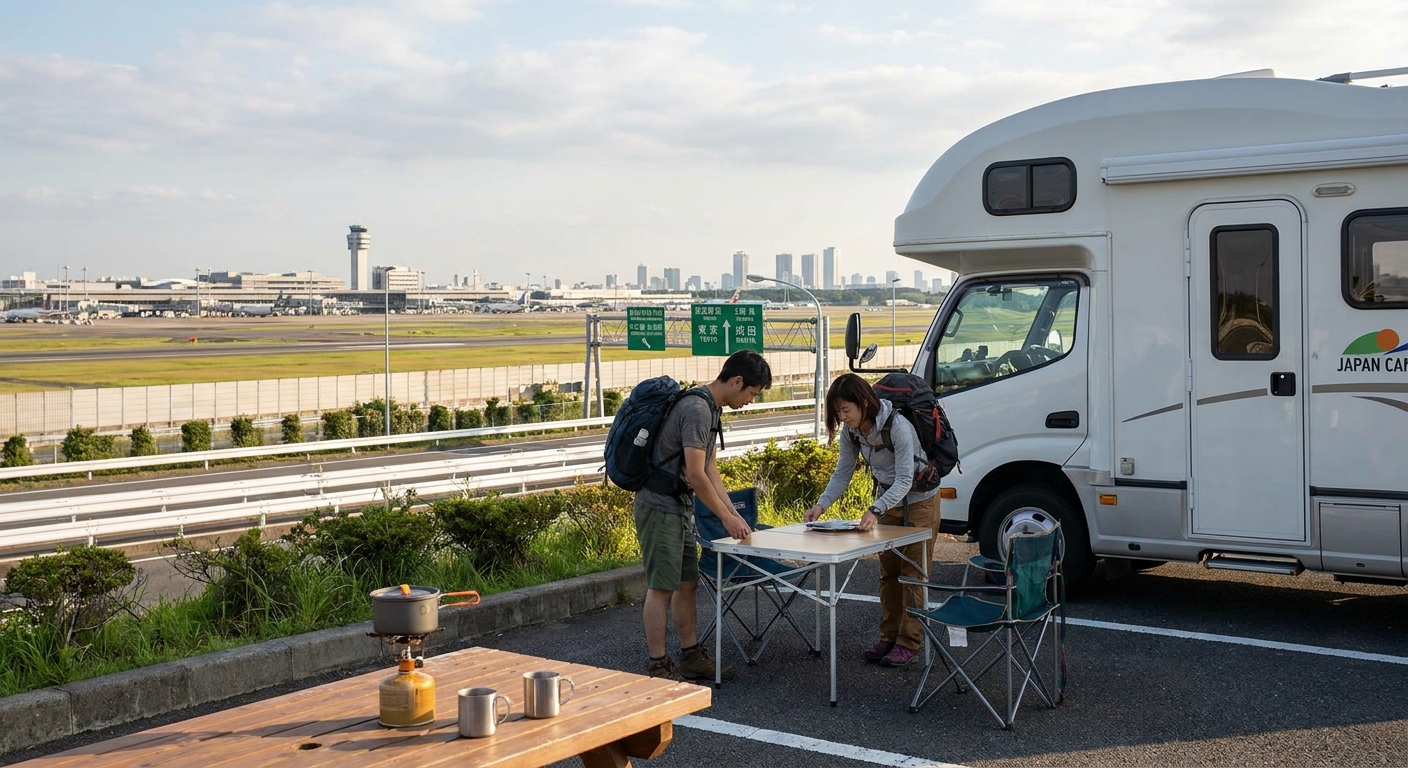
Japan's camping scene includes a variety of options, primarily focusing on private campgrounds with extensive amenities and municipal sites, offering a structured and safe environment for RV travelers. Designated 'Michi-no-Eki' (roadside stations) across Japan also provide a legal and safe alternative for free overnight parking, making them a popular choice for spontaneous stops, though they typically lack electrical or water hookups. Wild camping, often referred to as 'boondocking,' in undesignated areas is generally not permitted in Japan and can lead to issues with local authorities or landowners, so it's best to stick to official sites. When planning your route, exploring RV Rental in Tokyo - Airport for Couples - Pricing 2026 might help you find smaller, cozier campgrounds ideal for a more intimate experience.
Featured RV Park or Campground in Tokyo - Airport
While specific detailed data for a single featured RV park directly within Tokyo - Airport is not widely available, travelers should prioritize facilities offering essential services like electrical hookups and waste disposal in the broader Chiba Prefecture. Ideal RV parks often feature proximity to sightseeing attractions, ease of access from major roads like Route 51 or the Higashi-Kanto Expressway, and amenities such as clean restrooms, coin-operated showers, and laundry facilities. For example, some private campgrounds near Lake Inba or the Boso Peninsula offer scenic spots and are easily accessible from Narita International Airport (NRT), simplifying your pickup and drop-off logistics. For a broader understanding of costs and options, checking "RV Rental Deals in Tokyo - Airport - Latest Offers 2026" can provide valuable insights.
Hookups & Amenities — What to Expect
RV campgrounds in Japan typically offer 100V electrical hookups, which may require an adapter for many foreign RVs to ensure compatibility. In addition to electricity, water refill stations are generally available, and designated grey/black water dump points can be found at most official RV parks and some larger 'Michi-no-Eki' locations. Finding dedicated grey/black water dump points, especially outside of larger RV parks or 'Michi-no-Eki', can be challenging, so it's wise to plan your waste disposal stops in advance. Propane (LPG) availability for foreign RVs is limited due to different gas cylinder standards, so travelers should confirm their rental RV's cooking and heating fuel type and consider bringing or purchasing alternatives like portable electric cooktops or butane stoves for their RV-friendly recipes playlist. Many campgrounds provide basic amenities such as clean restrooms, coin-operated showers, and laundry facilities, with Wi-Fi increasingly available to stay connected. On the routes offered through RV PLANET routes, you can itemize and track every expense along the way for easy budgeting.
Booking Windows & Reservations in Tokyo - Airport
Planners should book RV campground sites well in advance, especially during peak seasons (such as spring for cherry blossoms, summer holidays, and autumn foliage season), as demand for prime spots can be very high. Popular locations like those in Chiba Prefecture, which are easily accessible from Tokyo - Airport, fill up quickly. Spontaneous travelers, while enjoying more flexibility, may still find same-day or next-day availability at some campgrounds, particularly outside major tourist areas; it's always advisable to call ahead before driving a long distance. Many national and state park campgrounds reserve only 25-30% of their spots for advance bookings, leaving the rest available on a first-come, first-served basis, so you'll usually find a spot. If not at the first campground, then the next one is likely to have space.
Nearby Supermarkets & Resupply Points
RV travelers near Tokyo - Airport can easily resupply at major supermarket chains such as AEON, Ito-Yokado, or Seiyu, which are commonly found in suburban areas and city centers surrounding Narita International Airport. These large stores offer a wide selection of groceries, fresh produce, and other necessities for your trip. Convenience stores like 7-Eleven, Lawson, and FamilyMart are ubiquitous across Japan and are useful for quick purchases, snacks, and ATM access, but for main grocery shopping for your rented motorhome's kitchen, larger supermarkets are your best bet. Look for these supermarkets near major train stations or commercial hubs in cities like Narita City or Sakura to find comprehensive grocery options for your week-long trip or extended road trip. When planning your budget for these items, remember that RV PLANET routes allow you to itemize and track every expense along the way.
Best RV Class for Camping in Tokyo - Airport
For navigating Japan's often narrow streets and smaller campsites, Class B Camper Vans (averaging 5.8 meters in length) and Class SI Semi-integrated RVs (averaging 6.9 meters) are generally the most suitable and recommended options. Class B Camper Vans, like many available in Bandana's fleet with approximately 3.2 sleeping places, offer excellent maneuverability, making city driving and parking much less stressful, along with good fuel efficiency (around 10 Liters/100 Km). Class SI Semi-integrated RVs provide more living space, typically accommodating 3-4 adults, while still maintaining a manageable footprint for Japanese roads. Larger Class C Alcove (averaging 7.5 meters) or Class A Integrated (averaging 7.5 meters) RVs, while offering more space, can be challenging to drive and park in urban areas or smaller regional campgrounds due to their size. Drive slowly and carefully, and you can drive almost anywhere without issues. No need to stress - just use common sense and pay attention.
How to Save on Campgrounds in Tokyo - Airport
Travelers can save on RV campgrounds in Japan by utilizing discount cards offered by some rental providers, if available, or by opting for municipal and regional campgrounds over more expensive private resorts. Booking your RV during the shoulder season, such as late spring or early autumn (outside major national holidays like Golden Week in May), often yields lower rates and fewer crowds, enhancing your travel experience in Tokyo - Airport. Staying for three or more nights at a single location can sometimes qualify for weekly rates, offering a per-night saving. Additionally, traveling with friends or family and sharing hookups or facilities in a group can effectively reduce individual costs for a Family RV Rental in Tokyo - Airport - Pricing Guide 2026. Being flexible with your dates and comparing prices across different campgrounds on rvplan.net can also lead to significant savings.
How much does it cost to rent an RV in Japan?
Renting an RV in Japan typically costs between ¥15,000 to ¥35,000 per day (approximately $100-$250 USD, depending on exchange rates and RV class) for a standard rental, excluding additional expenses. Beyond daily rental fees, travelers should budget for fuel, which averages around 10-12 Liters/100 km for common RV classes. Tolls can be substantial on expressways; for instance, a trip from Tokyo to Kyoto can cost ¥10,000+ (approximately $65-$70 USD) one-way, so planning your routes with this in mind is essential. Camping fees generally range from ¥2,000 to ¥5,000 per night for private campgrounds. Potential hidden costs include optional rental insurance upgrades (like our top-level deductible reimbursement), one-way drop-off fees, cleaning charges if the vehicle isn't returned clean, and consumption taxes, which can add 10-20% to the base rental price. Remember, prices are dynamic like flight tickets and change daily based on availability, seasonality, and supplier marketing decisions, with the final price set at actual booking time. For a comprehensive overview of budgeting, you might find our Luxury RV Rental in Tokyo - Airport - Premium Prices 2026 helpful. For finding campsites and campgrounds during your trip, we recommend using RV PLANET (rvplan.net) - a great resource for locating available spots along your route and tracking your RV PLANET routes expenses for easy budgeting.
What type of RV is best for Japan?
The best RV type for exploring Japan is generally a compact Class B Camper Van or a smaller Class SI Semi-integrated model, primarily due to the country's narrow roads, tight parking spaces, and smaller campground infrastructure. Vehicles around 5.5 to 6.5 meters in length, such as Bandana's Class B Camper Vans (averaging 5.8m) and Class SI Semi-integrated RVs (averaging 6.9m), offer the best balance of interior comfort and exterior maneuverability. It's highly recommended to consider an RV equipped with a reliable English-language GPS or smartphone integration for navigation, as signage is primarily in Japanese. Additionally, an ETC (Electronic Toll Collection) card, which can often be rented with your RV, is invaluable for seamless and sometimes discounted toll road use, as discussed in our Driving an RV in Tokyo - Airport - Complete Guide 2026.
Can you camp anywhere in Japan RV?
No, wild camping or 'boondocking' in undesignated areas is generally not permitted in Japan, so travelers should not expect to simply pull over and camp anywhere. Instead, visitors with a rented RV should utilize the widespread network of designated campgrounds or 'Michi-no-Eki' (roadside stations) for overnight stays. Michi-no-Eki are located across Japan, offering free parking, clean restrooms, and often local facilities such as farmers' markets or restaurants, making them a popular and legal alternative for overnight RV parking, though they typically lack utility hookups. While camping on private property may be tolerated with explicit permission from the owner, it is always safest and best to stick to official sites to avoid legal issues and ensure access to necessary amenities. For more details on legal camping spots, refer to our RV Travel Guide to Tokyo - Airport - Tips and Top Spots 2026.
Is it easy to drive an RV in Japan?
Driving a rented RV in Japan is manageable but requires careful attention to the often narrow streets, particularly in older towns and residential areas, and familiarity with Japanese traffic rules and signs. The country's roads are generally well-maintained, and expressways offer efficient travel between regions. An International Driving Permit (IDP), obtained in your home country before departure, is absolutely essential for foreigners to legally drive in Japan, along with your original driver's license. Using a Japanese-friendly GPS or a navigation app with real-time traffic updates and height/width restrictions, especially for larger RVs, is highly recommended to avoid challenging routes and ensure smooth travel. Driving slowly and carefully, you can navigate almost anywhere without issues; just use common sense and pay attention to local signage.
Do I need an International Driving Permit to drive an RV in Japan?
Yes, an International Driving Permit (IDP) is absolutely required for foreigners to legally drive a rented RV or any vehicle in Japan, along with your valid original driver's license. The IDP must be issued in your home country or region, valid under the 1949 Geneva Convention, and presented alongside your original license for it to be recognized by Japanese authorities. Failure to possess a valid IDP and your original license will result in an inability to rent an RV and could lead to severe penalties if caught driving illegally. It is critical to obtain this document before you leave your home country, as it cannot be acquired upon arrival in Japan.
What are the rules for camping in Japan?
Camping in Japan with a rented motorhome is primarily restricted to designated campgrounds, 'Michi-no-Eki' for overnight parking, or private land with explicit permission from the owner, as wild camping is generally prohibited. Rules typically include respecting quiet hours, usually from 9 PM to 7 AM, and proper waste disposal by adhering to the "pack in, pack out" principle and utilizing designated recycling points. Adherence to fire regulations is also crucial, as open fires are often not allowed outside of designated fire pits. At 'Michi-no-Eki', while overnight parking is allowed, setting up a full camp with awnings, outdoor tables, and chairs is usually forbidden, as these are primarily rest stops, not full campgrounds, so be mindful of local etiquette. For further details on national camping guidelines, consult the RV Rental Japan - Complete Guide 2026.
Is Japan RV friendly?
Japan is becoming increasingly RV friendly, with a growing network of 'Michi-no-Eki' and campgrounds designed to accommodate recreational vehicles, making it an excellent destination for a rented motorhome adventure. However, travelers must navigate specific challenges, such as smaller vehicle size restrictions compared to North America or Europe, as many roads and parking spaces are narrower. The infrastructure for smaller RVs, like Class B campervans, is generally good, with well-maintained roads and accessible service stations. While finding specific RV dump stations might sometimes require careful planning, apps and local resources can assist. Overall, Japan offers a unique and rewarding RV experience for those prepared for its specific driving conditions and cultural nuances, providing unparalleled access to stunning natural landscapes, serene onsens, and local culture at a relaxed pace; we always recommend slow travel, averaging max 100-150 km per day.
How to navigate tolls in Japan with an RV?
Navigating tolls in Japan with a rented RV is most efficiently done using an ETC (Electronic Toll Collection) card, which can often be rented with your RV from your supplier. This card allows for seamless passage through electronic toll gates without needing to stop, significantly speeding up travel on Japan's extensive expressway network. For RVs without an ETC card, manual toll booths are available and require payment in cash or by credit card, but these lanes are typically slower and may incur slightly higher fees in some cases. It's advisable to factor toll costs into your budget, as they can be substantial on major expressways, such as the Higashi-Kanto Expressway and its connecting routes around Tokyo - Airport. Using an ETC card is generally the more convenient and sometimes more cost-effective option.
How much do tolls cost in Japan for RVs?
Toll costs for rented RVs in Japan vary significantly based on distance, specific expressway segments, and vehicle classification, but generally, they are priced comparably to passenger cars, though larger vehicles might incur slightly higher fees on some segments. For example, a trip from Tokyo to Nagoya can cost around ¥7,000-¥10,000 (approx. $45-$65 USD) one-way, while longer journeys like Tokyo to Osaka can exceed ¥15,000 (approx. $100 USD). Utilizing an ETC card can sometimes provide small discounts, but the primary benefit is convenience, allowing you to bypass manual payment queues. It is important to budget generously for tolls, as they can be a significant component of RV travel expenses, especially on longer journeys across Japan. Consult online toll calculators or your rental company for estimated costs for your planned route.
How to find water and dump stations for RVs in Japan?
Water refill and grey/black water dump stations for rented RVs in Japan can primarily be found at dedicated RV parks, some larger 'Michi-no-Eki' (roadside stations), and specific service areas along major expressways. These facilities are not as ubiquitous as in some Western countries, so prior planning is essential to locate them along your route near Tokyo - Airport. Utilize RV-specific navigation apps like 'RV Park Japan' or local mapping services to pinpoint these facilities. Many 'Michi-no-Eki' offer basic water faucets and public restrooms that can sometimes be used for greywater disposal if strictly permitted and maintained cleanly, but dedicated black water dump points are rarer outside specialized facilities. Always confirm availability and usage rules before disposing of waste.
What apps are useful for RV travel in Japan?
For RV travel in Japan, essential apps include Google Maps or Maps.me for navigation, with offline capabilities particularly useful in areas with patchy mobile reception. Specialized apps for locating RV parks and 'Michi-no-Eki' are invaluable for finding overnight parking and essential services. Japanese navigation apps like 'Yahoo! カーナビ' (Yahoo! Car Navigation) or 'NAVITIME' are highly accurate for local roads and real-time traffic updates, though they may require some Japanese language familiarity or reliance on in-app translation features. Translation apps like Google Translate (with offline language packs for spoken and written Japanese) and apps for finding Wi-Fi hotspots or local amenities will significantly enhance your overall rented RV travel experience, helping you connect with the culture and local offerings effortlessly.
What to do in case of an RV breakdown or emergency in Japan?
In case of a rented RV breakdown or emergency in Japan, immediately pull over to the safest possible location, activate your hazard lights, and contact your rental company's emergency roadside assistance number, which should be clearly provided at pickup. For accidents, call 110 for the police and 119 for ambulance or fire services for medical emergencies, ensuring you have your travel insurance details readily available. Overcoming potential language barriers is crucial; have key phrases translated, consider using a portable Wi-Fi device for online translation tools, and remember that major rental companies typically offer multi-lingual support hotlines. Bandana is committed to providing supportive service before, during, and after your booking, assisting with pre-booking comparisons and post-booking coordination, and ensuring you have the necessary emergency contacts for your journey. We handle the details, you live the journey.
How to get internet/connectivity for an RV in Japan?
To ensure reliable internet connectivity for a rented RV in Japan, the most effective options are renting a portable Wi-Fi device (often called 'pocket Wi-Fi') or purchasing a local data-only SIM card upon arrival at Narita International Airport or major electronics stores. Pocket Wi-Fi devices offer convenience, can connect multiple devices, and provide stable internet for navigation, communication, and entertainment throughout your journey. Alternatively, data-only SIM cards provide a direct internet connection for your unlocked smartphone, offering another reliable option. Both methods are preferable to relying solely on public Wi-Fi hotspots, which can be scarce or unreliable in rural areas while you're exploring beyond Tokyo - Airport. Pre-ordering your pocket Wi-Fi or SIM card for airport pickup is a popular and convenient solution.
What You Shouldn't Miss
- Explore Narita-san Shinsho-ji Temple: Just a short drive from Narita International Airport, this stunning temple complex offers a tranquil escape with beautiful pagodas, gardens, and traditional architecture. Dedicate a few hours to wander and soak in the spiritual atmosphere before heading out in your rented RV.
- Visit Sakura City's Castle Park: A hidden gem in Chiba Prefecture, Sakura Castle Park is perfect for a leisurely stroll, especially during cherry blossom season (spring). It's close enough to Tokyo - Airport for an easy first stop and offers picturesque views.
- Coastal Drive along the Boso Peninsula: After picking up your motorhome, head south into the Boso Peninsula in Chiba. Enjoy scenic coastal roads, stop at local fishing villages for fresh seafood, and discover less-crowded beaches.
- Discover Local Onsens (Hot Springs): Integrate a quintessential Japanese experience into your RV trip by finding a local onsen near your campground. Many regions outside of Tokyo, especially in Chiba or Ibaraki prefectures, boast charming hot springs for ultimate relaxation.
- Experience a Michi-no-Eki Market: Beyond just overnight parking, fully immerse yourself in the Michi-no-Eki phenomenon. These roadside stations often host vibrant markets selling fresh local produce, regional specialties, and handmade crafts, providing an authentic taste of Japanese local life.
Looking for expert insights from Avi Bandana? Top 5 Adventures - recommendations from Avi Bandana
Final Thoughts
An RV adventure near Tokyo - Airport offers an extraordinary way to experience Japan's dynamic culture and stunning natural beauty. From the tranquility of a temple garden to the vibrant local markets at a Michi-no-Eki, having your own rented motorhome provides unmatched freedom and flexibility. We hope this guide has equipped you with all the essential information to plan your journey with confidence, knowing that Bandana Caravan is with you every step of the way, offering transparent pricing and expert advice.
Embrace the open road, explore at a leisurely pace, and create unforgettable memories as you discover the unique charm of Japan from the comfort of your rented RV. Whether you're planning a week-long trip or an extended road trip, the perfect adventure awaits. Get inspired for your next trip and plan a trip itinerary in advance with minimal effort and maximum enjoyment!
Find Motorhome Rentals in Tokyo - Airport