For live availability and current prices, start with our RV Rental North West US - Complete Guide 2026 guide.
In This Guide
- Can You Drive an RV in North West US? License & Age Rules
- Road Conditions & Terrain in North West US
- RV Size Limits, Bridges & Restricted Zones
- Fuel: Diesel vs. Petrol & Cost per 100 km
- Tolls, Vignettes & Border Rules
- Driving Tips for Family RV Rental Travelers
- Recommended RV Class for North West US Roads
- Should I Choose a Compact Van Instead of a Large RV in North West US?
- Can I Park Anywhere? Free & Wild Camping Rules in North West US
- Can I Drive an RV Into the City Center? Heights, Tunnels & Local Signage
- What is the 3-3-3 rule for RV?
- Can your family ride in a RV while it drives?
- What states have banned RVs?
- What is the new RV law in Washington state?
- Which states are RV friendly?
- What is the largest RV you can drive without a special license?
- What states require a special RV license?
- Who has the least expensive RV insurance?
Can You Drive an RV in North West US? License & Age Rules
Yes, you can drive an RV in the North West US with a standard driver's license, making it accessible for most travelers. A standard driver's license (Class D) is typically sufficient for operating most rental RVs weighing under 26,000 pounds (11,793 kg) across the North West US states of Washington, Oregon, Idaho, and Montana. Most RV rental companies require drivers to be at least 21 or 25 years old, with specific age requirements varying by provider and RV class; Bandana RV welcomes renters aged 21 and up with no young driver surcharges. Foreign visitors generally need a valid driver's license from their home country, along with an International Driving Permit (IDP) and their passport, to legally drive an RV in the North West US, though an IDP is recommended and not always mandatory in all states.
Road Conditions & Terrain in North West US
The North West US offers highly diverse terrain, from the rugged coastlines and dense forests of Washington and Oregon to the vast mountain ranges and high deserts of Idaho and Montana, all presenting unique driving considerations for RVs. Major interstates are generally well-maintained, but expect varying road quality on secondary highways, particularly in rural and mountainous areas, where roads can be winding, narrow, or occasionally unpaved. Navigating steep grades and mountain passes, such as those in the Cascade Range or the Rockies, requires careful attention, slower speeds, and proper use of engine braking, especially for larger or heavily loaded RVs. Seasonal conditions can significantly impact travel, with snow and ice on mountain passes common from late fall through spring, and strong winds along coastal routes or in open plains.
RV Size Limits, Bridges & Restricted Zones
While most North West US roads are accommodating to RVs, drivers must be aware of specific height, length, and weight restrictions that may apply in tunnels, underpasses, national/state parks, and on certain ferries. The maximum legal RV length in Washington, Oregon, and Idaho is typically 45 feet, while Montana allows slightly longer single vehicles up to 55 feet, covering most rental RVs. Specific low bridges are uncommon on main travel arteries but can be encountered on older, local roads; always heed posted signage for height clearances. Unlike some European regions, the North West US does not broadly implement environmental zones with emissions restrictions, but some cities may have local ordinances regarding idling or parking large vehicles. Ferry travel, especially to destinations such as the San Juan Islands in Washington, imposes strict length and weight limits, and advance reservations are highly recommended or often mandatory for RVs.
Fuel: Diesel vs. Petrol & Cost per 100 km
Both diesel and petrol (gasoline) are widely available across the North West US. Larger RVs, particularly Class A and larger Class C models, typically run on diesel due to its efficiency for heavy-duty engines. Bandana's fleet data indicates that Class C Alcove RVs typically consume 10–12 Liters/100 km, while Class SI Semi-integrated RVs average 10–11 Liters/100 km, and Class B Camper Vans about 8-10 Liters/100 km. The average cost per 100 km will vary significantly based on current fuel prices, RV class, driving style, and terrain (mountain driving increases consumption); diesel is often priced differently than petrol. Some RV rental companies may offer fuel discount cards or participation in loyalty programs, which can help reduce overall fuel expenses during your North West US journey.
Tolls, Vignettes & Border Rules
The North West US states do not utilize vignettes (pre-paid road tax stickers) and have relatively few toll roads compared to other regions of the United States or Europe. Tolls are primarily found on specific bridges or express lanes in Washington State (e.g., SR 167/WA 509, SR 99 Tunnel), but are uncommon in Oregon, Idaho, and Montana. When traveling to Canada (British Columbia or Alberta), all occupants will require valid passports, and RV drivers must carry their rental agreement and proof of insurance. Rental motorhomes may offer services such as pre-purchasing electronic toll passes (e.g., a 'Good To Go!' pass for Washington) to ensure smooth travel and avoid potential late fees or fines. On the routes offered through RV PLANET routes, you can itemize and track every expense along the way for easy budgeting.
Driving Tips for Family RV Rental Travelers
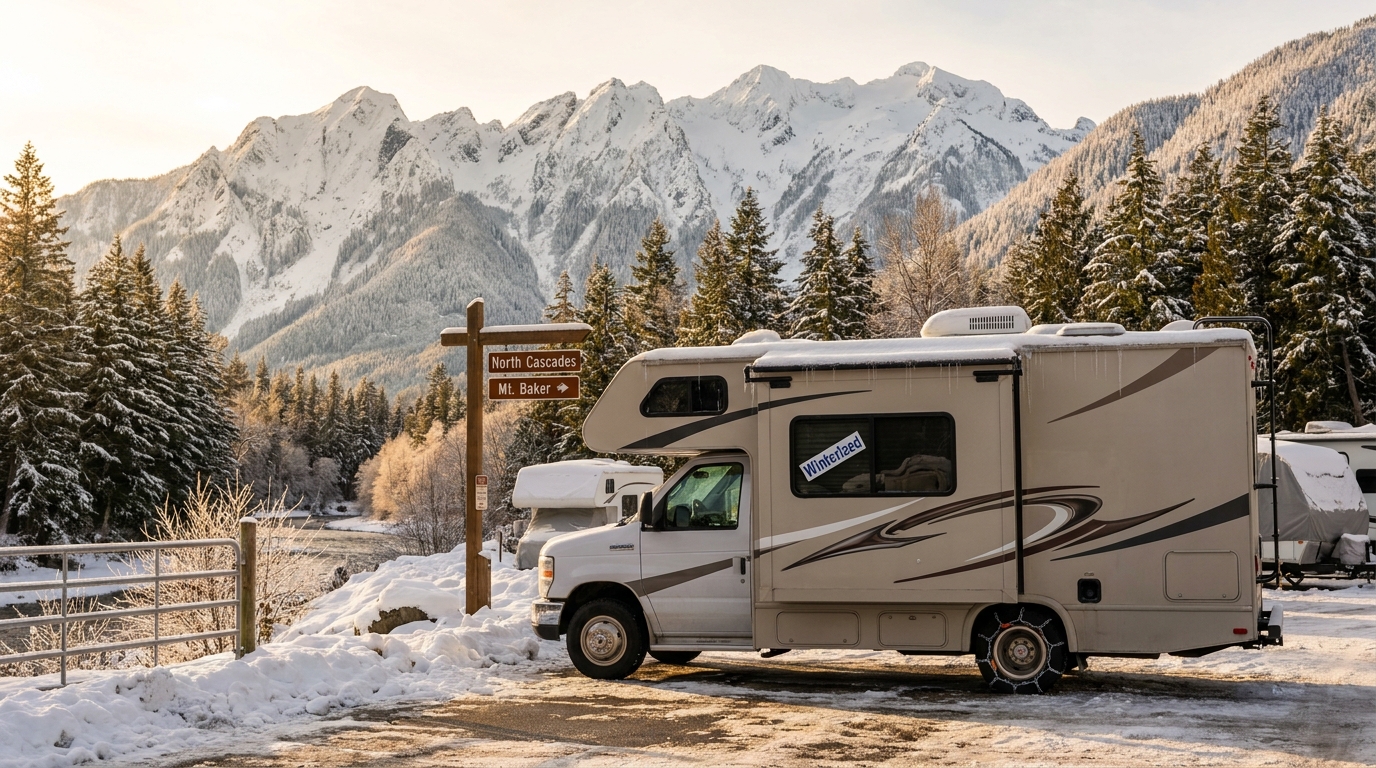
Planning your family RV adventure in the North West US involves a few key driving strategies to ensure a safe and enjoyable trip. Plan your route with frequent stops (every 2-3 hours) to accommodate family needs, allowing for breaks, stretching, and enjoying scenic overlooks. Practice defensive driving and maintain a greater following distance than with a passenger car, especially in the variable weather and diverse terrain of the North West. When ascending or descending mountain passes, shift to a lower gear to manage speed and prevent brake overheating, a critical safety measure for heavy RVs. Budget for extra travel time; the scenic routes and mountain roads in the NW US are often slow, and unforeseen delays can occur due to weather, traffic, or road construction. Always check local weather forecasts and road conditions, especially when planning to traverse mountain passes, which can close due to snow or adverse conditions seasonally (e.g., North Cascades Highway SR 20).
Recommended RV Class for North West US Roads
For family RV rentals in the North West US, Class C Alcove RVs are highly recommended. They strike an excellent balance between spacious living, comfortable sleeping for multiple occupants, and manageable driving on diverse terrains. Bandana's Class C Alcove models typically average 7.5 meters (approximately 24.6 feet) in length, offer an average of 5.8 sleeping places, and comfortably accommodate around 4.4 adults, with a robust load capacity for family gear. Alternatively, Class SI Semi-integrated RVs, averaging 6.9 meters in length and accommodating about 3.4 adults, provide a slightly more compact option with good amenities for smaller families or those seeking slightly easier maneuverability. Both classes offer sufficient ground clearance and power for navigating the region's mountain passes and scenic byways while providing the necessary comfort for family travel.
Should I Choose a Compact Van Instead of a Large RV in North West US?
For most family RV rental adventures in the North West US, a larger RV like a Class C or Semi-integrated motorhome provides significantly more comfort, living space, and amenities that often outweigh the marginal maneuverability benefits of a compact van. While a compact van (such as Bandana's Class B Camper Van, averaging 5.8 meters in length) offers easier parking in urban centers and access to very tight spots, it compromises on indoor space, dedicated sleeping areas, and storage crucial for families. The main roads and campgrounds throughout the North West are generally well-suited for larger RVs, meaning maneuverability is rarely a prohibitive factor for typical tourist routes. A compact van might be preferable if your primary focus is stealth camping in urban areas or accessing extremely remote, unpaved forest service roads, but for a family-oriented trip prioritizing comfort and space, a larger RV is usually the better choice.
Can I Park Anywhere? Free & Wild Camping Rules in North West US
Free or 'wild' camping in an RV is generally restricted on private land and within most developed areas of the North West US, but it is permitted on much of the federally managed public lands, such as National Forests and Bureau of Land Management (BLM) lands, under specific regulations. Washington, Oregon, Idaho, and Montana offer extensive opportunities for dispersed camping, often without fees, provided campers adhere to 'Leave No Trace' principles, observe fire restrictions, and respect length-of-stay limits. It is illegal to park overnight on city streets in many municipalities, and most retail parking lots prohibit overnight RV stays, so always look for designated RV parks, campgrounds, or approved overnight parking areas. Rules vary significantly by region and land management agency; always check local regulations, posted signage, or consult resources like the US Forest Service or BLM websites before parking overnight to ensure compliance and avoid fines.
Can I Drive an RV Into the City Center? Heights, Tunnels & Local Signage
Yes, you can almost always drive an RV into city centers in the North West US; however, drivers must remain vigilant for local signage indicating height limits, tunnel restrictions, one-way streets, and low bridges. Major cities like Seattle, Portland, Boise, and Missoula feature well-maintained main thoroughfares that accommodate RVs, but older districts or specific parking garages may have height or length restrictions that prevent larger vehicles. The North West US does not typically impose environmental zones or congestion charges for city driving, unlike some European cities, but parking can be challenging to find and expensive for large vehicles. It is advisable to park RVs in designated larger parking lots or on the periphery of very dense downtown areas and utilize public transport or ride-sharing services to explore the core city center.
What is the 3-3-3 rule for RV?
The '3-3-3 rule' for RV driving is a popular guideline recommending that RVers drive no more than 300 miles a day, arrive at their destination by 3 PM, and stay for at least 3 days. This rule is especially beneficial for family RV rentals in the North West US, where diverse terrain including mountains, winding coastal roads, and unpredictable weather (particularly in the Cascades or Rockies) can make long driving days more fatiguing and less enjoyable. Adhering to the 3-3-3 rule helps minimize driver stress, allows ample time for setting up camp and exploring destinations, and ensures families can enjoy a more relaxed and safer trip rather than rushing through beautiful scenery. For challenging NW conditions, the '300 miles' aspect might be better interpreted as '3-4 hours of driving' to account for slower speeds on mountain passes and scenic byways.
Can your family ride in a RV while it drives?
Yes, in the North West US states (Washington, Oregon, Idaho, Montana), passengers, including family members, are generally permitted to ride in the living area of an RV while it is in motion, provided they are seated and using available seat belts. State laws typically mandate that all passengers, especially children, be secured with a seat belt if one is present in the RV's living area, and strict child restraint laws apply based on age, height, and weight for car seats. For safety, it is highly recommended that all passengers, particularly young children, remain properly secured in designated seating with seat belts and avoid moving around while the RV is in motion, especially on winding or uneven roads common in the North West. While legal, the safest practice is for everyone to be in forward-facing seats in the cab, but this is often impractical for larger families in an RV.
What states have banned RVs?
No US state, including those in the North West (Washington, Oregon, Idaho, Montana), has enacted a complete 'ban' on RVs; however, specific local ordinances and park regulations may restrict RV access, parking, or overnight stays in certain areas. Restrictions commonly involve limitations on RV length or weight in historic districts, on particular scenic drives within national parks (e.g., specific sections of Glacier National Park), or within certain campgrounds. RVers should always research specific destination regulations for any potential restrictions on RV size or type, particularly when planning visits to popular attractions or considering dispersed camping options.
What is the new RV law in Washington state?
There is no single, statewide 'new RV law' that comprehensively bans or severely restricts RVs across all of Washington State; instead, specific municipalities and counties periodically update ordinances related to RV parking, camping, and long-term occupancy. Recent legislative discussions and local city council actions in Washington have often focused on regulating overnight RV parking on public streets, especially in urban areas like Seattle and Spokane, to address public safety, sanitation, and homelessness concerns. These local ordinances typically do not impact legitimate RV touring or short-term stays in designated campgrounds but can affect attempts at urban boondocking or extended parking. RVers planning a trip to Washington should always consult the specific regulations of the cities and counties they intend to visit or stay in, as rules can vary widely and are subject to change.
Which states are RV friendly?
All four North West US states—Washington, Oregon, Idaho, and Montana—are largely considered exceptionally RV friendly, offering extensive infrastructure, diverse landscapes, and abundant camping opportunities. Oregon is particularly renowned for its numerous state parks, many with excellent RV facilities along its famous coastline and inland rivers, making it a top destination for RVers. Montana and Idaho provide vast public lands managed by the Forest Service and BLM, offering numerous dispersed camping options and access to unparalleled wilderness experiences for those seeking a more rustic RV adventure. Washington delivers a rich mix of coastal, mountain, and island experiences with a well-developed road network and state park system, though urban areas require more strategic parking planning. These states collectively boast thousands of campgrounds, easily accessible dump stations, propane refill stations, and RV repair services, making them ideal for family RV adventures.
What is the largest RV you can drive without a special license?
In most US states, including Washington, Oregon, Idaho, and Montana, you can drive any RV with a Gross Vehicle Weight Rating (GVWR) of up to 26,000 pounds (approximately 11,793 kg) using a standard Class D driver's license. This weight threshold comfortably covers the vast majority of rental RVs, including large Class C Alcove models (Bandana's fleet averages 7.5 meters in length), Class A Integrated RVs (also averaging 7.5 meters), and smaller Class B Camper Vans. RVs exceeding 26,000 lbs GVWR typically require a non-commercial Class B or Class A license, as they are considered heavier vehicles, though these are less common in standard rental fleets. Always confirm the specific GVWR of your rental RV and check the Department of Motor Vehicles (DMV) requirements for your state of residency if you plan to rent an exceptionally large or heavy unit.
What states require a special RV license?
While most US states, including Washington, Oregon, Idaho, and Montana, do not require a special license for recreational vehicles under 26,000 pounds GVWR, a few states do mandate a non-commercial Class B or Class A license for heavier RVs. States such as California, New York, Texas, and Pennsylvania are examples that have special licensing requirements for RVs exceeding specific weight thresholds (typically above 26,000 lbs GVWR or when towing very heavy trailers). For travel specifically within the North West US, a standard Class D license is generally sufficient for operating typical rental RVs; however, it is prudent for drivers of exceptionally large or heavy private RVs to verify their specific state's DMV regulations. Obtaining a non-commercial special license, if required, usually involves both a written knowledge test and a practical driving test in a vehicle of the appropriate class, focusing on large vehicle handling and safety protocols.
Who has the least expensive RV insurance?
For family RV rentals, the 'least expensive RV insurance' is often integrated directly into the standard rental agreement, providing basic liability and sometimes collision coverage, rather than being a separate policy purchased by the renter. Rental companies typically offer optional supplemental insurance packages to reduce deductibles, expand coverage for roadside assistance, personal effects, or specific damages, which renters can choose based on their comfort level. For private RV ownership, major insurance providers such as Progressive, GEICO, National General, and Good Sam often compete to offer comprehensive RV insurance, with rates depending on factors like vehicle type, driver history, usage, and chosen coverage limits. When renting, always thoroughly review the rental agreement's insurance terms, understand what is covered, and consider whether additional coverage offered by the rental company or your personal auto insurance policy (if it extends to rentals) is necessary for your peace of mind.
What You Shouldn't Miss
- Drive the Pacific Coast Scenic Byway in Oregon for breathtaking ocean vistas and access to charming coastal towns.
- Explore the dramatic mountain landscapes and alpine lakes of Glacier National Park, Montana – remember bear safety protocols!
- Visit Mount Rainier National Park in Washington for stunning volcano views, wildflower meadows (in season), and RV-accessible trails.
- Discover the geothermal wonders of Yellowstone National Park, straddling Wyoming, Montana, and Idaho, with numerous RV campgrounds.
- Tour the wineries of the Willamette Valley in Oregon, a picturesque region perfect for a leisurely RV drive and tasting experience.
- Experience the rugged beauty of Idaho's Sawtooth National Recreation Area, offering incredible hiking and RV camping opportunities amidst towering peaks.
Final Thoughts
Renting an RV for your family adventure in the North West US opens up a world of incredible experiences, from the dramatic Pacific coastline to the majestic Rocky Mountains. By understanding the driving considerations, route planning, and embracing the slow travel ethos, your journey will be filled with unforgettable moments.
Remember to book in advance, especially during peak season, to secure your preferred vehicle and dates. With Bandana Caravan, you get transparent pricing and dedicated support, ensuring your RV rental experience is smooth and enjoyable from start to finish. Get inspired for your next trip!
Discover top destinations, planning tips, all in one place! Plan a trip itinerary in advance with minimal effort and maximum enjoyment. Compare Motorhome Prices for North West US and start planning your dream RV vacation today!