For live availability and current prices, start with our RV Rental Bergen - Complete Guide 2026 guide.
In This Guide
- Can You Drive an RV in Bergen? License & Age Rules
- Road Conditions & Terrain in Bergen
- RV Size Limits, Bridges & Restricted Zones
- Fuel: Diesel vs. Petrol & Cost per 100 km
- Tolls, Vignettes & Border Rules
- Driving Tips for family rv rental Travelers
- Recommended RV Class for Bergen Roads
- Should I Choose a Compact Van Instead of a Large RV in Bergen?
- Can I Park Anywhere? Free & Wild Camping Rules in Bergen
- Can I Drive an RV Into the City Center? Heights, Tunnels & Local Signage
- What is the 3-3-3 rule for RVs?
- Can your family ride in a RV while it drives?
- Do you have to have a CDL to drive a 40 ft motorhome?
- How many people can legally drive in an RV?
- Can you park an RV anywhere in Norway?
- What is the 3-3-3 rule when rving?
- What is the 4 4 4 rule for rving?
- Which RV does not require a license?
- Do I need a separate license for an RV?
- Do I need a CDL to drive a 40 ft motorhome?
Embarking on a family RV rental adventure from Bergen Airport (BGO) opens up Norway’s majestic fjord landscapes and vibrant city life right from your doorstep. Renting a motorhome is an incredible way to experience the stunning beauty of Western Norway at your own pace, providing both comfort and flexibility. For live availability and current prices, start with our RV Rental Bergen - Complete Guide 2024.
Can You Drive an RV in Bergen? License & Age Rules
Yes, you can absolutely drive a family RV in Bergen and throughout Norway, with a standard car driver's license being sufficient for most recreational vehicles. A standard Class B driving license is sufficient for RVs up to 3,500 kg Total Permissible Mass (TPM) in Norway, which covers most camper vans and many smaller semi-integrated models. For larger RVs with a TPM between 3,500 kg and 7,500 kg, a Class C1 license is typically required; however, all motorhome classes rented through Bandana RV can be driven with a standard car license, meaning no special license or CDL is necessary. The minimum driving age for an RV rental in Norway through our partners is 21 years, with no young driver surcharges for any vehicle class. Foreign drivers generally need a valid national driving license, and an International Driving Permit (IDP) is recommended for visitors from non-English-speaking countries, although it is not mandatory in most cases. You’ll find that driving a rented motorhome in Norway is quite accessible, allowing families to comfortably explore the region.
We work with over 50 leading RV suppliers worldwide, including trusted names like El Monte and Apollo, ensuring you have a wide selection of family-friendly motorhomes that meet these licensing requirements. For those considering an extended road trip, our guide on RV Rental Norway - Complete Guide 2024 offers broader context on driving regulations across the country. Remember, our focus is on full transparency, so you'll never encounter hidden fees or surprises regarding licensing or any other aspect of your rental.
Road Conditions & Terrain in Bergen
Bergen's road conditions vary significantly, from smooth urban streets to challenging narrow and winding mountain passes, especially on the scenic routes leading out of the city toward the fjords. The terrain around Bergen is characterized by steep fjords and rolling hills, often accompanied by wet weather, which demands careful and attentive driving. You should anticipate encountering single-lane tunnels, sharp bends, and occasional gravel roads when venturing into more rural or incredibly scenic areas like those on the Hardangerfjord. While driving these routes can be exhilarating, family RV travelers should plan for slower travel speeds to safely navigate the varied terrain and fully immerse themselves in the breathtaking scenery. For instance, the "Bergen Round trip - Norway’s Coastal Wonders" covers 782.9 km over 8 days, perfectly illustrating the recommended slow travel pace of max 100-150 km per day.
The city's unique geography requires drivers to be comfortable with various road types. Don't stress too much about the size of your rented motorhome; just drive slowly and carefully, and you can navigate almost anywhere without issues. For more specific driving insights, consider reviewing the "RV Travel Guide to Bergen - Tips and Top Spots 2026".
RV Size Limits, Bridges & Restricted Zones
While Norway does not impose universal size limits that outright prohibit RVs, drivers must always adhere to specific height, width, and weight restrictions clearly posted for tunnels, bridges, and certain narrow roads around Bergen. Most tunnels in the region typically have height limits ranging from 3.5 to 4.5 meters; larger RVs, such as a Class C Alcove motorhome with an average length of 7.4 meters, require constant attention to these warning signs. Ferry crossings, which are a common and enjoyable part of navigating Norway's coastal fjords, have tariffs based on vehicle length and weight, potentially impacting your family RV trip budget if you choose a larger model. Currently, Bergen does not have strict environmental zones that ban most modern RVs outright, but it is always wise to check local signage in specific urban areas for any temporary or localized restrictions.
Navigating the city center of Bergen is generally manageable for all RV sizes if you drive slowly and carefully, paying close attention to road signs. No need to stress; just use common sense. For detailed pricing considerations related to vehicle size and other factors, check out our "RV Rental in Bergen - Prices and Best Deals 2026" guide.
Fuel: Diesel vs. Petrol & Cost per 100 km
The vast majority of modern RVs and campervans rented in Norway, including those available through Bandana RV, run on readily available diesel fuel. Understanding fuel consumption is key for budgeting your family RV adventure around Bergen, as fuel costs in Norway are generally higher than in many other European countries. A smaller Class B Camper Van, like a V3 model with a 2-liter engine and 75-liter fuel tank, typically consumes around 8 liters per 100 km. Larger Class SI Semi-integrated and Class C Alcove motorhomes average 10-12 liters per 100 km. When planning your route from Bergen, factor in these consumption rates. To help manage your trip expenses, consider using RV PLANET routes, where you can itemize and track every ancillary expense, from fuel to campground fees, for easy budgeting. On the routes offered through RV PLANET routes, you can itemize and track every expense along the way for easy budgeting.
Keeping an eye on fuel prices and filling up when opportunities arise, especially outside of major city centers, can also help. We believe in full transparency, which extends to advising you on these practical costs so there are no surprises during your journey.
Tolls, Vignettes & Border Rules
Norway operates an extensive network of automated toll roads and ferries, particularly in the Bergen area and along the scenic coastal routes, managed efficiently by the AutoPASS system. Most RV rentals from our partner suppliers typically come equipped with an AutoPASS transponder, which automatically registers all tolls and ferry charges. This convenient system eliminates the need for on-the-spot payments, with charges usually settled as a single invoice at the conclusion of your rental period. Unlike some other European countries, Norway does not utilize a vignette system; instead, tolls are charged per passage. If your family RV adventure extends beyond Norway's borders, perhaps into neighboring Sweden, be aware that different tolling systems apply, and you should research those specific rules in advance. Border crossings within the Schengen Area are generally open, but customs checks can occasionally occur. For a comprehensive overview of driving requirements across the country, consult our "RV Rental Norway - Complete Guide 2026".
Driving Tips for family rv rental Travelers
For an enjoyable and stress-free family RV rental trip from Bergen, prioritizing frequent stops every 2-3 hours is essential, especially with children, allowing everyone to stretch and refresh. This supports the slow travel philosophy, where the journey itself is as important as the destination, covering ideally a maximum of 100-150 km per day on average. Budgeting for tolls is simplified by leveraging pre-payment systems or AutoPASS tags often included with your rented motorhome, which streamlines travel and helps avoid potential fines. Before departing from Bergen Airport (BGO), take time to familiarize yourself with your RV's dimensions, especially its height and width, to safely navigate the many narrow roads and tunnels common in Western Norway. Always maintain a safe driving distance, particularly in mountainous terrain or wet conditions, and be prepared for Norway's sudden weather changes. For added comfort, especially when navigating winding fjord roads, consider a rented motorhome with an automatic transmission, which is increasingly available and can make driving larger RVs much easier.
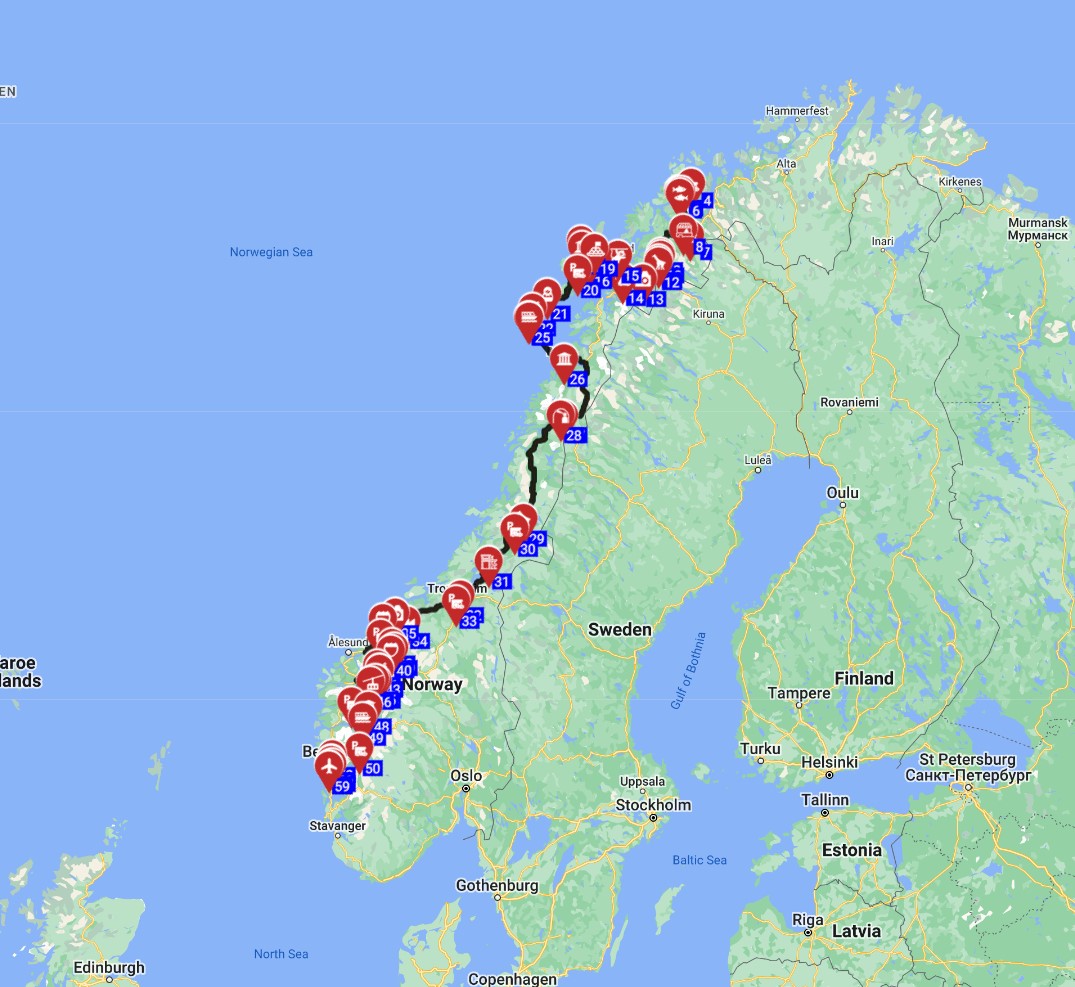
Imagine your family making breakfast in your motorhome, then hitting the road for a spectacular fjord drive. Planning your route can also enhance your trip. For example, the "Bergen to Tromso - Norwegian Coastal Odyssey" (17 days, 2746.3 km) offers a wealth of experiences, including 2 scenic routes and 3 cruise terminal/sailing opportunities. Or if you're returning south, the "
Recommended RV Class for Bergen Roads
For families exploring Bergen and its stunning scenic surroundings, a Class B - Camper Van or a Class SI - Semi-integrated RV is generally recommended due to their excellent balance of maneuverability and comfortable living space. Class B Camper Vans, averaging around 5.7 meters in length, are particularly agile for navigating tighter city streets and fitting onto smaller ferry spots, offering driving ease similar to a large car but with all the essential RV amenities like a small kitchen and sleeping areas. Semi-integrated RVs, such as the V3 model (6.36 meters long, 2.05 meters wide) which offers 2 sleeping places and has a 100-liter fresh water tank, provide a more spacious interior for families while remaining highly manageable on most Norwegian roads, including winding mountain passes and coastal routes. These classes typically offer sufficient ground clearance and are less prone to issues with height restrictions in tunnels compared to very large Class A Integrated or Alcove models. Ultimately, the best choice depends on your family's size and desired comfort levels, but these medium-sized motorhomes are ideal for Norway's diverse driving conditions.
Choosing a reliable vehicle is crucial, and Bandana RV partners with top suppliers to offer well-maintained, recent model campervans and motorhomes, giving you peace of mind throughout your journey. We are true RV specialists, not just a side department of a travel agency, meaning we genuinely know what we're talking about when it comes to RV travel.
Should I Choose a Compact Van Instead of a Large RV in Bergen?
While a compact campervan offers superior maneuverability in very tight historic centers or extremely narrow mountain passes, there is usually no significant issue driving a standard Class SI (average 6.9m) or even Class C (average 7.4m) RV in Bergen and its surrounding areas. For a family RV rental, the enhanced comfort, indoor space, and amenities of a larger motorhome often significantly outweigh the marginal maneuverability benefits of a compact van, especially for week-long trips or longer and in Norway's often unpredictable weather. Imagine preparing a warm meal for your family inside a spacious RV after a day of hiking, utilizing the built-in kitchen amenities. You can find many inspiring ideas on our RV-friendly recipes playlist. A compact van truly shines when your priority is extreme agility for spontaneous parking in bustling urban centers or tackling the most challenging, unpaved backroads. However, for typical family travel with luggage and the desire for proper cooking, dining, and sleeping facilities, a larger RV provides a much more comfortable and enjoyable experience without excessive compromise on road access in Norway. Drive slowly and carefully, and you can drive almost anywhere without issues. No need to stress - just use common sense and pay attention.
Can I Park Anywhere? Free & Wild Camping Rules in Bergen
No, you cannot park an RV just anywhere in Norway, even though 'Allemannsretten' (everyman's right) allows for wild camping on uncultivated land, specific rules and local regulations still apply, especially regarding private property and designated parking. Under Allemannsretten, you can typically stay for up to two nights on uncultivated land, provided you are at least 150 meters from an inhabited house or cabin and do not disturb anyone. Wild camping is generally not permitted on cultivated land, such as farms or gardens, without explicit permission from the landowner, and stricter rules apply within national parks or protected natural areas. In and around Bergen, designated campsites offer essential facilities for waste disposal, fresh water, and electricity, making them the most convenient and legally compliant option for overnight stays. Always ensure you follow local regulations and practice "leave no trace" principles to protect Norway's pristine environment. For more information on finding suitable overnight spots, our "RV Camping in Bergen - Best Campgrounds 2026" guide is an excellent resource.
Can I Drive an RV Into the City Center? Heights, Tunnels & Local Signage
Yes, it is generally possible to drive an RV into the city center of Bergen, but this requires careful attention to local signage regarding height limits, narrow tunnels, and any restricted access zones. Bergen features several tunnels, such as the Fløyfjellstunnelen, that may have specific height or width restrictions; always look for signs indicating maximum vehicle dimensions before proceeding. Certain streets in the historic core of Bryggen or pedestrian-heavy areas may be restricted to residents or public transport only, or simply be too narrow for comfortable RV navigation. While technical access is often possible, finding suitable and affordable parking for an RV in Bergen's city center can be quite challenging, with limited options, so peripheral parking areas or official campsites with good public transport links (like the Bergen Light Rail) are usually recommended. Drive slowly and carefully, and you can drive almost anywhere without issues. No need to stress - just use common sense and pay attention. Always observe local environmental zone signs and understand that road conditions, especially during peak tourist season, can make city center navigation stressful for larger vehicles.
What is the 3-3-3 rule for RVs?
The 3-3-3 rule for RVs is a popular guideline designed to ensure safe and enjoyable travel, recommending that you drive no more than 300 miles (approximately 480 km) a day, arrive at your destination by 3 PM, and stay for at least 3 nights. This rule promotes a relaxed travel pace, significantly reducing driver fatigue and allowing ample time to comfortably set up camp, explore the local area, and address any unexpected issues that may arise. Adhering to the 3-3-3 rule is particularly beneficial for family RV trips, as children often thrive on routine and benefit from less time spent constantly on the road, enabling more quality time to connect with the culture, food, and scenery of Bergen. While this is a guideline, it's especially useful in scenic regions like the Norwegian fjords where the journey itself is an integral part of the overall experience, encouraging appreciation of the surroundings rather than rushing between destinations. Embracing slow travel enhances your experience.
Can your family ride in a RV while it drives?
Yes, passengers can typically ride in an RV while it drives, provided they are seated in designated spots with seatbelts securely fastened, in accordance with strict Norwegian traffic laws. All passengers, including children, must use an approved seatbelt or an appropriate child restraint system if the vehicle is in motion, just as they would in a standard car. It is generally not permitted and unsafe for passengers to be in sleeping berths, standing, or moving freely around the living area while the RV is being driven. Before your family RV rental trip from Bergen, ensure that the RV's registration certificate clearly specifies the legal number of passenger seats, and never exceed this capacity to ensure everyone's safety and legal compliance. Our top-level deductible reimbursement option means you can travel with extra peace of mind, knowing we’ve got the details covered.
Do you have to have a CDL to drive a 40 ft motorhome?
No, you typically do not need a Commercial Driver's License (CDL) to drive a 40 ft (approximately 12 meters) motorhome for private recreational use in Norway, as CDLs are primarily for commercial transport of goods or passengers. For private recreational vehicles in most European countries, including Norway, the key determinant for the required license is the RV's Total Permissible Mass (TPM), not solely its physical length. A Class C1 license is required for vehicles with a TPM between 3,500 kg and 7,500 kg, which encompasses most large motorhomes, while a full Class C license is needed for those exceeding 7,500 kg. Both Class C1 and Class C are non-commercial licenses, distinctly different from a CDL, making larger RVs surprisingly accessible for rental travelers. At Bandana RV, we partner with suppliers offering a range of Class A, B, and C motorhomes, all drivable with a standard car license (Class B, C1, or C, depending on weight), making your family RV rental in Bergen straightforward.
How many people can legally drive in an RV?
Generally, only one person can legally operate the controls and drive an RV at any given moment, although multiple appropriately licensed individuals can certainly take turns driving during a long family RV trip from Bergen. Each potential driver must possess a valid driving license that permits them to operate the specific class and weight of the RV they are driving in Norway. It is absolutely crucial to ensure that all individuals who will be driving the rented motorhome are explicitly listed and covered by the rental insurance policy, as unauthorized drivers may void coverage in the unfortunate event of an accident. It is quite common and highly recommended for couples or adult family members to share driving responsibilities on longer RV trips, as this practice effectively promotes safety by preventing driver fatigue and enhancing overall trip enjoyment.
Can you park an RV anywhere in Norway?
No, you cannot park an RV just anywhere in Norway, even with the 'Allemannsretten' (everyman's right), which allows for wild camping on uncultivated land, as specific rules and local regulations apply, especially concerning private property and designated parking. Under Allemannsretten, overnight parking is generally permitted for up to two nights on uncultivated land, provided you are at least 150 meters away from inhabited buildings and do not cause any disturbance to the area or its residents. Parking is strictly prohibited on cultivated land, such as agricultural fields or private gardens, without the landowner's explicit permission. In urban areas like Bergen, RV parking is typically restricted to designated parking lots or official campgrounds, and strict adherence to local signage for height, weight, and time limits is essential to avoid fines. Proper waste disposal is critical when parking anywhere; 'leave no trace' principles must be rigorously followed to preserve Norway's renowned pristine environment and ensure a sustainable experience for future travelers. To find suitable campsites and campgrounds during your trip, we recommend using RV PLANET (rvplan.net) - a great resource for locating available spots along your route.
What is the 3-3-3 rule when rving?
The 3-3-3 rule in RVing is a useful guideline that advises travelers to limit their daily driving to no more than 300 miles (approximately 480 km), aim to arrive at their camping spot by 3 PM, and plan to stay for at least 3 nights at each location. This structured approach is designed to significantly maximize enjoyment, reduce travel-related stress, and enhance safety during an RV trip by preventing rushed schedules and driver exhaustion. Following this rule allows families ample time to comfortably set up their RV, thoroughly explore the surrounding attractions of Bergen and its fjords, and fully relax without the constant pressure of moving on. It is particularly beneficial for family RV rentals in Bergen, where the diverse landscapes, numerous hiking opportunities, and cultural sites truly warrant a slower pace to fully appreciate the experience. Our Rent&Plan service can help you create itineraries that embrace such relaxed travel, ensuring you make the most of your Norwegian adventure.
What is the 4 4 4 rule for rving?
The '4-4-4 rule' for RVing is a less commonly cited, yet similar, guideline to the 3-3-3 rule, often suggesting driving no more than 400 miles (approximately 640 km), arriving by 4 PM, and staying for at least 4 nights at each location. This rule, like its 3-3-3 counterpart, emphasizes a slower, more deliberate travel pace to enhance the overall RV experience and actively reduce fatigue for all travelers. It provides a flexible framework for planning itineraries that allow for even more in-depth exploration of each destination and additional relaxation time for families. While either rule serves as a useful planning tool, the core principle is to actively avoid over-scheduling your journey and prioritize safety and enjoyment over covering maximum distance, especially when navigating the unique terrain and diverse attractions surrounding Bergen.
Which RV does not require a license?
In Norway, no RV can be driven without any license; however, smaller campervans (like Class B models, averaging 5.7 meters in length) and some semi-integrated RVs typically only require a standard Class B (or equivalent) car driving license, meaning they do not require a special endorsement like a CDL or C1. The requirement for a specific license class in Norway is based on the Total Permissible Mass (TPM) of the vehicle, not its physical size or type, ensuring safety and appropriate driver qualification. Most RVs with a TPM under 3,500 kg can be driven legally with a standard Class B car license, which is the most common license held by the vast majority of drivers. Therefore, if you hold a regular car license, you can drive a significant portion of the available RV rental fleet in Bergen and throughout Norway without needing any additional specialized licensing. Bandana RV offers a wide range of such user-friendly motorhomes, making RV travel accessible.
Do I need a separate license for an RV?
In Norway, whether you need a 'separate' or additional license for an RV depends entirely on its total permissible mass (TPM); most standard RVs up to 3,500 kg can be driven with a Class B car license, the most common license type. A Class B license is sufficient for a wide range of camper vans and many semi-integrated RVs, making them an accessible option for many travelers. For heavier RVs with a TPM between 3,500 kg and 7,500 kg, a Class C1 license is required; this is an upgrade from a standard B license but is not considered a full commercial license (CDL). It is crucial to always check the specific TPM of your chosen RV rental and compare it against your existing driving license categories to ensure complete legal compliance before embarking on your family RV trip from Bergen. We are true RV specialists and can provide clear guidance on this.
Do I need a CDL to drive a 40 ft motorhome?
No, you typically do not need a Commercial Driver's License (CDL) to drive a 40 ft (approximately 12-meter) motorhome for private recreational use in Norway, as CDLs are specifically for commercial transport purposes. For private recreational motorhomes, even those of substantial size, the required license depends on the vehicle's Total Permissible Mass (TPM), rather than solely its length. Motorhomes with a TPM between 3,500 kg and 7,500 kg require a Class C1 license in Norway, while those with a TPM over 7,500 kg require a Class C license. Both Class C1 and Class C are non-commercial licenses, distinct from a CDL, which would only be necessary if the motorhome were used for commercial activities, such as transporting paying passengers or goods. This means a spacious, comfortable Class A motorhome for your family RV rental in Bergen is more accessible than you might think.
🎬 Video coming soon
What You Shouldn't Miss
- Take the Floibanen Funicular up Mount Fløyen for panoramic views of Bergen, its fjords, and surrounding mountains.
- Wander through the historic Bryggen Wharf, a UNESCO World Heritage site with its colorful wooden houses and narrow alleyways.
- Experience the vibrant atmosphere and local delicacies at Bergen's famous Fish Market (Fisketorget), perfect for a fresh seafood lunch.
- Drive a portion of the scenic Hardangerfjord National Tourist Route (part of a loop from Bergen) to witness stunning waterfalls and fruit orchards.
- Visit Troldhaugen, the charming former home of Norway's most famous composer, Edvard Grieg, located just outside Bergen.
- Explore Bergenhus Fortress, one of Norway's oldest and best-preserved stone fortifications, offering a glimpse into the city's rich history.
Looking for expert insights from Avi Bandana? Top 5 Adventures - recommendations from Avi Bandana
Final Thoughts
A family RV rental from Bergen Airport is your ticket to an unforgettable Norwegian adventure, blending the comforts of home with the freedom of the open road. From navigating scenic mountain passes to discovering charming fjord-side villages, the experience of exploring Bergen and its stunning surroundings by motorhome is truly special. Remember to embrace the local pace, travel slowly, and immerse yourselves in the culture and breathtaking scenery.
At Bandana RV, we're dedicated to making your journey as smooth and enjoyable as possible. We offer full transparency, 24/7 support for your booking process, and expert guidance every step of the way. With a rented campervan, you're not just booking a vehicle; you're unlocking a world of possibilities for a truly memorable family vacation.
Ready to start your Norwegian coastal expedition? Get inspired for your next trip and discover why RV travel is the perfect choice for exploring Bergen's wonders!
Find Motorhome Rentals in Bergen