In This Guide
- The 4 RV Families Compared for Tokyo - Airport
- Class A (Integrated) – Best For
- Class SI (Semi-Integrated) – Best For
- Class C (Alcove) – Best For
- Class B (Campervan) – Best For
- Price Comparison by RV Class in Tokyo - Airport
- Side-by-Side Comparison Table
- Our Recommendation for Short-Trip RV Travelers in Tokyo - Airport
- Detailed, step-by-step guidance on RV pickup and drop-off logistics at Narita (NRT) and Haneda (HND) airports
- First-night strategy post-pickup: Immediate campgrounds or Michi-no-Eki near NRT/HND
- Comprehensive information on RV parking at or near Tokyo airports
- Practical advice for navigating Japanese roads with an RV from the airport areas
- Luggage management for RV travelers from Tokyo airports
- A direct comparison of NRT vs. HND for RV pickup in Tokyo - Airport
- Information on essential RV services immediately accessible from Tokyo airports
- Cultural nuances and etiquette for RV camping in Japan
Discovering Japan by rented motorhome offers unparalleled freedom, allowing you to venture beyond the bustling cityscapes of Tokyo and into serene landscapes or historical towns. Whether you're planning a quick trip from Tokyo airports or an extended road trip across the country, selecting the right RV is key to a comfortable and memorable journey. For live availability and current prices, start with our RV Rental Tokyo - Airport - Complete Guide 2026 guide.
At Bandana RV, we specialize in making your RV rental experience seamless and transparent. We're true RV specialists, not just a side department of a general travel agency, and have been helping tens of thousands of travelers explore the world by RV since 2001. We partner with over 50 leading RV suppliers worldwide, including trusted names like El Monte and Apollo, to bring you comprehensive choices with full transparency and no hidden fees.
The 4 RV Families Compared for Tokyo - Airport
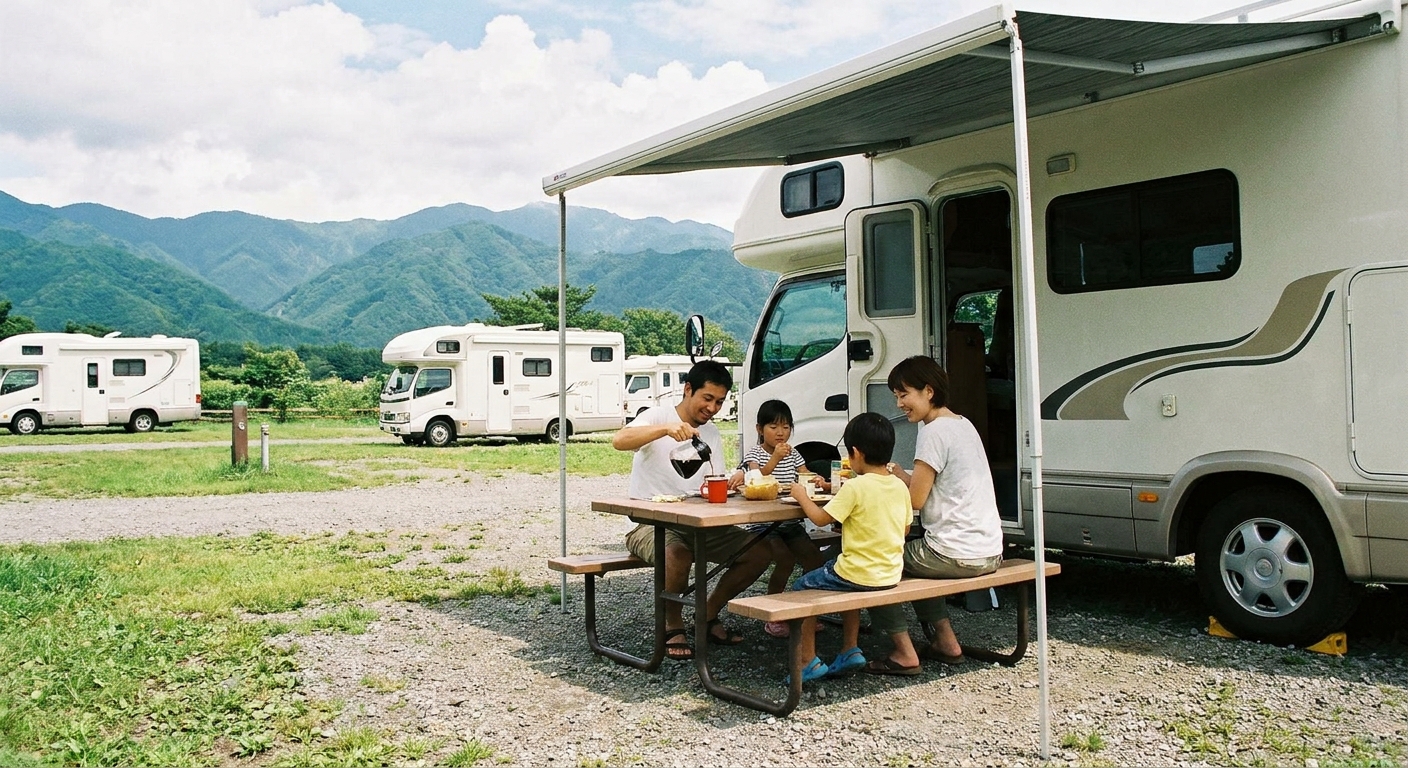
Choosing the ideal RV family for a Tokyo - Airport trip is crucial for navigating Japan's unique road conditions and maximizing your adventure. The primary factors to consider are vehicle length for Japan's often narrower roads and compact parking, sleeping capacity for your group size, and fuel efficiency for managing your travel budget effectively. Given the shorter duration of many trips originating from the airport, prioritizing a maneuverable and efficient RV is particularly important.
Japan's infrastructure is generally excellent, but urban areas and smaller towns often feature more compact dimensions than what some international drivers might be used to. Therefore, understanding the typical size and handling characteristics of each motorhome class will greatly enhance your travel enjoyment. We compare final prices across 50+ suppliers, so you can easily compare options.
Class A (Integrated) - Best For
Class A integrated motorhomes, averaging 7.5 meters in length and sleeping 4 to 6 people, are ideal for larger groups or families seeking maximum comfort and amenities for a significant RV rental journey from Tokyo airports. Bandana's fleet typically sees these vehicles consuming around 10-12 Liters/100 km, offering a luxurious experience despite their size. They are best suited for travelers prioritizing spacious living areas and a comprehensive suite of features for a comfortable, longer trip, and who are confident navigating larger vehicles on Japanese roads.
While offering ample space and features like full kitchens with refrigeration and dining areas, these larger motorhomes do come with trade-offs. They generally have higher fuel costs compared to smaller models and can present challenges for maneuverability on smaller roads or in tight parking situations common in some Japanese towns. Drive slowly and carefully, and you can drive almost anywhere without issues. No need to stress - just use common sense and pay attention. On the routes offered through RV PLANET routes, you can itemize and track every expense along the way for easy budgeting.
Class SI (Semi-Integrated) - Best For
Class SI semi-integrated motorhomes, with an average length of 6.9 meters and comfortably sleeping 3 to 4 people, strike an excellent balance between comfort and maneuverability, making them a popular choice for short-duration RV rentals from Tokyo airports. Bandana's fleet typically consumes around 10-11 Liters/100 km, offering good fuel efficiency for their size. These RVs are ideal for couples or small families seeking a comfortable touring experience without the bulk of a Class A, making them easier to navigate on Japanese roads.
They provide more living space and amenities, including a kitchen and private toilet/shower, than a typical campervan, yet are generally easier to handle and park than full-sized alcove models. This makes them a versatile option for exploring both popular attractions and more secluded natural areas around Tokyo. Consider the amenities of a campervan hire new zealand example Euro Deluxe, known for its spacious layout and comfortable beds, or a more compact rv rental denver example Category Van for easier city driving.
Class C (Alcove) - Best For
Class C alcove motorhomes, averaging 7.5 meters in length and sleeping up to 6 people, are perfect for families or larger groups needing extra sleeping capacity for a short RV rental from Tokyo airports. Bandana's fleet typically consumes 10-12 Liters/100 km, providing a cost-effective option for group travel. Their distinctive over-cab bunk offers additional sleeping space without significantly increasing the footprint beyond a Class A, making them well-suited for family adventures.
These RVs offer a good compromise between interior space and relative ease of driving compared to Class A motorhomes, fitting well with Tokyo's surrounding road conditions and short-trip travel priorities. The "cruise america rv rental example Explorer" is a popular Class C choice, offering comfortable beds, including a 160/220cm bed over the cab and a 163/210cm double bed in the rear, along with a functional kitchen equipped with a 4-burner gas stove and a 90-liter refrigerator. Families often appreciate the space provided by a Class C for cooking meals on board; remember to check out our RV-friendly recipes playlist for inspiration!
Class B (Campervan) - Best For
Class B campervans, averaging 5.8 meters in length and sleeping 2 to 3 people, excel in maneuverability and fuel economy, making them an excellent choice for solo travelers, couples, or small groups on a short RV rental from Tokyo airports. Bandana's fleet typically consumes around 8-10 Liters/100 km, offering significant savings on fuel. These compact RVs are ideal for navigating Japan's narrower roads, fitting into standard parking spaces, and exploring diverse areas including some city fringes without feeling cumbersome.
They offer a balance of comfort and agility, making them preferred for travelers prioritizing flexibility and ease of driving over extensive interior space for a brief getaway. A standard car driver's license is sufficient for all motorhome classes, including these nimble campervans, and the minimum rental age is 21 with no young driver surcharges. Look for models like the Active Classic or Camper Van for amenities like a front air condition, toilet, and shower, perfect for a comfortable road trip.
Price Comparison by RV Class in Tokyo - Airport
RV rental prices in Tokyo - Airport are dynamic, much like flight tickets, and change daily based on availability, seasonality, and supplier marketing decisions. The final price is set at the actual booking time. The table below provides real example prices from Bandana's live search for various RV classes and rental durations, giving you a realistic cost breakdown for planning your journey.
Live April Price Comparison — RV Class × Trip Length
| Trip length | Class A | Class B | Class C | Class SI | Class TC |
|---|---|---|---|---|---|
| 1 week 15/04 → 22/04 | Check prices | Check prices | Check prices | Check prices | Check prices |
| 2 weeks 15/04 → 29/04 | Check prices | Check prices | Check prices | Check prices | Check prices |
| 1 month 01/04 → 30/04 | Check prices | Check prices | Check prices | Check prices | Check prices |
Estimates only — flex-rate prices change daily based on availability and season.
These prices are estimates and update daily based on demand and availability. Always check the live search box at the top of the page for the most current rates for your specific dates. For broader cost estimations, you might find useful information in our "RV Rental Deals in Tokyo - Airport - Latest Offers 2026" guide.
Remember that ancillary costs like fuel, campground fees, and tolls can significantly impact your total trip cost. On RV PLANET routes, travelers can itemize and track every expense along the way for easy budgeting, helping you manage your daily expenses efficiently.
Side-by-Side Comparison Table
Below is a direct comparison of the key characteristics for each RV family, helping you quickly identify the best fit for your short-duration RV rental needs in Tokyo - Airport. This table provides average figures to aid your decision-making.
| Family | Avg Length (m) | Sleeps | Fuel Use (L/100km) | Best Use Case in Tokyo - Airport |
|---|---|---|---|---|
| Class A (Integrated) | 7.5 | 4-6 | 10-12 | Larger groups seeking luxury and space for longer journeys |
| Class SI (Semi-integrated) | 6.9 | 3-4 | 10-11 | Couples/small families balancing comfort and maneuverability |
| Class C (Alcove) | 7.5 | 5-6 | 10-12 | Families needing extra sleeping capacity with good amenities |
| Class B (Campervan) | 5.8 | 2-3 | 8-10 | Solo/couples prioritizing maneuverability and fuel efficiency |
Our Recommendation for Short-Trip RV Travelers in Tokyo - Airport
For most short-duration RV rental travelers arriving at Tokyo's airports, the Class SI (Semi-integrated) motorhome is our primary recommendation. Its average length of 6.9 meters provides a good balance of interior space for 3-4 people and improved maneuverability on Japan's roads compared to larger units. With a typical fuel consumption of 10-11 Liters/100 km, it's also relatively efficient for a short trip, offering features like front air conditioning, a shower, and a toilet.
The runner-up is the Class B (Campervan), especially for solo travelers or couples, offering superior agility and fuel economy (8-10 Liters/100 km) for navigating local areas and fitting into smaller parking spots. These compact options, like the "rv rental denver example Category Van" are perfect for exploring the immediate vicinity of Tokyo or heading out for a brief scenic drive. Remember, Bandana focuses on longer trips typically 1 week or more, but these vehicle types are versatile for any duration.
Detailed, step-by-step guidance on RV pickup and drop-off logistics at Narita (NRT) and Haneda (HND) airports
Upon arrival at either Narita (NRT) or Haneda (HND), expect most RV rental companies to operate off-airport depots, necessitating a shuttle service from the terminal to the pickup location. Pre-arrival communication with your rental company is vital to confirm shuttle details, pickup times, and any specific terminal meeting points, often provided via your booking confirmation from Bandana.
Required documentation typically includes your valid international driving permit (IDP), your home country's driver's license (standard car driver's license is sufficient for all motorhome classes), passport, and the credit card used for booking. The pickup procedure involves a thorough vehicle inspection (exterior, interior, systems check), signing the rental agreement, and receiving an orientation on the RV's features and Japanese road rules. For drop-off, ensure the RV is returned clean, with the fuel tank at the agreed level, and waste tanks emptied to avoid additional charges; follow the company's instructions for vehicle return and shuttle back to the airport. We provide supportive guidance before and after your booking, coordinating all these details.
First-night strategy post-pickup: Immediate campgrounds or Michi-no-Eki near NRT/HND
After a long flight and RV pickup from Tokyo - Airport, prioritize comfort and convenience by planning your first night at a nearby Michi-no-Eki (roadside station) or a pre-booked private campground within easy driving distance of NRT or HND. Michi-no-Eki offer free overnight parking, clean restrooms, and sometimes local food stalls, making them ideal for a relaxed first stop.
Consider Michi-no-Eki Tako (Chiba) for Narita pickups or explore options south of Haneda towards Yokohama or Hakone for convenient access. Always verify overnight parking rules as extended camping activities are generally not allowed. For a more amenities-rich experience, research and book a private campground in advance through rvplan.net, ensuring facilities like power hookups, fresh water, and dedicated waste disposal. Remember to account for jet lag and consider making an initial grocery stop before heading to your overnight spot to stock up on essentials. Travel slowly, max 100-150 km per day on average, especially on your first day.
Comprehensive information on RV parking at or near Tokyo airports
RV parking directly at Narita (NRT) and Haneda (HND) airports is generally limited to short-term oversized vehicle zones for pickup/drop-off, with very few official long-term or dedicated overnight RV parking options. Airport parking facilities may accommodate larger vehicles in specific zones, but be prepared for higher fees and potential size restrictions. For instance, the multi-story parking structures typically have height limits around 2.1 meters.
For extended parking needs or overnight stays before/after a flight, explore nearby private parking lots that cater to larger vehicles or utilize Michi-no-Eki further afield (though these are for rest, not typically long-term camping). It's crucial to check specific airport parking websites or contact private lots directly for current fees, vehicle height/length restrictions, and availability for RVs. Overnight stays directly in airport parking lots are generally prohibited or impractical for RVs; a Michi-no-Eki or campground is always the preferred option for sleeping.
Practical advice for navigating Japanese roads with an RV from the airport areas
Navigating Japanese roads with a rented RV from Tokyo airports requires strategic planning, familiarity with the ETC (Electronic Toll Collection) system, and attention to specific road signage, especially for international drivers. An ETC card is highly recommended and often rentable with your RV, allowing for seamless passage through toll gates on Japan's extensive expressway network, which is crucial for efficiency. You'll find these toll roads leading out of Narita Airport towards Chiba or from Haneda into Kawasaki and beyond.
Drive on the left-hand side of the road, and pay close attention to road signs, which often feature both Japanese (Kanji) and English translations for major routes and destinations. To avoid major city congestion, particularly in central Tokyo, plan your routes using GPS (Waze, Google Maps) to bypass peak hours (morning/evening commutes) and utilize expressways for longer distances. Drive slowly and carefully, and you can drive almost anywhere without issues. No need to stress - just use common sense and pay attention to speed limits, which are often 80-100 km/h on expressways and lower on local roads.
Luggage management for RV travelers from Tokyo airports
Efficient luggage management is key for RV travelers from Tokyo airports, as RV cargo space can be more limited than anticipated, especially for longer trips or larger groups. The average rental campervan, for example, typically has exterior storage compartments around 0.5-1 cubic meter, with interior storage varying widely. Utilize airport luggage storage services (coin lockers or staffed counters, available at both NRT and HND) for items you won't need immediately in the RV, providing a secure place for excess bags.
Consider using Japan's excellent Takuhaibin (luggage delivery) services to ship larger bags directly from the airport to a future accommodation or back to the airport for your departure. This can save valuable space in your rented motorhome. Pack smartly by using soft-sided bags instead of rigid suitcases, which are easier to store in an RV's compartments. Minimize non-essential items and consider clothing layers rather than bulky individual garments to maximize available storage within your RV. For related route planning, consult our "RV Travel Guide to Tokyo - Airport - Tips and Top Spots 2026".
A direct comparison of NRT vs. HND for RV pickup in Tokyo - Airport
Choosing between Narita (NRT) and Haneda (HND) for RV pickup significantly impacts your initial journey from Tokyo - Airport, as each offers distinct pros and cons concerning traffic, accessibility to first campsites, and onward travel routes. NRT (Narita International Airport), located about 60-70 km east of central Tokyo, often allows for an easier drive out of the immediate airport area onto expressways without navigating heavy city traffic.
From NRT, routes east towards Chiba's coast (e.g., Kujukuri Beach Road) or north/south via expressways like the Higashi-Kanto Expressway are often less congested, making it suitable for a swift departure to your first campsite. HND (Haneda Airport) is much closer to central Tokyo, about 15-20 km, which can mean more immediate exposure to urban traffic on the Bayshore Route or Metropolitan Expressway. However, HND offers quicker access to destinations southwest like Hakone, Mt. Fuji, or the Izu Peninsula. If heading north or east, NRT might be preferable; if heading south or west, HND could save travel time, assuming you manage initial city traffic. Consider flexible booking options when planning your trip, which Bandana offers, so you can adapt if needed.
Information on essential RV services immediately accessible from Tokyo airports
Immediately after RV pickup from Tokyo's airports, essential services such as fuel stations, grocery stores, and opportunities for fresh water are generally accessible within a short driving distance. Fuel stations are plentiful on major roads leading from both NRT and HND, such as Route 296 near Narita or Route 15 near Haneda; ensure you understand the fuel type for your RV (most are diesel in Japan) and payment methods (credit cards are widely accepted, but cash is a good backup).
Large grocery stores and supermarkets (e.g., Aeon, Ito-Yokado, specific locations vary) can be found in suburban areas surrounding the airports, ideal for stocking up on food and supplies for your trip. Dedicated RV waste disposal facilities (dump stations) are less common outside of campgrounds or specific service centers, so plan your route using RV PLANET to include a stop at a campsite for emptying grey and black water tanks. Fresh water can usually be refilled at most campgrounds; some Michi-no-Eki may have potable water access, but it's not guaranteed at all locations. This full transparency on services helps avoid surprises.
Cultural nuances and etiquette for RV camping in Japan
RV camping in Japan requires adherence to specific cultural etiquette, particularly for international travelers, to ensure a respectful and harmonious experience, especially concerning Michi-no-Eki usage and waste disposal. Michi-no-Eki are roadside rest areas for drivers to take a break, not designated campsites; while overnight parking is generally tolerated for rest, extensive camping activities (like deploying awnings, setting up tables outside, or loud gatherings) are generally frowned upon.
Strict quiet hours (typically 9 PM to 7 AM) are enforced at most campgrounds and should be observed diligently; loud noises or late-night gatherings are considered disrespectful. Japan has rigorous waste sorting rules; familiarize yourself with local guidelines for separating burnable, non-burnable, plastic, and recyclable waste, and dispose of it properly at designated points. Maintain cleanliness in all areas, including public restrooms and shared facilities, and always leave your campsite or parking spot as clean, or cleaner, than you found it. This respect for local customs enhances everyone's travel experience in Japan.
What You Shouldn't Miss
- **Mount Fuji Views:** Drive west from Tokyo - Airport towards Lake Kawaguchiko for iconic views of Mount Fuji, especially stunning during sunrise or sunset.
- **Hakone's Hot Springs & Art:** Explore the Hakone Open-Air Museum and relax in a traditional *onsen* town, easily accessible for a short RV trip from Haneda.
- **Coastal Drive in Chiba:** Head east from Narita Airport to the scenic Kujukuri Beach Road for coastal drives and fresh seafood.
- **Nikko's Temples & Nature:** Venture north to Nikko, a UNESCO World Heritage site, offering magnificent shrines, temples, and beautiful waterfalls like Kegon Falls.
- **Izu Peninsula's Volcanic Beauty:** Discover the rugged coastlines, hot spring resorts, and geological wonders of the Izu Peninsula, a perfect destination for a couple's RV rental in Tokyo - Airport.
Looking for expert insights from Avi Bandana? Top 5 Adventures - recommendations from Avi Bandana
Final Thoughts
Embarking on a motorhome adventure from Tokyo - Airport is an incredible way to experience the beauty and culture of Japan, even if it's for a shorter trip. From selecting the perfect Class B campervan for nimble exploration to understanding local driving customs and campsite etiquette, careful planning ensures a smooth journey. Remember that your standard car driver's license is all you need, and Bandana RV is dedicated to providing full transparency and support every step of the way.
Imagine yourself navigating scenic routes outside the city, preparing delicious meals in your rented RV, and discovering hidden gems at Michi-no-Eki. This unique mode of travel offers flexibility and intimacy with your surroundings that traditional tours simply cannot match. So, get inspired for your next trip and start planning!
Find Motorhome Rentals in Tokyo - Airport