In This Guide
- Can You Drive an RV in North Canada? License & Age Rules
- Road Conditions & Terrain in North Canada
- RV Size Limits, Bridges & Restricted Zones
- Fuel: Diesel vs. Petrol & Cost per 100 km
- Tolls, Vignettes & Border Rules
- Driving Tips for weekend rv rental Travelers
- Recommended RV Class for North Canada Roads
- Should I Choose a Compact Van Instead of a Large RV in North Canada?
- Can I Park Anywhere? Free & Wild Camping Rules in North Canada
- Can I Drive an RV Into the City Center? Heights, Tunnels & Local Signage
- What is the 3 3 3 rule for RV travel?
- What do you need to enter Canada with a RV?
- Do you need a different license to drive an RV in Canada?
- Do RVs get searched at the Canadian border?
- Can Americans RV in Canada?
- Where can I park my RV for free in Canada?
- Can you walk around in a motorhome while driving in Canada?
Imagine the freedom of exploring North Canada's vast, untouched wilderness with a rented RV, turning a typical short trip into an unforgettable adventure. This extraordinary region, encompassing the Yukon, Northwest Territories, and Nunavut, offers some of the most unique and breathtaking landscapes on Earth, perfect for those who dream of vast open roads and unparalleled natural beauty.
While many of our customers enjoy extended week-long or two-week adventures, even a shorter getaway in North Canada demands careful planning due to its remote nature. We're here to provide you with all the expert insights you need for a safe and memorable RV experience. For live availability and current prices, start with our RV Rental North Canada - Complete Guide 2026 guide.
Can You Drive an RV in North Canada? License & Age Rules
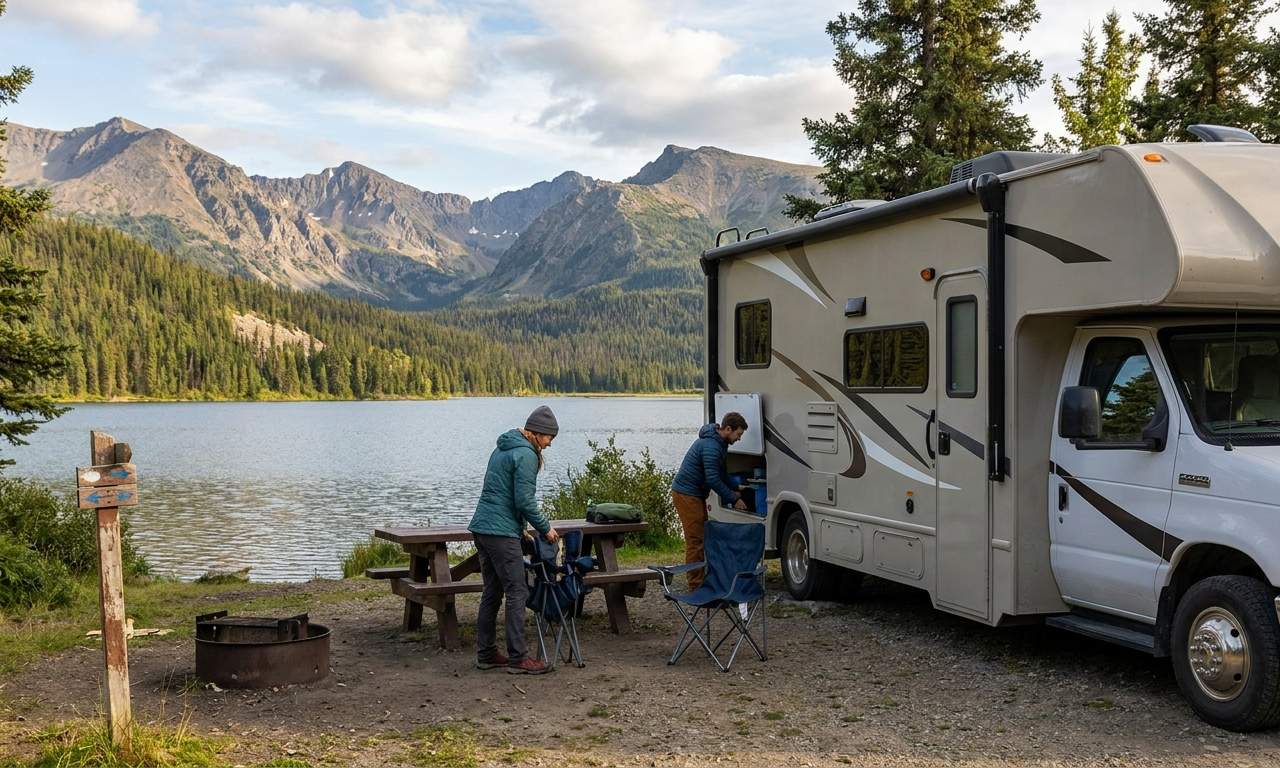
Yes, you can absolutely drive a rented RV in North Canada, with standard driver's license requirements applying to most rental units. Drivers holding a valid standard (Class 5 or G equivalent) license from their home province or country can typically operate motorhomes and campervans weighing under 11,000 kg (24,250 lbs), which covers the vast majority of our rental fleet.
Rental companies generally require a minimum age of 21 years to rent an RV in North Canada, regardless of provincial driving age laws. There are no young driver surcharges and no vehicle class restrictions based on age with Bandana. For international visitors, a valid driver's license from your home country is essential. An International Driving Permit (IDP) is highly recommended for licenses not issued in English or French, though it is not strictly mandatory in all cases. No special commercial driver's license (CDL) or additional permits are needed for any standard rental motorhome.
Road Conditions & Terrain in North Canada
Road conditions in North Canada present a unique and adventurous challenge, varying significantly from well-maintained paved sections, such as parts of the Alaska Highway, to extensive stretches of gravel and even seasonal ice roads. Travelers should expect diverse terrain, including imposing mountainous passes, vast boreal forests, and expansive tundra landscapes, often with considerable distances between services. The region's permafrost can lead to challenging driving conditions, including frost heaves and uneven surfaces, necessitating reduced speeds and careful driving to ensure a smooth and safe journey for your rented RV.
Wildlife encounters are a common and exciting part of a North Canada RV trip, requiring constant vigilance; always encourage slow, scenic driving to appreciate the surroundings and ensure safety for both you and the local fauna. Extreme weather, including sudden temperature drops, heavy rain, and early snow, can occur even during the summer months, so preparedness is key. Always check local road conditions and weather forecasts before setting out, as Bandana RV is dedicated to helping you have a supportive and transparent experience from the start.
RV Size Limits, Bridges & Restricted Zones
North Canada generally offers fewer strict RV size limitations compared to more densely populated urban areas, making it accommodating for most rental motorhomes and campervans. While most major routes, including the Alaska Highway and the partially gravel Dempster Highway, can easily accommodate standard rental RVs, it is always wise to be mindful of local signage. Height and weight restrictions can apply to specific bridges, tunnels, and ferry services, such as those crossing the Yukon River. Always verify these limits in advance if they are part of your planned itinerary. Environmental zones are rarely an issue in North Canada, however, access to some protected areas or Indigenous lands may require specific permits or adhere to vehicle type restrictions, so research your route carefully.
We believe that with careful driving and common sense, you can navigate almost anywhere without issues, regardless of your RV size. There's no need to stress about vehicle size limitations in North Canada; just use common sense and pay attention to posted signs. As true RV specialists, we understand that planning these details makes all the difference for your peace of mind.
Fuel: Diesel vs. Petrol & Cost per 100 km
Both diesel and petrol (gasoline) are available in North Canada, but fuel stations can be exceptionally sparse, often with hundreds of kilometers between services. For this reason, planning your fuel stops is critically important, especially when navigating routes like the Alaska Highway or the remote Dempster Highway. Bandana's global fleet averages indicate that a Class SI - Semi-integrated RV typically consumes 10-11 Liters/100 km (petrol or diesel), while Class C - Alcove motorhomes average 10-12 Liters/100 km. More compact Class B - Camper Vans, such as the `V2L` with a 2 L engine, offer superior fuel economy, typically averaging 8-10 Liters/100 km, making them an efficient choice for longer distances.
Be prepared for fuel costs in remote northern regions to be significantly higher than in southern Canada due to complex transportation logistics; budgeting accordingly is essential. Carrying extra fuel in approved containers is highly recommended for extended stretches without services. When planning your trip and considering all ancillary costs like fuel, propane, and campground fees, remember that RV PLANET routes allow travelers to itemize and track every expense for easy budgeting, ensuring full transparency with no hidden surprises. We're with you before and after your booking to help you coordinate all these important details. On the routes offered through RV PLANET routes, you can itemize and track every expense along the way for easy budgeting.
Tolls, Vignettes & Border Rules
North Canada is wonderfully free of toll roads or vignette systems, meaning you won't encounter unexpected fees for simply driving on its vast network of highways. This focus on accessibility, rather than direct user charges, makes budgeting for your rented RV trip more straightforward. However, if your adventure includes crossing international borders, such as into Alaska, ensuring all international border crossing documentation is in order for both vehicle and occupants (passports, rental agreement, and valid proof of insurance) is crucial.
There are no specific toll passes commonly required for RVs within the northern territories (Yukon, Northwest Territories, Nunavut). While some Bandana partner suppliers might offer pre-purchased toll passes for other regions, these are largely irrelevant for North Canada's toll-free roads. Always check current regulations for any specific region or park you plan to visit, as rules can change, but generally, RV travel in the Canadian North is free of unexpected road tolls.
Driving Tips for weekend rv rental Travelers
When embarking on an RV adventure in North Canada, planning for remoteness is paramount. Always carry extra water, food, emergency supplies, a well-stocked first-aid kit, and essential vehicle spare parts due to the vast distances between services. Cellular service and internet connectivity are virtually non-existent outside of major towns like Whitehorse or Yellowknife, so plan to disconnect or invest in a satellite communication device for emergencies.
Wildlife preparedness is another key tip; drive defensively and be aware of large animals like moose, caribou, and bears that frequent roadways. Embrace slower speeds and allow ample time for travel between destinations, aiming for an average of no more than 100-150 km per day. This slow travel approach allows you to make frequent stops to rest and truly immerse yourself in the unique northern landscapes and local cultures. Finally, always be mindful and respectful of Indigenous communities and their lands, particularly when stopping or seeking camping spots.
Recommended RV Class for North Canada Roads
For navigating the diverse roads of North Canada, a Class SI - Semi-integrated motorhome or a Class B - Camper Van is often highly recommended, offering an excellent balance of comfort and maneuverability. Class SI - Semi-integrated RVs, such as the `F2` with a length of 6.5 meters and a 12-14 Liters/100 km fuel consumption, provide ample indoor space for 3-4 adults while remaining manageable on varied road conditions.
Alternatively, a Class B - Camper Van, like the compact `V2L` at 5.99 meters in length, offers superior maneuverability and better fuel economy (typically 8-10 Liters/100 km), making it ideal for navigating gravel roads and more remote areas for shorter getaways. While larger Class C and Class A RVs, such as the `24 Class C Motorhome` (7.46 meters long, 25-35 Liters/100 km fuel consumption), are certainly feasible, their increased length and fuel consumption might be less practical for the more adventurous forays into truly remote northern regions. Bandana offers a wide range of these vehicle types through its direct partnerships with 50+ leading RV suppliers worldwide, including trusted names like El Monte and Cruise America.
Should I Choose a Compact Van Instead of a Large RV in North Canada?
While there is generally no issue driving any RV size in North Canada, a compact campervan (Class B) often offers significant advantages for exploring this unique region, especially for shorter trips. Compact vans provide superior fuel efficiency, typically consuming 8-10 Liters/100 km for Bandana's fleet, which is crucial given the region's high fuel prices and sparse stations. Their smaller footprint makes them notably easier to navigate on narrower gravel roads, within smaller communities, and when seeking informal parking or boondocking spots.
Larger motorhomes (Class C or Class A) certainly offer more indoor comfort and space, which can be a welcome luxury for longer trips or if adverse weather necessitates extended time indoors. For example, a 6-berth motorhome provides ample room for a family of 2+2. However, for those seeking true off-the-beaten-path exploration during a quick getaway, a compact van genuinely helps maximize flexibility and access. Ultimately, your choice depends on your comfort preferences and how extensively you plan to venture off main highways. We at Bandana provide full transparency on all vehicle features and sizes, ensuring no surprises with your chosen rental RV.
Can I Park Anywhere? Free & Wild Camping Rules in North Canada
Free and wild camping, often referred to as boondocking or dispersed camping, is generally more common and widely accepted in the vast, remote areas of North Canada than in more populated southern provinces, offering incredible opportunities for solitude and immersion in nature. Crown Land (public land) in the Yukon and Northwest Territories often permits free camping, provided you are not on private property, Indigenous land without explicit permission, or within established protected areas with specific regulations.
Always follow Leave No Trace principles strictly, packing out all trash, using designated fire pits if available, and respecting wildlife and natural habitats. Camping on Indigenous lands without explicit permission is prohibited and disrespectful; research land designations along your route to ensure you're compliant and respectful of local customs. Rules vary by region, so checking local territorial park rules and following local law before parking overnight is essential, especially near communities or designated recreational areas. For finding campsites and campgrounds during your trip, we recommend using RV PLANET (rvplan.net) - a great resource for locating available spots along your route.
Can I Drive an RV Into the City Center? Heights, Tunnels & Local Signage
Yes, you can almost always drive a rented RV into the city centers of North Canada's towns, such as Whitehorse or Yellowknife, without significant issues. These northern communities are generally RV-friendly and do not possess the tight restrictions or complex environmental zones found in larger metropolises further south. Drive slowly and carefully, and you can navigate almost anywhere without issues. No need to stress - just use common sense and pay attention to local signage.
While low bridges and tunnels are rare on main routes within northern city centers, it's always prudent to verify your specific route for any unexpected height clearances, especially when planning to use parking garages (though most RVs won't fit anyway). Parking for larger RVs can sometimes be a bit more challenging during peak tourist season in the very core of Whitehorse or Yellowknife, so consider utilizing larger parking lots on the periphery or designated RV parking areas. As true RV specialists, we ensure you're equipped with the right information for a smooth journey, offering 24/7 support for pre-booking inquiries and coordination.
What is the 3 3 3 rule for RV travel?
The 3-3-3 rule for RV travel is a widely adopted guideline designed to encourage safe and enjoyable trips, recommending that you drive no more than 300 miles (approximately 500 km) per day, arrive at your destination by 3 PM, and stay for a minimum of 3 nights. This rule promotes a relaxed travel pace, significantly reducing driver fatigue, which is particularly beneficial in the remote and often challenging driving conditions of North Canada.
While the "300 miles" aspect of the rule might be adjusted downwards for North Canada due to gravel roads, lower speed limits, and frequent wildlife sightings, the core principle of slow travel remains invaluable. Arriving by 3 PM provides ample daylight for campsite setup, exploration, and relaxation, a crucial advantage in unfamiliar northern environments, especially during shoulder-season daylight hours. Although staying 3 nights is ideal for a more immersive experience, even a shorter 2-night stay offers more depth than constantly moving. We at Bandana encourage slow travel, averaging max 100-150 km per day, to truly connect with the culture, food, and scenery of North Canada, as highlighted in our RV Travel Guide to North Canada - Tips and Top Spots 2026.
What do you need to enter Canada with a RV?
To enter Canada with a rented RV, you will primarily need a valid passport for all occupants, the RV's registration and proof of insurance, and your official rental agreement. For U.S. citizens and permanent residents, a valid passport is typically sufficient for land entry. Visitors from other countries may require a visa or an Electronic Travel Authorization (eTA) if arriving by air, but an eTA is generally not required for driving across the border from the U.S.
Be prepared to declare all goods, including any food items, alcohol, tobacco, and particularly firearms, as Canada has strict regulations on agricultural products and firearms. Customs officials may ask about your itinerary and duration of stay, so having your RV Rental North Canada - Complete Guide 2026 or other travel plans readily available can smooth the process. Ensure your rental vehicle meets Canadian safety standards. As true RV specialists, we ensure full transparency in all documentation, so you'll have no hidden fees or surprises at the border.
Do you need a different license to drive an RV in Canada?
No, you generally do not need a different license to drive most rental motorhomes or campervans in Canada, including the remote regions of North Canada. If your existing driver's license is valid for operating standard passenger vehicles in your home jurisdiction, it is typically sufficient. A standard Class 5 license (or its equivalent in other provinces, such as a G license in Ontario) allows you to operate most recreational vehicles up to 11,000 kg (24,250 lbs) in Canada.
This weight threshold encompasses the vast majority of commonly rented Class B, Class C, and even many Class SI RVs in North Canada, such as the `MH-B` motorhome which typically seats 6. Only for exceptionally large or heavy RVs exceeding this specific weight or requiring air brakes might a specialized license be necessary, which is extremely rare for standard rental units. For international drivers, an International Driving Permit (IDP) is highly recommended in conjunction with your home country's license if it is not in English or French, making border crossings smoother. For more detailed information, consult our RV Rental USA - Complete Guide 2026 for broader context.
Do RVs get searched at the Canadian border?
Yes, RVs can and do get searched at the Canadian border, similar to any other vehicle, as customs officials possess the authority to inspect all vehicles and their contents. Searches are generally conducted based on various factors, including declarations, perceived risk, or random selection, rather than being a guaranteed occurrence for every RV crossing the border into North Canada.
To minimize delays and potential issues, ensure all occupants have proper identification, declare all items truthfully, and keep your travel documents, including the rental agreement, easily accessible. Officials are particularly vigilant for undeclared alcohol, tobacco, firearms, cannabis, and restricted food items (such as fresh fruits, vegetables, and certain meat products without proper packaging or origin). Having a clear understanding of what you are carrying and being transparent with officials will make your border experience smooth and hassle-free, upholding our commitment to no surprises.
Can Americans RV in Canada?
Yes, Americans can absolutely RV in Canada, including the remote and beautiful regions of North Canada, provided they meet standard entry requirements for international visitors. U.S. citizens need a valid passport to enter Canada by land, and the rented RV itself must have current registration and proof of insurance that is valid within Canada. There are no specific restrictions preventing Americans from bringing their own RV or a rented RV into Canada for temporary visits.
However, it is crucial to be aware of different regulations for firearms, cannabis, and certain agricultural products, which are often much stricter in Canada than in some U.S. states. For example, cannabis is legal in Canada but illegal to transport across international borders. North Canada offers incredibly popular RV routes for Americans, notably the iconic Alaska Highway, which winds through the Yukon Territory, promising an unforgettable journey. Bandana RV supports thousands of travelers from the USA every year to discover North Canada and more. We handle the details, you live the journey – personal service from day one until your booking is confirmed.
Where can I park my RV for free in Canada?
You can find opportunities for free RV parking in Canada primarily on vast expanses of Crown Land (public land), in designated rest stops, and occasionally in the parking lots of large retailers or casinos with prior permission, though specific rules vary significantly by region. In North Canada, particularly across the Yukon and Northwest Territories, extensive Crown Land offers numerous opportunities for dispersed or "wild" camping, allowing you to park your rented RV for free in remote, incredibly scenic locations.
However, always verify local regulations, respect private property boundaries, and never camp on Indigenous lands without explicit permission. For more detailed guidance on regulations and ethical practices for free and wild camping in remote northern regions, refer to the "Can I Park Anywhere? Free & Wild Camping Rules in North Canada" section above. Always adhere to Leave No Trace principles, pack out all waste, and be prepared for self-sufficiency when boondocking in remote areas. For finding developed campsites and planning your itinerary, remember to check out RV PLANET (rvplan.net) - a fantastic resource.
Can you walk around in a motorhome while driving in Canada?
No, passengers are generally prohibited from walking around in a motorhome while it is in motion in Canada; all occupants must be seated and wear a seatbelt. Canadian traffic laws, including those enforced throughout the northern territories like the Yukon and Northwest Territories, strictly mandate that anyone traveling in a motorhome must occupy a designated seating position and be properly restrained with an approved seatbelt while the vehicle is being driven.
This rule is in place for paramount safety; an unsecured person could face serious injury or cause injury to others in the unfortunate event of a sudden stop or collision, a risk heightened by North Canada's sometimes rugged road conditions. While it may be tempting to use the facilities or prepare meals in your rented RV's kitchen (where you can find RV-friendly recipes playlist), it is both illegal and unsafe to do so while the RV is in motion. Plan for breaks at designated rest areas or safe pull-offs to allow passengers to move around, use facilities, or access amenities within the RV safely. This ensures everyone arrives at your incredible North Canada destination ready to explore.
What You Shouldn't Miss
- **The Alaska Highway Drive:** Experience a legendary road trip, starting from Dawson Creek, BC, and winding through the Yukon. Consider driving a rented `29′ Class C Motorhome` (averaging 7.5 meters) for comfort on this iconic route.
- **Dempster Highway Adventure:** Take on Canada's only road crossing the Arctic Circle, a true wilderness route. A compact campervan like the `Combi Van` (5 meters long, 9-12 Liters/100 km fuel consumption) is perfect for this challenging 736 km journey.
- **Kluane National Park and Reserve Exploration:** Discover Canada's highest peaks and immense icefields. RV-friendly campgrounds offer access to world-class hiking and wildlife viewing.
- **Whitehorse, Yukon:** Explore this vibrant northern capital, known for its friendly atmosphere and the iconic SS Klondike sternwheeler. Ample RV parking is available on the city's periphery.
- **Northern Lights Viewing:** Plan your trip for late August to April for the best chance to witness the spectacular Aurora Borealis, a truly magical experience from your rented motorhome.
Looking for expert insights from Avi Bandana? Top 5 Adventures – recommendations from Avi Bandana
Final Thoughts
Embarking on a rented RV journey through North Canada is an experience like no other, offering unmatched wilderness and a profound sense of adventure. It's a trip that rewards preparation and a spirit of discovery. From understanding the unique road conditions caused by permafrost to planning your fuel and camping spots carefully, every detail contributes to an incredible journey. With Bandana, you have a partner committed to full transparency and support, ensuring your focus remains on the breathtaking scenery and unforgettable moments.
Whether you're dreaming of experiencing the midnight sun or spotting majestic wildlife, a rented motorhome or campervan provides the perfect base for your North Canada exploration. We're here to make the process as easy and stress-free as possible, providing you with the best deals and expert advice. So, why wait? Get inspired for your next trip! Discover top destinations, planning tips, all in one place!
Find your ideal rented motorhome or campervan and begin crafting your North Canadian adventure today. Compare Motorhome Prices for North Canada now and start planning a trip itinerary in advance with minimal effort and maximum enjoyment. Your open-road adventure awaits!