
In This Guide
- The 4 RV Families Compared for Norway, Sweden, Denmark, Germany, Scandinavia
- Class A (Integrated) - Best For
- Price Comparison by RV Class in Norway, Sweden, Denmark, Germany, Scandinavia
- Class SI (Semi-Integrated) - Best For
- Class C (Alcove) - Best For
- Class B (Campervan) - Best For
- Side-by-Side Comparison Table
- Our Recommendation for rv rental Travelers in Norway, Sweden, Denmark, Germany, Scandinavia
- Another important point regarding motorhome length
- What You Shouldn't Miss
- Why Book with Bandana Caravan
- Final Thoughts
- Frequently Asked Questions
The 4 RV Families Compared for Norway, Sweden, Denmark, Germany, Scandinavia
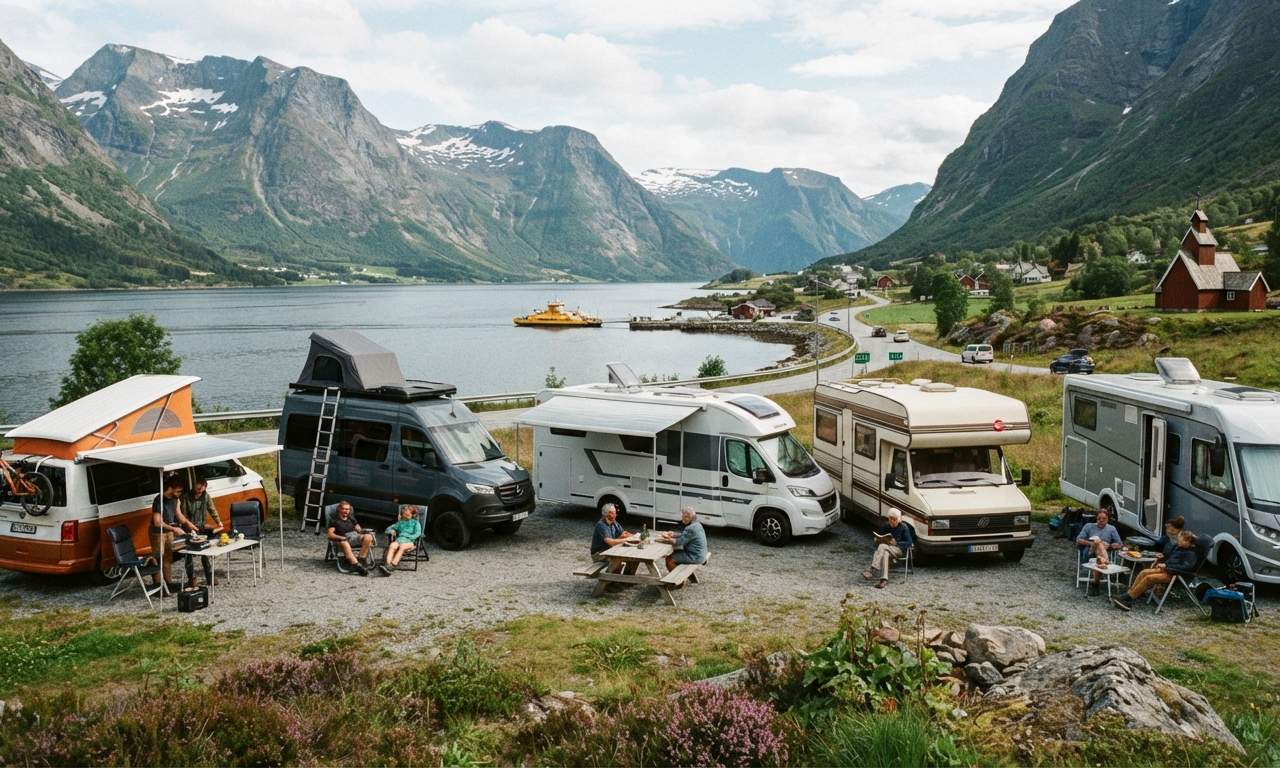
Choosing the right RV family is crucial for a successful trip through Norway, Sweden, Denmark, and Germany, as diverse terrains, varying climates, and road conditions across Scandinavia impact maneuverability, comfort, and fuel efficiency. A common consideration when exploring these regions is the potential ferry cost savings offered by campervans under 6 meters in length, particularly in Norway. While these savings are a valid point, depending on your itinerary and the number of crossings, it is essential to balance them against the daily living space and comfort a larger rental motorhome provides. Imagine yourself cruising through the scenic coastal roads of Norway or the picturesque landscapes of Sweden, and ask what kind of mobile home will make your journey truly inspiring. Consider factors like trip length, group size, desired level of comfort, and planned activities-from navigating narrow fjord roads to cruising German autobahns-to select an RV that best fits your adventure. Drive slowly and carefully, and you can drive almost anywhere without issues. No need to stress - just use common sense and pay attention.
Class A (Integrated) - Best For
Class A integrated motorhomes are best suited for travelers seeking maximum comfort and luxury during their RV rental journey across Norway, Sweden, Denmark, and Germany, particularly for larger groups or longer trips. Bandana's fleet typically features Class A motorhomes with an average length of 7.5 meters, accommodating around 4.4 sleeping places (4 adults), and offering a substantial load capacity of approximately 209.5 kg. These vehicles provide expansive living spaces, comprehensive amenities, and panoramic views, ideal for touring major routes and comfortable stays in designated campgrounds. Their size might require extra caution on Norway's narrower fjord roads or older European city streets, but confident drivers will find them manageable; just drive slowly and carefully. A representative model, similar to the "rent rv example E3," would offer luxurious living with spacious interiors, perfect for families or groups who prioritize comfort on their extended road trip. You can easily prepare delicious meals on board, exploring local ingredients and cuisines from your mobile kitchen, and for more culinary inspiration, check out our RV-friendly recipes playlist.
Class SI (Semi-Integrated) - Best For
Class SI semi-integrated motorhomes are ideal for RV rental travelers in Norway, Sweden, Denmark, and Germany who desire a balanced blend of comfort, space, and maneuverability, making them a versatile choice for couples or small families. Bandana's fleet typically shows Class SI models averaging 6.9 meters in length, offering about 3.8 sleeping places (3.4 adults), and a load capacity of approximately 72.2 kg. These models often outperform Class A in ease of driving on varied European roads, including scenic routes and city outskirts, and generally offer better fuel economy than Class C, typically consuming 10-11 liters per 100 km. Their compact design compared to integrated models provides a more nimble experience while still delivering essential home comforts, such as a comfortable dining area and a functional kitchen. The "Luxury Small" model, for example, combines these benefits, making it an excellent option for those seeking a practical yet comfortable rental motorhome for their week-long or extended road trip through the beautiful Nordic and German landscapes.
Class C (Alcove) - Best For
Class C alcove motorhomes are a prime choice for families embarking on an RV rental adventure in Norway, Sweden, Denmark, or Germany, thanks to their dedicated over-cab sleeping area that maximizes space and privacy. Bandana's fleet typically features Class C vehicles with an average length of 7.5 meters, providing a generous 5.8 sleeping places (4.4 adults), and a load capacity of approximately 42.4 kg. These RVs combine ample sleeping capacity with robust amenities, making them cost-efficient for family trips without sacrificing comfort, even during unexpected rainy days indoors. Their design is well-suited for varied European road conditions, offering a good balance between size and manageability, with typical fuel consumption around 10-12 liters per 100 km. Models such as the "Euro Deluxe" or "MHC24" exemplify this class, offering multiple beds, a fully equipped kitchen, and a comfortable living area ideal for a family of 2+2 or a group of friends. They provide a mobile headquarters to venture out to national parks and charming towns, ensuring everyone has space to relax.
Class B (Campervan) - Best For
Class B campervans are perfectly suited for solo travelers or couples seeking maximum maneuverability, fuel economy, and flexibility for their RV rental exploration of Norway, Sweden, Denmark, and Germany. Bandana's fleet typically has Class B campervans averaging 5.8 meters in length, providing about 3.2 sleeping places (2.7 adults), and a load capacity of approximately 37 kg. These compact vehicles excel in scenarios requiring navigation through narrow city streets, parking in tight spaces, and accessing more remote areas of Scandinavia. Their efficient size means lower fuel consumption, typically 8-10 liters per 100 km, making them a cost-effective and agile option for adventurous journeys.
A common recommendation found online for trips to Scandinavia is to choose a campervan under 6 meters in length, based on the idea that this allows for significant savings on ferry costs.
There is a valid basis for this. In Norway—and on some other Scandinavian ferry routes—there is a significant price threshold around the 6-meter mark. In certain cases, a campervan measuring up to 6 meters pays a significantly lower fare than one measuring 6.01 meters or longer.
However, it is important to understand that these savings are not guaranteed; they depend heavily on the itinerary, the number of ferry crossings, the timing of the trip, and the specific fares for each crossing.
The Season Matters, Too
Some ferry routes have higher summer rates.
In 2026, for example, special summer rates in Norway apply in certain regions as early as May 1st, in others starting June 1st, and in Troms only from June 20th. These summer rates end on August 31st.
Therefore:
- May: Not necessarily a cheap time to travel across all of Norway. In some regions, such as Møre og Romsdal and Nordland, summer rates are already in effect.
- July and August: Typically the period when the price difference between a campervan up to 6 meters long and a larger vehicle is most significant.
- Late September: Summer rates no longer apply in most regions, so the seasonal price difference is smaller.
So, just how large can the difference be?
The following table is intended to illustrate the general scale only.
It assumes an itinerary involving an average of one paid ferry crossing every two days—meaning approximately 5 crossings for a 10-day trip, 8 crossings for a 15-day trip, and 11 crossings for a 21-day trip.
The calculation is based on typical price differences found in 2026 rates for Norway: roughly 150–205 NOK per crossing during the standard season, compared to approximately 220–265 NOK per crossing at the summer rate, for a vehicle over 6 meters versus one up to 6 meters. For example, on the Flakk–Rørvik route, the difference is 205 NOK at the standard rate and 265 NOK at the summer rate; on the Brekstad–Valset route, the difference is 151 NOK and 220 NOK, respectively.
| Trip Duration | May* | July / August | Late September* |
|---|---|---|---|
| 10 days | Approx. 750–1,025 NOK | Approx. 1,100–1,325 NOK | Approx. 750–1,025 NOK |
| 15 days | Approx. 1,200–1,640 NOK | Approx. 1,760–2,120 NOK | Approx. 1,200–1,640 NOK |
| 21 days | Approx. 1,650–2,255 NOK | Approx. 2,420–2,915 NOK | Approx. 1,650–2,255 NOK |
* May and late September are shown here at the standard rate for illustrative purposes. In reality, there are areas in Norway where the summer rate already applies in May, so the price difference could be greater.
Roughly speaking, this amounts to a difference of a few tens to a few hundred euros over the course of an entire trip, rather than thousands of euros.
It is also important to remember that AutoPASS discounts may apply in some cases. For example, an "AutoPASS for ferry" agreement can provide a 50% discount for private customers and a 40% discount for business customers on applicable ferry fares. Consequently, the actual amount paid by the customer may be lower than the prices shown here.
Additionally, not all ferries in Norway charge a fee, and some ferries that were previously free may now be subject to a special summer rate. But the truly important question is different.
If a small campervan suits your needs, that’s great.
A small campervan can be easier to drive, maneuver, and park; plus, it might save you money on ferry crossings.
However, if you are torn between a small, cramped campervan and a larger, more comfortable one, you shouldn't base your decision solely on ferry costs.
Consider the bigger picture:
- Ferry savings represent a one-time expense—or a few expenses—over the course of the trip.
- In contrast, the living space inside the campervan is part of your daily experience, throughout the entire day.
For a two- or three-week trip—especially with a family—it is worth asking yourself:
- Do you want to save a few hundred euros on ferries, or is the extra space in the campervan worth the additional cost?
- Is the small campervan comfortable enough for sitting, sleeping, cooking, and storage?
- And what happens on a rainy day when the whole family is stuck inside the vehicle?
There is no single answer that fits everyone.
For those who find a small campervan comfortable and spacious enough, it can be an excellent choice, offering advantages that go beyond just saving money on ferries. However, if you feel that a larger motorhome would be significantly more comfortable for you, it is worth considering the additional ferry costs as part of the trip's total expense, rather than as a "loss" resulting from choosing a larger vehicle.
Look at the trip as a whole, not just the ferry price.
Let’s assume, for the sake of example, that the larger motorhome will cost you an extra €200–€300 in ferry fees over the course of the trip.
The question isn't just:
"How can I save that €200–€300?"
But rather:
"Am I willing to spend an extra €200–€300 to enjoy more space over the course of 15 or 21 days?"
That is a completely different calculation.
The extra cost might be a few hundred euros, but the return is greater living space, comfort, storage, larger beds, the ability to move around inside the vehicle, and better comfort when the weather keeps you indoors.
On the other hand, if you are comfortable in a compact motorhome, you might actually prefer the smaller vehicle. In that case, you get a vehicle that is easier to drive and park, plus potential savings on ferry costs.
Therefore, there is no single "right" motorhome; there is simply the motorhome that suits *you*.
Side-by-Side Comparison Table
This table provides a quick overview of key specifications and ideal use cases for each RV class available for rental across Norway, Sweden, Denmark, and Germany, helping you compare options at a glance. Remember, a standard car driver's license is sufficient for all these motorhome classes, and the minimum rental age is 21 with no young driver surcharges.
| Family | Avg Length (m) | Sleeps | Fuel Use (L/100 km) | Best Use Case in Norway, Sweden, Denmark, Germany, Scandinavia |
|---|---|---|---|---|
| Class A - Integrated | 7.5 | 4.4 | 8-12 | Luxury touring, large groups, long trips, comfortable main road travel |
| Class SI - Semi-integrated | 6.9 | 3.8 | 10-11 | Couples/small families, balanced comfort and maneuverability, scenic routes |
| Class C - Alcove | 7.5 | 5.8 | 10-12 | Families with children, ample sleeping, good amenities, budget-conscious travel |
| Class B - Camper Van | 5.8 | 3.2 | 8-10 | Solo/couples, nimble city/remote driving, fuel-efficient, maximum flexibility |
Another important point regarding motorhome length
When renting a motorhome, you generally book a vehicle category rather than a specific length.
Therefore, even if a particular category typically includes motorhomes that are under 6 meters, it's advisable to confirm the exact length with your rental provider if ferry costs are a critical factor.
What You Shouldn't Miss
- **Cruise Geirangerfjord in Norway:** Take a ferry through this UNESCO World Heritage site, marveling at the towering cliffs and waterfalls. Remember to check ferry schedules and pricing, as even a small RV will find the journey breathtaking.
- **Explore Stockholm's Gamla Stan, Sweden:** Park your motorhome on the outskirts and take public transport to wander the cobblestone streets of the old town, discovering vibrant markets and historic sites.
- **Visit Legoland in Billund, Denmark:** A perfect stop for families with kids, easily accessible with a rented RV and offering plenty of family-friendly campgrounds nearby.
- **Drive the Romantic Road in Bavaria, Germany:** This 400 km route takes you through charming medieval towns like Rothenburg ob der Tauber, ideal for slow travel and soaking in the culture.
- **Experience the Midnight Sun or Northern Lights:** Head north into the Arctic regions of Norway or Sweden during summer for endless daylight, or in winter for a chance to witness the spectacular Aurora Borealis.
- **Hike in Jotunheimen National Park, Norway:** Offers some of the country's most stunning mountain trails and opportunities for adventure, with RV-friendly parking available at park entrances.
Looking for expert insights from Avi Bandana? Top 5 Adventures - recommendations from Avi Bandana
🎬 Video coming soon
Final Thoughts
Embarking on an RV rental journey through Norway, Sweden, Denmark, and Germany is an experience filled with breathtaking landscapes, rich history, and the freedom to explore at your own pace. While the allure of ferry savings with a smaller campervan might be tempting, remember to prioritize your comfort and travel needs throughout your entire trip. The difference of a few hundred euros on ferries might seem significant, but the daily enjoyment of ample living space, a comfortable bed, and a functional kitchen can truly elevate your adventure.
At Bandana RV, we're dedicated to helping you find the perfect rental motorhome, ensuring full transparency and support from your initial search to your confirmed booking. Our expertise as true RV specialists means we understand the nuances of international travel and are here to guide you every step of the way. Whether you choose a nimble campervan or a spacious Class C motorhome, we encourage you to embrace slow travel, savoring each moment as you connect with the diverse cultures and stunning scenery of Norway, Sweden, Denmark, and Germany.
Ready to discover your ideal mobile home for an unforgettable European road trip? Get inspired for your next trip and compare options today!
Find Motorhome Rentals in Norway, Sweden, Denmark, Germany, Scandinavia