
In This Guide
- The 5 RV Families Compared for China
- Class A (Integrated) — Best For
- Class SI (Semi-Integrated) — Best For
- Class C (Alcove) — Best For
- Class B (Campervan) — Best For
- Class TC (Truck Camper) — Best For
- Side-by-Side Comparison Table
- Our Recommendation for long term rv rental Travelers in China
- How much does it cost to rent an RV for a month in China?
- Is it hard to drive an RV in China?
- How do I find RV parks in China?
- What is the best time to RV in China?
- How do you navigate language and cultural differences while RVing in China?
- What are the internet and connectivity options for RV travelers in China?
- What happens if my RV breaks down in China?
- How can RV travelers ensure safety and security in China?
- Can you take an RV on the Great Wall of China?
The 5 RV Families Compared for China
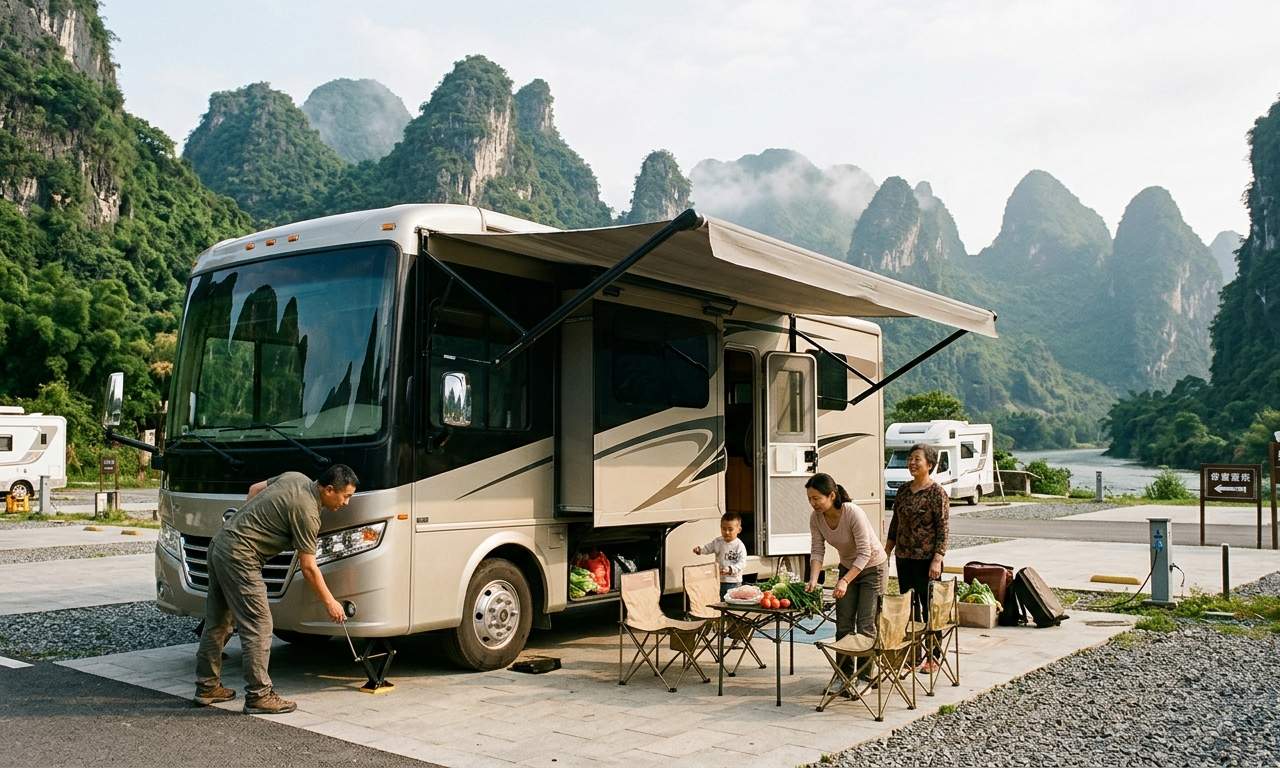
Choosing the right RV family is paramount for a successful and enjoyable long-term trip in China, a country offering diverse terrain and infrastructure. Your selection significantly impacts comfort, sleeping capacity, load capacity, and fuel efficiency, all critical factors for extended travel and varying group sizes. Understanding the distinct characteristics of each RV class is crucial to optimizing your travel experience across China's unique landscapes and bustling cities. From the expansive Class A to the agile Class B, each type presents a unique set of advantages for exploring this vast and varied country.
Consider that Bandana's fleet data indicates average dimensions and capacities across different suppliers and models, providing a helpful baseline for comparison. For instance, Class A integrated motorhomes typically average 7.5 meters in length and can sleep around 4.4 people, while more compact Class B campervans average a mere 5.8 meters, sleeping about 3.2. These figures highlight the significant differences in living space and maneuverability you can expect.
Class A (Integrated) — Best For
Class A integrated motorhomes offer the most luxurious and spacious experience, making them ideal for extended trips or larger groups seeking maximum comfort. Bandana's fleet data suggests these typically average 7.5 meters in length, sleep around 4.4 people, accommodate approximately 4 adults, and provide a substantial load capacity of about 209.5 kg. While providing unparalleled amenities for long-term travel, Class A RVs can present challenges in navigating narrower Chinese roads or finding suitable parking in crowded urban centers. Their common fuel consumption ranges from 8-12 Liters/100 km, which is a factor to consider for extended journeys across China.
Despite potential navigation difficulties, the sheer comfort and extensive facilities of a Class A RV make it a compelling choice for those prioritizing a home-like experience on the road. Imagine relaxing in a spacious living area after a day of exploring ancient cities or breathtaking natural landscapes. For travelers who envision their long-term China adventure as a fully equipped, mobile living space, the Class A is an excellent, albeit larger, option.
Class SI (Semi-Integrated) — Best For
Class SI semi-integrated motorhomes strike an optimal balance between space and maneuverability, making them an excellent choice for couples or small families embarking on long-term RV adventures in China. Bandana's fleet data indicates these models typically average 6.9 meters in length, sleep approximately 3.8 people, accommodate about 3.4 adults, and have a common fuel consumption around 10-11 Liters/100 km. These RVs perform exceptionally well, offering superior ease of navigation compared to larger Class A models, while providing more living comfort than the smaller Class B campervans.
Their versatility makes them well-suited for diverse Chinese road conditions, from modern expressways to more winding routes through mountainous regions. You can expect ample amenities for extended stays, ensuring a comfortable journey without the significant parking challenges that larger RVs might encounter. For a balanced approach to exploring China's vastness with a comfortable living space, the Class SI is a highly recommended option.
Class C (Alcove) — Best For
Class C alcove motorhomes are exceptionally well-suited for families or larger groups traveling long-term in China, primarily due to their characteristic over-cab sleeping area that maximizes capacity. Bandana's fleet data shows these models typically average 7.5 meters in length, sleep about 5.8 people, accommodate roughly 4.4 adults, and consume fuel at a rate of 10-12 Liters/100 km. These RVs offer a robust blend of interior space and relative cost-efficiency for extended trips, proving capable on varied Chinese road conditions while providing comfortable accommodations for everyone.
The additional sleeping space in the alcove is a significant advantage for families or groups with children, offering dedicated sleeping spots that don't require converting the main living area. This layout enhances privacy and convenience, particularly during longer stays where the RV serves as a primary residence. For those seeking maximum sleeping capacity and a family-friendly living environment, the Class C is a standout choice.
Class B (Campervan) — Best For
Class B campervans are the ideal choice for solo travelers or couples seeking high maneuverability, fuel efficiency, and the flexibility to navigate both urban and rural landscapes in China. Bandana's data suggests these typically average a compact 5.8 meters in length, sleep around 3.2 people, accommodate approximately 2.7 adults, and are quite fuel-efficient, consuming around 8-10 Liters/100 km. Their smaller footprint makes them perfect for scenarios where larger RVs might struggle, offering an agile and economical option for exploring China's diverse regions during a long-term rental.
Imagine effortlessly gliding through bustling city streets or parking with ease in charming, off-the-beaten-path villages. The campervan's compact nature allows for spontaneous detours and access to areas that might be inaccessible to larger motorhomes. For travelers who value agility, ease of driving, and a more intimate connection with their surroundings, the Class B campervan is an exceptional selection.
Class TC (Truck Camper) — Best For
Class TC truck campers are uniquely positioned for the adventurous long-term RV traveler in China, offering unparalleled off-road capability and flexibility due to their detachable living unit. Bandana's fleet information indicates these typically average 5.5 meters in length, sleep around 2.4 people, accommodate approximately 2.1 adults, and can have variable fuel consumption depending on the truck base, often ranging from 12-17 Liters/100 km. This class is perfectly suited for exploring remote Chinese terrains and less accessible areas where traditional integrated RVs cannot venture, providing a rugged yet comfortable base for extended exploration.
The ability to detach the camper unit from the truck offers remarkable versatility. You can leave your living quarters at a campsite and use the truck for excursions into more challenging terrain, or vice-versa. This adaptability is invaluable for reaching remote natural wonders or exploring less developed regions of China, making the truck camper a robust companion for true adventurers.
Side-by-Side Comparison Table
This table offers a direct comparison of key specifications for each RV family, enabling travelers to quickly assess which model best aligns with their long-term rental needs in China. Reviewing average length, sleeping capacity, fuel consumption, and ideal use cases side-by-side helps clarify the trade-offs between comfort, maneuverability, and cost. Utilizing this comparison will guide your decision-making process, ensuring your chosen RV family is optimized for China's unique road conditions and your specific travel plans.
| RV Class | Average Length (m) | Average Sleeping Capacity | Average Adult Capacity | Average Fuel Consumption (L/100km) | Ideal Use Case |
|---|---|---|---|---|---|
| Class A (Integrated) | 7.5 | 4.4 | 4 | 8-12 | Maximum luxury and space for extended trips or larger groups. |
| Class SI (Semi-Integrated) | 6.9 | 3.8 | 3.4 | 10-11 | Balanced comfort and maneuverability, ideal for couples or small families. |
| Class C (Alcove) | 7.5 | 5.8 | 4.4 | 10-12 | High sleeping capacity for families or larger groups. |
| Class B (Campervan) | 5.8 | 3.2 | 2.7 | 8-10 | Agile and fuel-efficient for solo travelers or couples, ideal for urban and rural navigation. |
| Class TC (Truck Camper) | 5.5 | 2.4 | 2.1 | 12-17 | Off-road capability and flexibility for exploring remote terrains. |
Our Recommendation for long term rv rental Travelers in China
For most long-term RV travelers in China, a Class SI (Semi-integrated) motorhome is our primary recommendation. These vehicles offer an excellent balance of comfort, maneuverability, and amenities suitable for diverse routes across the country. You'll find they handle varying road conditions with ease while providing ample living space for extended journeys.
The Class C (Alcove) is a strong runner-up, particularly recommended for families or larger groups. It provides superior sleeping capacity and interior space, often at a more budget-friendly long-term rate compared to Class A models. If your priority is accommodating more people comfortably without breaking the bank, the Class C is an excellent choice.
For solo adventurers or couples who prioritize ultimate flexibility and easy access to urban areas or narrower roads, a Class B (Campervan) offers an agile and fuel-efficient alternative. Their compact size makes navigating China's cities and smaller towns a breeze.
How much does it cost to rent an RV for a month in China?
Monthly RV rental costs in China vary significantly by RV class, season, and specific rental provider. Typically, you can expect costs to range from approximately $2,000 for a Class C motorhome to upwards of $5,000 or more for a spacious Class A. These figures are estimates, and the final price is determined at the time of booking, reflecting real-time availability and demand.
Beyond the base rental fee, a comprehensive budget should include ancillary expenses. Fuel costs are a considerable factor, with a Class C motorhome consuming around 10-12 Liters/100 km. Other essential budget items include tolls, varying campground fees, potential visa costs, food, and sometimes mandatory local guide costs for accessing restricted regions. Remember that longer rental periods, such as monthly bookings, often present a more cost-effective daily rate compared to shorter durations. On the routes offered through RV PLANET routes, you can itemize and track every expense along the way for easy budgeting.
To get a precise estimate for your specific travel plans, it’s recommended to use comparison platforms that show final prices, including any mandatory fees or popular add-ons. Always account for variable expenses, optional insurance upgrades, and essential services like Wi-Fi hotspots to get a complete financial picture for your month-long adventure.
Is it hard to drive an RV in China?
Driving an RV in China presents unique challenges that necessitate thorough preparation and awareness, especially for international drivers. Road quality varies significantly, from modern expressways to less-maintained rural routes. Traffic often involves a dense mix of cars, scooters, bicycles, and heavy trucks, requiring heightened defensive driving skills and patience.
International drivers must familiarize themselves with Chinese traffic laws, which can differ from Western norms regarding right-of-way and horn usage. Parking can also be a challenge, particularly for larger RVs in urban areas, where designated spots might be scarce or require specific maneuvering. Driving slowly and carefully, using common sense, and paying attention to your surroundings will allow you to navigate most situations without issue. No need to stress – just drive with awareness.
To make your driving experience smoother, consider using local navigation apps like Baidu Maps or Gaode Maps, which are often more accurate and up-to-date with local road conditions and regulations than international alternatives.
How do I find RV parks in China?
Finding RV parks and suitable camping spots in China requires leveraging local digital tools, understanding the developing infrastructure, and sometimes utilizing informal options with local permission. China's RV camping infrastructure is growing rapidly but remains unevenly distributed, offering a mix of modern, well-equipped parks in tourist areas and more basic, less formalized options elsewhere.
Essential strategies include using popular Chinese navigation apps like Baidu Maps or Gaode Maps, which often list designated RV campsites. Researching specific areas in advance is also highly recommended. Be aware that 'wild camping' is generally discouraged or requires specific local permission, so always respect local customs and regulations. Many of these developed campsites offer amenities such as power hookups, water, and waste disposal facilities, enhancing the convenience of your trip.
For planning your route and locating suitable overnight stops, we recommend using RV PLANET (rvplan.net) — a great resource for finding available spots along your route.
What is the best time to RV in China?
The best time to RV in China largely depends on your chosen region and desired climate, with spring (April-May) and autumn (September-October) generally offering the most favorable weather conditions across much of the country.
These shoulder seasons allow you to avoid the extreme heat and humidity of summer, as well as the harsh cold and snow experienced in northern regions during winter. This provides comfortable temperatures for driving and outdoor activities. However, regional differences are significant. Southern China maintains milder winter temperatures, while western areas like the Tibetan Plateau have a very specific, limited window (typically June-September) due to altitude and the necessity of special permits. Careful route and seasonal planning are essential for a comfortable and compliant journey.
How do you navigate language and cultural differences while RVing in China?
Navigating language and cultural differences while RVing in China requires proactive preparation. This includes utilizing essential translation apps, learning basic Mandarin phrases, and cultivating an understanding of local customs to ensure smooth interactions.
For non-Mandarin speakers, indispensable tools include translation apps like Baidu Translate or Pleco, complemented by a phrasebook for common RV-related terms such as "fuel," "water," and "parking." English proficiency varies widely outside major tourist hubs, so having these resources readily available is crucial. Respecting cultural etiquette, such as proper waste disposal, maintaining reasonable noise levels in public and camping areas, and understanding social cues, is vital for harmonious local interactions and a positive overall travel experience.
What are the internet and connectivity options for RV travelers in China?
Reliable internet and connectivity for RV travelers in China are primarily achieved through securing local SIM cards or eSIMs for mobile data, alongside essential VPN services to access familiar international websites and applications.
Upon arrival, purchasing a local SIM card from providers like China Mobile, China Unicom, or China Telecom is crucial for consistent mobile data access in most populated areas. This enables navigation, communication, and information retrieval. A robust Virtual Private Network (VPN) is also necessary to bypass China's "Great Firewall" and access many Western apps and services like Google Maps, WhatsApp, Facebook, and Instagram. For navigation within China, local alternatives such as Baidu Maps or Gaode Maps are often preferred for their accuracy and up-to-date information.
What happens if my RV breaks down in China?
In the event of an RV breakdown in China, contacting your rental provider's emergency support is the primary and most critical step. They will guide you through local repair services or arrange roadside assistance.
Unlike in some Western countries, specialized RV repair services can be scarce outside major cities. You may need to rely on general auto mechanics or the rental company's specific network, which might involve language barriers and varying service standards. Always keep the rental company's emergency contact numbers readily accessible. Be prepared for potential delays in part availability or service, especially for less common RV models, and ensure you have basic emergency supplies and a charging bank for your phone.
How can RV travelers ensure safety and security in China?
Ensuring safety and security while RVing in China involves diligent road safety practices, protecting personal belongings, and familiarizing yourself with local emergency procedures and contacts.
Adhere strictly to local traffic laws and be prepared for varied and sometimes unpredictable driving conditions, especially at night or in remote areas. Always ensure your rented RV is securely locked when parked or unattended to deter theft. It's also advisable to secure any valuable items out of sight. For travelers exploring the region, consulting guides like "RV Rental China - Complete Guide 2026" can provide additional context on local driving norms.
Familiarize yourself with China's emergency numbers: 110 for police, 120 for ambulance, and 119 for fire. Keeping contact information for your local embassy or consulate readily available is also wise for any unforeseen legal or personal emergencies.
Can you take an RV on the Great Wall of China?
While you cannot drive an RV directly *on* the Great Wall of China due to preservation efforts and safety regulations, many popular sections feature nearby parking facilities capable of accommodating tourist vehicles, including RVs. This allows for convenient access to the Wall itself.
Designated parking areas are typically available at accessible Great Wall sections such as Badaling, Mutianyu, or Jinshanling. From these parking areas, you can access the Wall via shuttles, cable cars, or walking paths. It is crucial to plan your visit by researching specific sections' accessibility, parking logistics, and any local restrictions in advance to ensure a smooth experience and avoid attempting to drive where vehicles are prohibited.
For those interested in scenic routes and historical sites, consider exploring guides like "One-Way RV Driving in China - Route Planner 2026" to integrate such landmarks into your journey.
What You Shouldn't Miss
- Drive the G219 Highway: Embark on a section of this legendary road, especially through the Tibetan Plateau (June-September), for unparalleled high-altitude scenery and cultural immersion. Special permits are often required for foreigners, so plan ahead.
- Explore Ancient Cities by RV: Park your rented RV in designated areas near Xi'an to visit the Terracotta Army or near Pingyao for a step back into China's imperial past. The convenience of having your accommodation nearby is invaluable.
- Navigate the Yangtze River Delta: While not directly navigable by RV, you can drive through the picturesque countryside surrounding Shanghai and Hangzhou, experiencing the blend of modernity and ancient waterways.
- Discover the Silk Road Heritage: Drive sections of the ancient Silk Road in the west, perhaps visiting Dunhuang's Mogao Caves or the oasis city of Kashgar, experiencing the rich history and diverse cultures that shaped this route.
- Scenic Routes in Yunnan: Explore the landscapes featured in the "Tea Horse Road" itineraries, encountering ethnic minority cultures, terraced rice fields, and stunning natural beauty.
- Experience China's Modern RV Culture: Visit one of the emerging "RV Cities" (房车小镇) or a well-equipped campsite to see firsthand the country's investment in and enthusiasm for RV travel.
Final Thoughts
Embarking on a long-term RV rental in China is an incredible opportunity to explore a country of vast contrasts and unparalleled beauty. By carefully selecting your RV class and preparing for the unique driving and cultural landscape, you can craft an unforgettable adventure.
Remember that flexibility with your dates and route can often lead to better pricing and availability. Utilize resources like RV PLANET (rvplan.net) to discover pre-planned itineraries and find the perfect spots along your way. With Bandana Caravan, you gain access to a world of RV travel possibilities, backed by transparent pricing and dedicated support.
Get inspired for your next trip! Discover top destinations, planning tips, all in one place! Plan a trip itinerary in advance with minimal effort and maximum enjoyment. Your Chinese RV adventure awaits!
