In This Guide
- Can You Drive an RV in South America? License & Age Rules
- Road Conditions & Terrain in South America
- RV Size Limits, Bridges & Restricted Zones
- Fuel: Diesel vs. Petrol & Cost per 100 km
- Tolls, Vignettes & Border Rules
- Driving Tips for RV Rental Beginners Travelers
- Recommended RV Class for South America Roads
- Should I Choose a Compact Van Instead of a Large RV in South America?
- Can I Park Anywhere? Free & Wild Camping Rules in South America
- Can I Drive an RV Into the City Center? Heights, Tunnels & Local Signage
- What is the 3-3-3 rule for RV travel?
- Can you technically drive from North America to South America?
- Can you RV in South America?
- Do you need a special license to rent and drive an RV?
- What countries are RV friendly?
- Can I rent an RV to drive across country?
- What kind of license do I need to rent an RV?
- What is the 3-3-3 rule for RV living?
- How much is the cleaning fee at Cruise America?
- Will my auto insurance cover a rental RV?
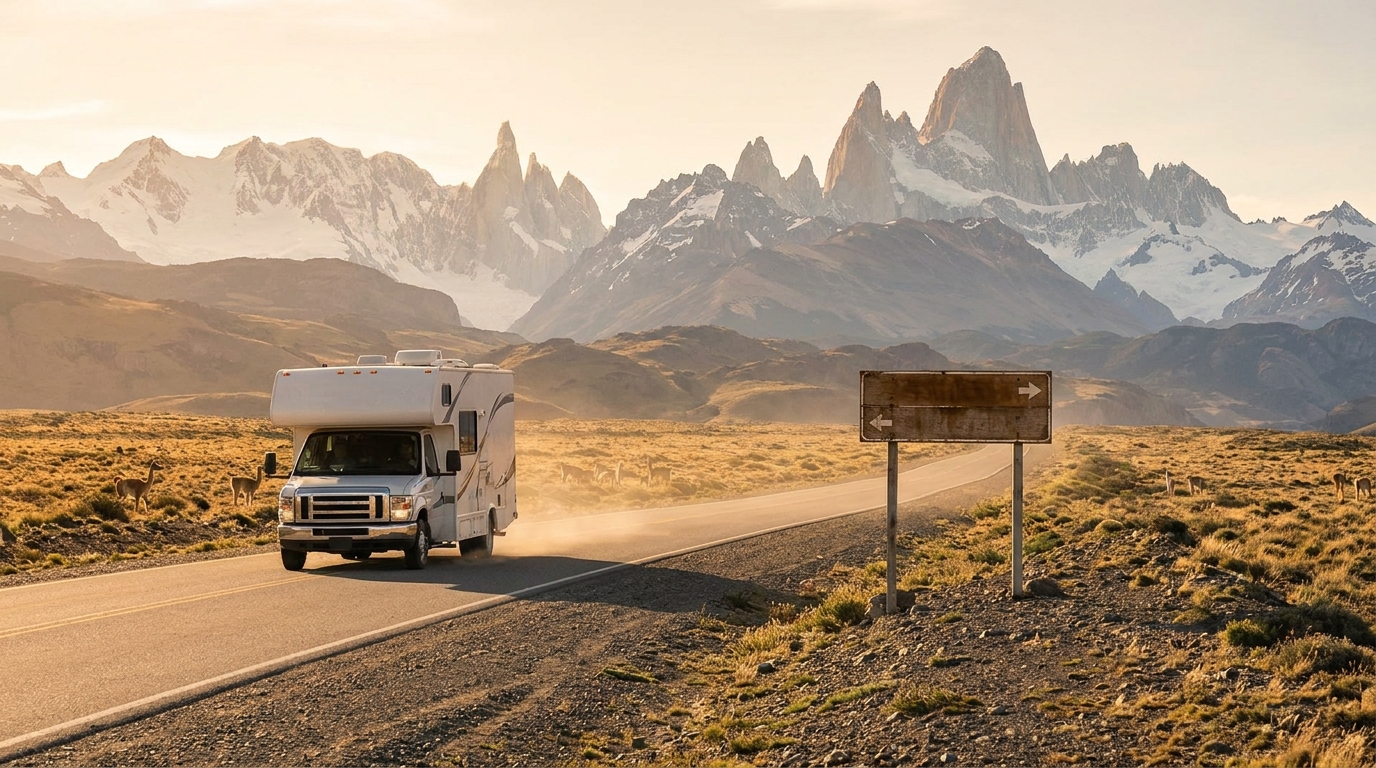
Embarking on your first RV rental adventure in South America promises an unforgettable journey through some of the world's most breathtaking landscapes, from the towering Andes to the vast Patagonian plains. With a rented motorhome or campervan, you unlock unparalleled freedom, allowing you to explore at your own pace and immerse yourself in local cultures. For live availability and current prices, start with our RV Rental South America - Complete Guide 2026 guide.
Can You Drive an RV in South America? License & Age Rules
Yes, you can absolutely drive a rented RV in South America, and a standard Class B driver's license from your home country, typically allowing vehicles up to 3,500 kg (7,700 lbs) Gross Vehicle Weight (GVW), is generally sufficient for renting most motorhomes and campervans. While not strictly mandatory in every country, an International Driving Permit (IDP) is strongly recommended for foreign drivers, as it translates your national license into multiple languages, facilitating communication with local authorities. The minimum age for RV rentals in South America is 21 years old across most suppliers, with no young driver surcharges or vehicle class restrictions based on age, making it accessible for a wide range of travelers. Bandana Caravan partners directly with over 50 leading RV suppliers worldwide, including trusted names like El Monte and Apollo, ensuring you have diverse options that comply with local regulations and offer peace of mind with full price transparency and no hidden fees.
Road Conditions & Terrain in South America
South American road conditions vary dramatically, ranging from smooth, well-maintained sections of the Pan-American Highway to challenging unpaved gravel roads, high-altitude mountain passes (especially in the Andes), and congested urban areas. RV rental beginners should anticipate slower travel times, particularly on secondary routes and in remote regions, and prepare for diverse terrain that can include steep ascents, winding routes, and potential potholes or washouts. Driving a rented RV in South America encourages a slow, scenic pace, allowing travelers to adapt to local conditions, observe traffic patterns, and truly enjoy the journey through incredibly varied landscapes. Our Rent&Plan service can help you navigate these variations, offering pre-planned routes by professionals that factor in road conditions and recommended daily distances (max 100-150 km per day on average) to ensure a comfortable and enjoyable pace.
RV Size Limits, Bridges & Restricted Zones
While specific height and weight limits for RVs vary by country and region, RV rental beginners should be mindful of potential restrictions in older city centers, low-clearance tunnels, or historic bridges across South America. Ferry crossings, which are crucial for reaching certain remote areas like Patagonia's fjords, often have length and weight restrictions, and booking in advance for larger motorhomes is highly advisable. Some urban areas or national parks may implement environmental zones or vehicle size restrictions, so always check local signage and regulations, especially when approaching major cities; however, driving slowly and carefully allows you to navigate almost anywhere without issues. Bandana Caravan's true RV specialists can provide general guidance on typical vehicle dimensions for rented motorhomes like a Class C - Alcove RV, which can be around 7.5 meters long.
Fuel: Diesel vs. Petrol & Cost per 100 km
Most rental RVs in South America, including many in Bandana's fleet, predominantly run on diesel, which is generally more available and often more economical than petrol (gasoline) throughout the region. For Bandana's global fleet, a Class SI - Semi-integrated RV typically consumes 10-11 Liters/100 km, while a Class C - Alcove RV averages 10-12 Liters/100 km, and a Class B - Camper Van uses around 8-10 Liters/100 km, demonstrating varied fuel efficiency. Fuel availability and quality can vary significantly in remote areas, so it's always advisable to refuel whenever possible in larger towns, and carry local currency as cash-only payments are common at smaller stations. When planning your budget for a rented motorhome trip, remember that fuel costs are a major ancillary expense, along with campground fees and tolls. Our RV PLANET routes allow travelers to itemize and track every expense along the way for easy budgeting. On the routes offered through RV PLANET routes, you can itemize and track every expense along the way for easy budgeting.
Tolls, Vignettes & Border Rules
Most South American countries utilize a cash-based toll system on major highways, requiring local currency for payment, though electronic tolling is becoming more prevalent in some urban areas like Santiago, Chile. Border crossings between South American countries can be intricate for RVs, requiring Temporary Import Permits (TIPs) for the vehicle, proof of rental agreement, valid international insurance, and sometimes specific visas or entry/exit stamps for individuals. Navigating border officials smoothly involves having all documentation meticulously organized, being patient with the process, and understanding that procedures can differ greatly from one crossing to another; language barriers may also require some preparation, so having key phrases written down or a translation app can be very helpful. Our specialists at Bandana Caravan are dedicated to providing full transparency, offering support before and during your booking to ensure you have the correct documentation for a seamless cross-border experience with your rented campervan.
Driving Tips for RV Rental Beginners Travelers
Always drive defensively and be prepared for varied local driving habits; avoiding night driving, especially on unlit or unfamiliar roads, is a practical tip to minimize risks and enhance safety. Utilize reliable offline navigation apps (e.g., Maps.me, iOverlander) and pre-download maps, as cell service and internet connectivity can be unreliable in many remote South American regions. Prioritize safety and security by choosing secure parking (established campgrounds, well-lit gas stations with security, designated overnight spots), being aware of common scams, and securing all valuables out of sight within your rented motorhome. Learning basic Spanish or Portuguese phrases to communicate with locals is invaluable, especially in emergencies or when seeking directions or assistance with potential breakdowns and maintenance; a simple "Hola, ¿puede ayudarme?" (Hello, can you help me?) can go a long way. With our 25% Planning Discount when using rvplan.net, you can craft detailed itineraries that incorporate these safety considerations and help you prepare for a smooth journey.
Recommended RV Class for South America Roads
For RV rental beginners in South America, a Class SI - Semi-integrated RV, typically averaging 6.9 meters in length (like the "2 Berth Tamar" or "2 Berth Rover" models), or a Class B - Camper Van, averaging 5.8 meters in length (such as the "Active Classic" or "Juliette 2-3" models), often strikes the best balance between maneuverability and comfort. The more compact size of these classes facilitates easier navigation on narrower roads, through smaller towns, and on unpaved sections you might encounter, while still offering sufficient living space and essential amenities like a shower, toilet, and kitchen for extended travel. While larger Class C - Alcove (avg. 7.5m) or Class A - Integrated (avg. 7.5m) RVs offer more space, their increased length and weight can be more challenging on South America's diverse and sometimes demanding terrain, though driving slowly and carefully can overcome most obstacles. Choosing a vehicle like a Class B Camper Van ("Camper Van") provides excellent fuel efficiency, often consuming 8-10 Liters/100 km, and is ideal for couples or small families.
Should I Choose a Compact Van Instead of a Large RV in South America?
Choosing a compact van, often a Class B Camper Van like the "Combi Van" or "Active Standard" models, over a larger motorhome can offer significantly greater maneuverability for tight historic city centers, very narrow mountain passes, and potentially rougher, less-maintained tracks in South America. While smaller vans excel in agility and easier parking, larger RVs (Class C or Class A) often provide superior comfort, indoor living space, onboard amenities such as a dedicated shower and toilet, and ample storage capacity for longer trips, which are significant advantages for extended, multi-country adventures. For most major routes and tourist-frequented areas in South America, a larger rented RV generally presents no insurmountable issues, especially if you embrace the slow travel philosophy of averaging 100-150 km per day. The trade-off between a compact van's agility and a larger RV's comfort is a personal preference based on your itinerary and travel style, but rest assured, driving slowly and carefully means you can drive almost anywhere without issues, regardless of size.
Can I Park Anywhere? Free & Wild Camping Rules in South America
Free or wild camping (often called "boondocking" or "overlanding") is widely practiced in many parts of South America, particularly in remote natural areas or along scenic routes, but explicit rules vary significantly by country and even by local municipality. While less regulated than in some other continents, it is crucial for RV rental beginners to prioritize safety, always seek permission if on private land, and adhere strictly to 'Leave No Trace' principles by packing out everything you pack in. Rules vary by region, so always check local regulations and follow local laws before parking overnight, opting for established campgrounds, secure parking lots (like at major gas stations or hotels), or community-supported sites when in doubt. For finding campsites and campgrounds during your trip, we recommend using RV PLANET (rvplan.net) - a great resource for locating available spots along your route, ensuring you find secure and legal parking options. Many travelers will find spots; if not at the first campground, then the next one, but always call ahead before driving a long distance.
Can I Drive an RV Into the City Center? Heights, Tunnels & Local Signage
You can drive almost any rented RV size into most South American city centers without issues, by driving slowly and carefully, paying attention to signage. There's no need to stress about traffic or narrow streets. However, it does require careful attention to local signage regarding potential height limits for tunnels or underpasses, and awareness of very narrow streets, particularly in historic colonial districts. Parking a larger RV in dense urban areas can be challenging due to limited space and restricted zones, making it often more practical to park on the outskirts of cities like Buenos Aires or Rio de Janeiro and use public transport or smaller vehicles for exploration. Always watch for low bridges, overhead cables, and specific 'residents only' or restricted vehicle access signs, particularly in older, less-modernized districts where infrastructure may not be designed for larger vehicles. Remember, just use common sense and pay attention, and you'll navigate South American cities with your rented motorhome smoothly.
What is the 3-3-3 rule for RV travel?
The '3-3-3 rule' for RV travel suggests driving no more than 300 miles (approximately 480 km) a day, arriving at your campsite by 3 PM, and staying for at least 3 nights. This rule is designed to promote a relaxed travel pace, prevent driver fatigue, and allow ample time to set up camp, explore the surroundings, and truly enjoy each destination rather than constantly being on the move. Adhering to this guideline is particularly beneficial for RV rental beginners in South America, where road conditions can be unpredictable and setting up camp before dark enhances both safety and comfort for your family or group of friends. While we recommend a slower pace of max 100-150 km per day, this rule provides a helpful framework for balancing driving and exploration.
Can you technically drive from North America to South America?
No, you cannot technically drive continuously from North America to South America because there is no traversable road through the Darien Gap, a dense, 60-mile stretch of jungle and swampland located between Panama and Colombia. To transport a rented RV from North America to South America, vehicles must be shipped via cargo container or Roll-on/Roll-off (RoRo) ferry, typically from ports like Cartagena, Colombia, or Colon, Panama. The shipping process involves significant logistics, costs (ranging from thousands of dollars, depending on the vehicle size and shipping method), and considerable paperwork, including temporary import permits, customs declarations, and choosing a reputable shipping agent. This logistical hurdle means that while continent-to-continent travel is possible, it is not a direct drive.
Can you RV in South America?
Yes, RVing in South America is a profoundly rewarding and increasingly popular adventure, offering unparalleled freedom to explore diverse landscapes, from the dramatic Andes mountains to the vast Patagonian steppes and vibrant coastal regions. While it requires extensive planning, adaptability, and a strong spirit of adventure, the continent provides incredible opportunities for self-sufficient travel and unique cultural immersion. Preparation for varying road conditions, complex border crossings, and sometimes limited infrastructure in remote areas is key to a successful RV trip in South America, ensuring a smooth journey for any RV rental beginner. Our comprehensive "RV Rental South America - Complete Guide 2026" offers detailed insights to help you plan your ideal adventure.
Do you need a special license to rent and drive an RV?
Generally, for most rented motorhomes and campervans in South America (typically weighing up to 3,500 kg or 7,700 lbs GVW), a standard Class B driver's license from your home country, along with an International Driving Permit (IDP), is sufficient to rent and drive an RV. There are no special licenses, CDLs, or additional permits required for any rental motorhome within our fleet. While some larger RVs (exceeding 3,500 kg GVW) might theoretically require a higher license category in certain regions, these are less common for tourist rental fleets. Always confirm the specific license requirements with your chosen RV rental company and verify local regulations for the countries you plan to visit, as requirements can sometimes vary by nation. The minimum rental age for all classes is 21, and there are no young driver surcharges.
What countries are RV friendly?
Argentina and Chile are widely considered the most RV-friendly countries in South America, boasting relatively good infrastructure, a growing network of established campgrounds, and a strong culture of overlanding and adventure travel. Brazil also offers RV-friendly regions, particularly in its southern states, with numerous national parks and coastal areas suitable for motorhome exploration, though road quality can vary more widely compared to Argentina or Chile. While other countries like Uruguay, Peru, and Ecuador can certainly be explored by RV, they may present more significant challenges in terms of road conditions, the consistent availability of dedicated campgrounds, and more complex specific vehicle documentation requirements. For detailed information on these destinations, check out our guide on "RV Camping in South America - Best Campgrounds 2026."
Can I rent an RV to drive across country?
Yes, you can typically rent an RV to drive across countries within South America, provided the rental agreement explicitly allows for international travel and you complete all necessary border documentation for both the vehicle and yourself. One-way international RV rentals are extremely rare and, if available, would incur substantial fees (e.g., $500-$1000+) due to the significant logistical challenges and costs for the rental company to retrieve the vehicle from a different country. It is absolutely crucial to clarify your exact itinerary and all planned border crossings with the RV rental company in advance to ensure compliance with their terms and conditions, and to arrange necessary insurance and permits. Our 24/7 support team can assist you with understanding these options before you book your motorhome rental.
What kind of license do I need to rent an RV?
To rent most standard RVs in South America (typically under 3.5 tonnes or 7,700 lbs Gross Vehicle Weight), you will need your valid national driver's license, often supplemented by an International Driving Permit (IDP) for ease of understanding by local authorities. The IDP serves as an official translation of your national license and is legally required for foreign drivers in many South American countries. Ensure your national license has been held for a minimum period (commonly 1-3 years), as required by rental agencies, and that you meet the minimum age requirement, which is 21 years old across all motorhome classes without additional young driver surcharges. We strive for full transparency in the booking process, ensuring all licensing requirements are clear upfront.
What is the 3-3-3 rule for RV living?
The '3-3-3 rule for RV travel' is a widely adopted guideline that advises RVers to drive no more than 300 miles (approximately 480 km) a day, arrive at their destination by 3 PM, and stay for a minimum of 3 nights. This rule is particularly beneficial for RV rental beginners as it helps prevent fatigue, allows for sufficient time to set up and break down camp, and encourages a deeper exploration of each location. Implementing this approach fosters a more relaxed and enjoyable RV vacation experience, especially when navigating the diverse and sometimes challenging environments found in South America. Remember, Bandana RV recommends even slower travel, aiming for max 100-150 km per day, to truly connect with the culture, food, and scenery.
How much is the cleaning fee at Cruise America?
Cruise America, a prominent RV rental company with operations primarily in North America, typically charges a separate cleaning fee if a rented RV is not returned in a reasonably clean condition, in addition to the standard rental cost. These fees can vary based on the extent of cleaning required, often ranging from an incidental charge for minor tidying to a significant fee for deep cleaning or waste tank dumping if not completed by the renter, for instance, a fee of $150-$250 for excessive dirt. For RV rentals in South America, specific cleaning fees will depend on the individual rental company's policies, as Bandana partners with various local and international suppliers, so it's essential for beginners to clarify these details in their rental agreement before booking to ensure full transparency.
Will my auto insurance cover a rental RV?
It is highly unlikely that a standard personal auto insurance policy from your home country will provide comprehensive coverage for a rental RV during international travel in South America. Specialized international RV insurance is generally required, covering essential aspects such as third-party liability, collision, theft, and potentially breakdown assistance in foreign countries, which your domestic policy will typically not. When renting an RV in South America, beginners should meticulously review the insurance options offered by the rental company and consider purchasing additional travel or specialist RV insurance that explicitly covers the region and specific risks like breakdowns and parts availability, which can be more complex in remote areas. You can upgrade to a top-level deductible for extra peace of mind, which is an optional upgrade not included by default. We always recommend understanding these policies fully before you embark.
🎬 Video coming soon
What You Shouldn't Miss
- **Explore Patagonia's iconic landscapes:** Drive along Argentina's Route 40 or Chile's Carretera Austral for majestic glaciers, towering peaks, and incredible wildlife sightings.
- **Immerse in the culture of Peru:** Journey through the Sacred Valley to discover ancient Inca ruins and vibrant indigenous markets.
- **Experience the vastness of Salar de Uyuni:** Take a guided tour from your RV to the world's largest salt flat in Bolivia for surreal vistas and unforgettable stargazing opportunities.
- **Discover the natural wonders of the Amazon:** Park your RV in a nearby city and embark on a jungle excursion to witness unparalleled biodiversity.
- **Savor local cuisine:** Stop at roadside eateries or cook up your own RV-friendly recipes playlist using fresh ingredients from local markets.
Looking for expert insights from Avi Bandana? Top 5 Adventures - recommendations from Avi Bandana
Final Thoughts
Driving a rented RV in South America as a beginner is an incredible journey waiting to happen, full of discovery and unparalleled freedom. While preparation is key, facing the continent's diverse roads, unique driving customs, and varied regulations simply adds to the adventure. Embrace the philosophy of slow travel, averaging 100-150 km per day, allowing yourself to truly soak in the rich culture, delectable food, and breathtaking scenery at every turn. We're here to support you from the moment you start dreaming of your trip, through comparing rental options, and coordinating your booking, ensuring every detail is clear and transparent.
Imagine yourself cruising along a winding coastal highway in Chile or navigating the Andean foothills in Argentina in your comfortable campervan. With a bit of planning and the right mindset, your first RV trip in South America will not just be a vacation, but a life-enriching experience. Get inspired for your next trip and discover all the planning tips you need in one place. Your ultimate road trip awaits!
Compare Motorhome Rental Prices for South America Now