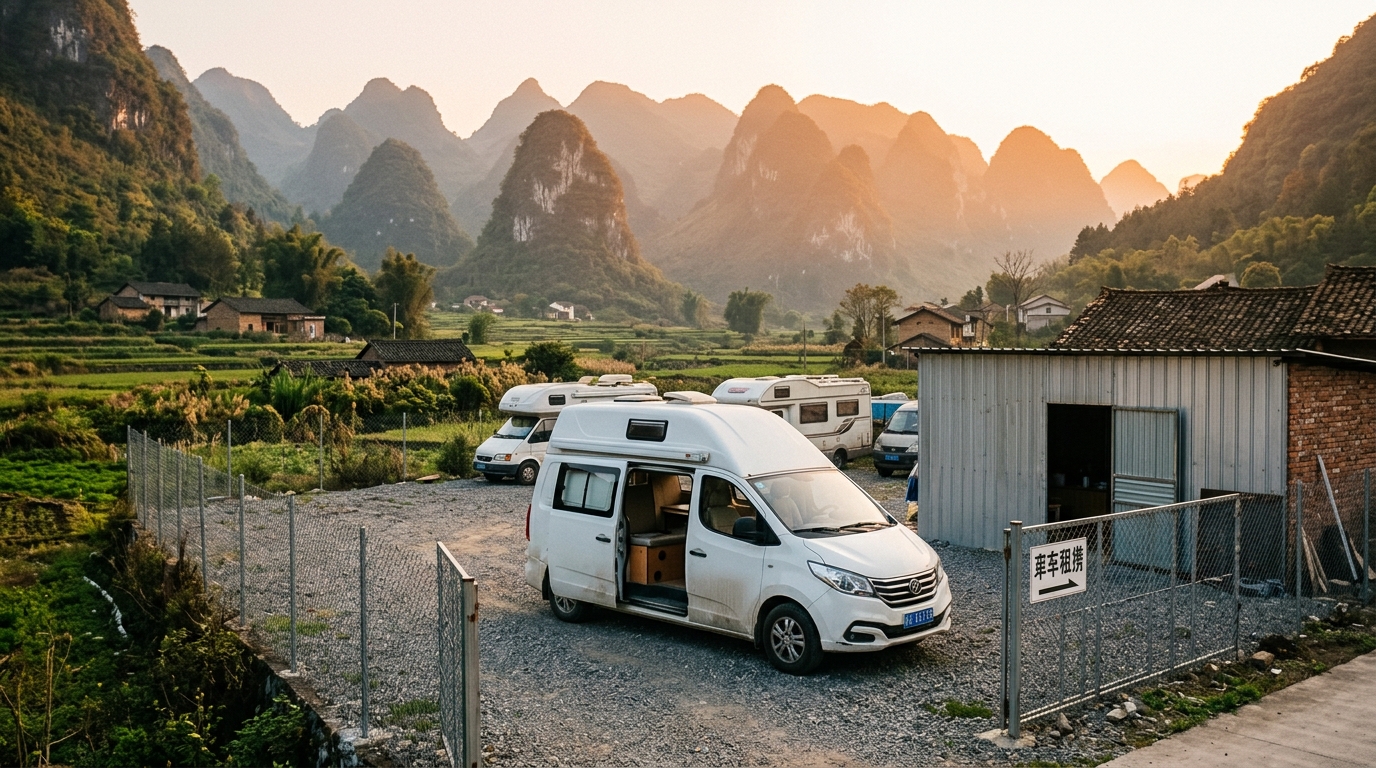
For live availability and current prices, start with our RV Rental China - Complete Guide 2026 guide.
Key Takeaways
A standard car driver's license is sufficient for all motorhome classes in China; an International Driving Permit (IDP) may be recommended by some rental companies or provinces but is not universally mandatory for foreigners.
The minimum driver age for RV rentals in China is typically 21, though some larger vehicles or specific providers may require drivers to be 25 or older.
Expect to pay ¥800 to ¥2000 (approx. $110-$280 USD) per day for RV rental in China, with costs varying by vehicle class, season, and rental duration.
Highway tolls are common and distance-based, with RVs potentially incurring higher rates than cars; mobile payment via Alipay or WeChat Pay is essential.
Wild camping is generally discouraged and difficult to find legal spots for; utilize designated RV campsites (房车营地) for a safer and more practical experience.
Navigating China's massive scale requires planning; the best time to book an RV rental is typically 3-4 months in advance to secure desired vehicles and potentially better rates.
`
Quick Facts: RV rental beginners in China
Average Daily Cost: $110-$280 USD for a Class C motorhome.Best Months: April-May and September-October for pleasant weather.License Required: Standard driver's license; IDP recommended.Top Campground: Yunnan’s Lijiang RV Park with hot springs.Booking Lead Time: 3-4 months recommended for best availability.Bandana Advantage: Access to a wide range of suppliers for competitive pricing.
Can You Drive an RV in China? License & Age Rules
Yes, foreigners can drive a rented RV in China, but it requires obtaining a temporary Chinese driving permit. This process typically involves presenting a valid foreign driver's license and sometimes an International Driving Permit (IDP), depending on specific provincial regulations and the rental company's policies. The minimum driver age for RV rentals generally aligns with standard vehicle rental practices, usually starting at 21, with some larger or more specialized RV categories potentially having higher age requirements, often around 25.
The temporary Chinese driving permit is crucial for all foreign drivers and can usually be obtained upon arrival by providing necessary documents such as your national driver's license, passport, a valid visa, and undergoing a basic medical examination. It's vital to ensure your temporary permit covers the specific vehicle category of your chosen RV, particularly its Gross Vehicle Weight (GVW) and dimensions, as vehicles exceeding 3,500 kg might necessitate a different license classification.
Road Conditions & Terrain in China
China offers an extensive and generally well-maintained road network, featuring modern highways that connect major cities. However, as an RV rental beginner, you'll encounter diverse terrain, from flat plains to more challenging mountain passes, high plateaus, and rural roads that might be less perfectly paved or narrower. While major expressways are excellent, venturing into scenic rural or mountainous areas can mean navigating winding, steep, and sometimes unpaved sections, requiring careful attention, reduced speeds, and a capable RV.
Driving in urban centers can be dense and fast-paced, demanding constant vigilance. Outside the cities, traffic typically lightens, opening up opportunities for more relaxed, scenic driving. Provinces known for their natural beauty, such as Yunnan or Sichuan, offer particularly rewarding experiences for slow, appreciative travel. When planning routes, be prepared for varying road qualities, especially as you move away from the primary tourist routes, and always prioritize safety by adjusting your speed and awareness to the conditions.
RV Size Limits, Bridges & Restricted Zones
While China doesn't enforce universally restrictive national size limits for RVs, drivers must be acutely aware of local regulations, particularly concerning bridge height and weight restrictions, and potential access limitations in certain zones. It's essential to pay close attention to road signage, noting symbols for height (限高 - xiàn gāo) and weight (限重 - xiàn zhòng) limits, as an RV's dimensions can easily exceed those of a standard car, posing risks in underpasses, tunnels, or on smaller bridges.
Many Chinese cities implement environmental protection zones or traffic restrictions based on vehicle emissions or license plate numbers. These can affect RV access to certain downtown areas, especially during peak hours. Understanding these local rules is crucial for a smooth journey. For most domestic RV travel within mainland China, ferry services are not a common requirement due to the extensive bridge networks. However, if you were to travel to specific island destinations, you would need to consider their individual size and weight restrictions.
Fuel: Diesel vs. Petrol & Cost per 100 km
Both diesel and petrol are widely available across China, primarily at stations operated by state-owned companies like PetroChina and Sinopec. Most rental RVs are typically diesel-powered. For a mid-sized RV from Bandana's global fleet, like a Class SI - Semi-integrated RV, common fuel consumption averages around 10-11 liters per 100 km. Larger models, such as a Class C - Alcove RV, might consume slightly more, in the range of 10-12 liters per 100 km, while more compact Class B - Camper Vans typically average 8-10 liters per 100 km. Integrated Class A RVs generally fall between 8-12 liters per 100 km.
Payment at fuel stations is predominantly handled via mobile payment apps like Alipay or WeChat Pay. While cash is accepted, credit card acceptance can be limited for foreign cards, and specific fuel discount cards for RV rentals are not universally offered. Before refueling, always confirm the correct fuel type for your rented RV; look for 柴油 (chái yóu) for diesel and 汽油 (qì yóu) for petrol to avoid costly engine damage.
Tolls, Vignettes & Border Rules
China's extensive highway network operates on a toll-based system, with fees collected at frequent toll booths. Unlike some European countries, there is no national vignette system for RVs. Toll charges are calculated based on distance traveled and vehicle type, with RVs potentially incurring higher rates than standard cars. Payment is most commonly made via cash or QR code using mobile payment apps like Alipay or WeChat Pay; an Electronic Toll Collection (ETC) system is available but primarily for local drivers. On the routes offered through RV PLANET routes , you can itemize and track every expense along the way for easy budgeting.
For foreign RVers, using cash or mobile payment at toll booths is generally the most straightforward method. Pre-purchased toll passes or ETC devices are not typically available or practical for short-term rentals. Bringing an international RV into China is a significantly complex undertaking, requiring extensive documentation, customs procedures, temporary plates, and often mandatory engagement with a local tour operator for a guided journey. For most beginners, renting an RV within China is the recommended and far more accessible option.
Driving Tips for RV rental beginners Travelers
**Pace Yourself and Plan Breaks:** China's vastness and the sheer number of sights mean it's best enjoyed at a relaxed pace. Plan frequent stops to explore attractions and prevent driver fatigue, especially when traveling with family. Regular breaks help everyone stay refreshed and engaged with the journey.
**Master Mobile Payments:** Ensure you have Alipay or WeChat Pay set up and linked to a payment method before you arrive. These apps are virtually essential for paying for fuel, tolls, food, parking, and almost all other transactions across China, streamlining your experience considerably.
**Understand Road Signage and Local Laws:** While major road signs in tourist areas are often bilingual, familiarize yourself with common Chinese road signs, typical speed limits, parking regulations, and local traffic customs. This preparation will enhance your safety and ease of navigation.
**Practice Defensive Driving:** Traffic in China can be fast-paced and unpredictable. Always maintain a safe distance from other vehicles, be aware of scooters, bicycles, and varying driving styles, and constantly use your mirrors to stay informed about your surroundings.
**Pre-plan Logistics and Navigation:** Research your route, potential campsites, and essential service points like waste disposal and water refill stations in advance. Rely on reliable navigation apps such as Baidu Maps or Gaode Maps (Amap) for real-time traffic updates and directions, as they are more commonly used and up-to-date in China than international alternatives.
Recommended RV Class for China Roads
For RV rental beginners in China, a Class SI - Semi-integrated RV or a Class C - Alcove RV generally offers the best balance of comfort, amenities, and maneuverability suitable for the country's diverse road conditions. A Class SI - Semi-integrated RV, with an average length of 6.9 meters and capacity for around 3-4 people based on Bandana's global fleet data, provides ample living space without being overly cumbersome for smaller roads or parking.
Class C - Alcove RVs, typically averaging 7.5 meters in length and accommodating 5-6 people, are excellent choices for families, offering more interior room and often a distinct sleeping area above the driver's cab. Both these classes usually provide adequate ground clearance for most paved and many well-maintained unpaved roads, ensuring a comfortable experience on China's extensive highway network and scenic routes. While more compact Class B - Camper Vans offer superior maneuverability, they might lack the extensive amenities and internal space desired by beginners for extended trips. Conversely, larger Class A - Integrated RVs, though luxurious, can be more challenging in very tight urban settings.
Should I Choose a Compact Van Instead of a Large RV in China?
While a compact van, like a Class B - Camper Van (averaging around 5.8 meters in length), offers superior maneuverability in very tight city centers or narrow mountain passes in China, the choice often hinges on your priorities for comfort and trip duration. For beginners, larger RVs such as Class SI - Semi-integrated (around 6.9 meters) or Class C - Alcove (around 7.5 meters) typically provide significantly more indoor living space, better sleeping arrangements, and more comprehensive kitchen and bathroom facilities, which greatly enhance comfort on longer journeys. For ideas you can prep on the road, watch our RV-friendly recipes playlist on YouTube.
In China, major roads and highways are generally accommodating for all RV sizes, so the primary advantage of a compact van is less about general road conditions and more about ease of parking and navigating extremely congested or historic urban areas. Consider a compact van if your itinerary heavily emphasizes urban exploration, very remote unpaved tracks, or if you prefer a minimalist travel style. However, for a comfortable and less stressful beginner RV experience, particularly with family, the added living space and amenities of a larger RV often outweigh minor maneuverability challenges.
🎯 Fun Facts About China
World's Most Extensive Highway Network: China boasts the world's most extensive highway network, with over 160,000 kilometers of expressways (高速公路 - gāosù gōnglù), surpassing even the United States. This means RV travelers can expect modern, well-maintained roads connecting major cities and remote regions, though often accompanied by frequent and sometimes costly toll booths.Aggressive RV Campsite Development: While still an emerging concept for international tourists, China has been aggressively building state-of-the-art 'RV Campsites' (房车营地 - fángchē yíngdì) as part of a national tourism strategy. These facilities are often equipped with modern amenities like electricity, water, waste disposal, and even restaurants, specifically designed to cater to growing domestic RV tourism, sometimes near hot springs or cultural sites.The G219 Highway - World's Highest & Longest: For the ultimate high-altitude road trip, China's G219 National Highway, running over 10,000 kilometers along its western frontiers, is one of the world's longest and highest roads. It traverses deserts, grasslands, and some of the planet's highest mountain passes, offering unparalleled (but extremely challenging and permit-restricted) views of the Himalayas and Karakoram range.Cashless Society Mandate: Forget cash and credit cards; RV travelers in China will operate almost exclusively via mobile payment apps like WeChat Pay and Alipay. From fueling up at a gas station to buying local snacks from a street vendor or paying campsite fees, nearly all transactions are digital, making a local SIM card and setting up mobile payments absolutely essential.Weekday License Plate Restrictions (限行 - xiànxíng): In many major Chinese cities (e.g., Beijing, Shanghai), traffic congestion and pollution are managed through 'license plate restrictions.' On certain weekdays, vehicles with specific last digits on their license plates are prohibited from driving within designated urban areas, which can significantly impact an RV traveler's itinerary and city access.
Can I Park Anywhere? Free & Wild Camping Rules in China
Free and wild camping (boondocking) for RVs in China is generally not widely supported or explicitly regulated in the same way as in some Western countries, making it challenging and often discouraged for beginners. While specific national laws may not always be explicit against wild camping, local authorities frequently impose restrictions, and finding safe, legal, and suitable spots with necessary amenities like water and waste disposal is difficult outside designated areas.
It is generally safer and more practical for RV rental beginners to utilize designated RV campsites, parking areas of large tourist attractions, or even some larger hotel parking lots (with explicit permission) for overnight stays. For those considering wild camping, extreme caution is advised to ensure personal safety, avoid private property, respect local communities, and be prepared for a complete lack of facilities and services. Rules can vary significantly by region, so always check local regulations, seek permission from landowners or local authorities, and adhere strictly to local law before parking overnight.
Can I Drive an RV Into the City Center? Heights, Tunnels & Local Signage
Yes, you can generally drive an RV into city centers in China, but it is crucial to pay close attention to local signage, which may indicate height limits, tunnel restrictions, low bridges, or environmental zones. Many Chinese cities feature modern infrastructure designed to accommodate larger vehicles, but older districts or specific historical areas might have narrower streets or height-restricted underpasses that could pose challenges for larger RVs.
Be aware that environmental zones restricting older or higher-emission vehicles are becoming more common in major cities. It's advisable to check local regulations for your specific destination, as access might be restricted during peak hours or for certain vehicle types. Always remain vigilant for signs indicating maximum height (限高 - xiàn gāo) or weight (限重 - xiàn zhòng). In very dense city centers, consider parking on the outskirts and utilizing public transport for inner-city exploration to avoid congestion and potential parking difficulties. While local signage in major tourist areas is often bilingual, having translation apps or local guidance for less common signs is beneficial to understand all restrictions.
How do I get a temporary driving permit for an RV in China?
Obtaining a temporary Chinese driving permit is essential for foreign RV renters. The process typically requires presenting a valid national driver's license, an International Driving Permit (IDP) if issued by your country and recognized in China, your passport, and a valid Chinese visa. The application usually involves visiting a local Vehicle Management Bureau (VMB) upon arrival, undergoing a simple medical examination, and completing a short form, with processing times often ranging from a few hours to a few days.
Required documents generally include the originals and copies of your foreign driver's license (with a certified Chinese translation if not in English), your IDP (if available), passport, visa, and relevant entry stamps. It is critical to ensure your temporary permit specifies the correct vehicle category that covers the Gross Vehicle Weight (GVW) of your rented RV, particularly for vehicles above 3,500 kg, to ensure legal compliance. Some RV rental companies in China may offer assistance with the temporary permit application, providing guidance or direct support, which can significantly simplify the procedure for first-time visitors.
What are the actual costs of RV rental and camping in China?
The actual costs of RV rental in China vary significantly based on RV class, rental duration, season, and provider. Daily rates typically range from ¥800 to ¥2000 (approximately $110-$280 USD) for a mid-sized RV. Beyond rental fees, beginners should budget for fuel costs, which are generally moderate (e.g., diesel around ¥7-¥8 per liter, approx. $1-$1.1 USD), specific highway toll costs that can accumulate on long journeys, and designated RV campsite fees.
Campsite fees in China can range from ¥100 to ¥300 (approx. $15-$45 USD) per night for a spot with basic hookups like electricity and water, with prices varying greatly by location and provided amenities. Be aware of potential hidden charges, which can include additional insurance coverage, cleaning fees, mileage limits and excess mileage charges, security deposits, and fees for extra equipment or late returns. Always review your rental agreement thoroughly before booking. It's advisable to allocate a daily budget for food, tourist attractions, and unexpected expenses, as real-world budgeting extends beyond just the vehicle and campsite costs.
What are the practical logistics of RV life in China - waste, water, power, internet?
Managing waste disposal, including black and grey water, in an RV in China requires careful planning, as dedicated dump stations are less common than in some Western countries. They are typically found at larger, purpose-built RV parks or certain highway service areas. For water refilling, you can often find designated spots at RV campsites, some gas stations (with permission), or by carrying portable water containers and purchasing bottled water from local stores. Ensure any water source for your fresh tank is potable if you intend to drink it.
Propane for cooking and heating can be challenging to refill due to different cylinder standards and safety regulations. Some rental RVs might use electric cooktops or provide smaller, portable gas canisters, or require tank swaps at specific locations. Electricity (shore power) is usually available at designated RV campsites with hookups, providing standard 220V power. Outside these sites, rely on your RV's battery system or solar panels if equipped. For internet and communication, securing a local SIM card (available with your passport at telecom stores) for mobile data is essential, or consider a portable Wi-Fi device from your rental provider, as public Wi-Fi can be unreliable or require local phone numbers.
What are the key safety considerations for RV travel in China?
Road safety in China requires heightened awareness due to diverse driving styles, heavy truck traffic on highways, and the unpredictable presence of scooters and bicycles, especially in urban and rural fringe areas. Always keep emergency contact numbers readily accessible, including your rental company, local emergency services (110 for police, 120 for ambulance, 119 for fire), and your embassy or consulate. Medical facilities in cities are generally easy to access, with a range of hospitals from local clinics to international-standard facilities available. Ensure you have comprehensive travel insurance that covers medical emergencies and know how to communicate your needs effectively.
In case of a breakdown, immediately contact your RV rental company, as they typically have roadside assistance protocols or partner with local mechanics. Carrying a basic tool kit and being able to communicate your precise location are vital. Other important safety considerations include properly securing your RV and belongings, being aware of common scams targeting tourists, and understanding cultural nuances to ensure a safe and respectful journey throughout your travels.
What are some recommended RV itineraries for beginners in China?
For RV rental beginners, popular and accessible routes include the scenic provinces of Yunnan (e.g., Kunming-Dali-Lijiang-Shangri-La), which offer well-developed infrastructure and abundant points of interest. A beginner-friendly itinerary could involve a 7-10 day loop through Sichuan province, exploring Chengdu, the Leshan Giant Buddha, and Mount Emei, offering a mix of cultural sites and natural beauty with relatively good road conditions.
For those seeking a more immersive nature experience, consider parts of the Silk Road in Gansu (e.g., Dunhuang, Zhangye), though this requires longer durations (10-14 days) and preparedness for varying road quality and potentially sparser services. Recommended durations vary: 5-7 days for regional exploration around major hubs, 10-14 days for inter-provincial journeys, and 3-4 weeks for extensive cross-country adventures. Suitable vehicle types for most recommended beginner itineraries are Class SI - Semi-integrated or Class C - Alcove RVs, as they provide comfort and capability for a mix of highway and scenic drives.
Where can I find designated RV campsites in China?
Designated RV campsites in China are primarily situated near popular tourist attractions, national parks, and increasingly along major highways, though their density and amenities can vary significantly by region. These official campsites often provide essential services such as electricity hookups (220V), fresh water, and waste disposal facilities. Some may also offer additional amenities like restrooms, showers, and recreational areas.
Online platforms and local apps are the best resources for finding and booking designated campsites. While international platforms might have limited information, local providers (e.g., specific Chinese RV forums or tourism apps like Ctrip/Trip.com, and Baidu Maps) are invaluable. RVing regions like Yunnan, Sichuan, and coastal areas tend to have a higher concentration of developed campsites compared to more remote or less-traveled provinces. It's always advisable to confirm campsite availability and book in advance, especially during peak travel seasons like national holidays, and to verify the specific amenities offered to ensure they meet your RV's needs.
How do RVers find food and supplies in China?
RVers in China can easily find food and supplies by navigating local markets and large supermarkets, which are ubiquitous in both urban and rural areas. These establishments offer a wide array of fresh produce, meats, and packaged goods. Large supermarket chains like Walmart, Carrefour, and local chains such as Hema Fresh or RT-Mart are excellent for general grocery shopping, often stocking many Western and international ingredients in larger cities.
For a truly authentic cultural experience and access to specific local ingredients, traditional wet markets (菜市场 - cài shìchǎng) are invaluable. However, language barriers might require the use of translation apps or learning a few basic Mandarin phrases. Cooking in your rented RV in China is practical given the widespread availability of fresh ingredients; ensure your rental RV's kitchen is adequately stocked with basic utensils and that you understand how to operate its cooking appliances. It's advisable to stock up on essentials when passing through larger towns, especially before venturing into more remote areas where specialized supplies might be limited, and to always carry adequate bottled water for drinking and cooking.
What You Shouldn't Miss
Drive the Sichuan-Yunnan Loop: Experience the diverse landscapes from lush bamboo forests to Tibetan plateau scenery.Explore the Ancient Silk Road Routes: Journey through Gansu province to witness ancient cave art and desert landscapes near Dunhuang.Marvel at the Giant Buddha in Leshan: Witness this colossal stone carving, a UNESCO World Heritage site, carved during the Tang Dynasty.Discover the Huanglong National Park: Witness its stunning travertine pools and colorful landscape in Sichuan.Experience the Terracotta Army: Visit Xi'an to see this incredible archaeological site, an underground army protecting China's first emperor.Taste Authentic Regional Cuisine: From spicy Sichuan hot pot to delicate Yunnan flavors, explore China's diverse culinary landscape directly from your RV kitchen.
Why Book with Bandana Caravan
Full Transparency, No Surprises
We believe in clear pricing with no hidden fees. What you see is what you get, allowing you to budget your trip with confidence.
Real RV Specialists
Unlike general travel agencies, we focus exclusively on RV rentals, offering unparalleled expertise and personal experience.
Your Peace of Mind, Our Priority
Travel with confidence, knowing you can upgrade to top-level deductible reimbursement for extra peace of mind.
Our Commitment to You
Founded in 2001, Bandana Caravan has been helping tens of thousands of travelers explore the world by RV for over 20 years. We have direct partnerships with over 50 leading RV suppliers worldwide, including names like El Monte, Cruise America, Apollo, and Britz. Through our sister company, RV PLANET (rvplan.net), we offer access to over 1,300 pre-planned routes across 5 continents. We provide bookings in over 30 currencies with complete price transparency and cover over 50 countries, backed by local expertise and support.
"We sell the way we'd like to buy – with honesty. No hidden fees, no surprises, no tricks or gimmicks. What you see is what you get."
— Avi Bandana, Founder of Bandana Caravan
"Life is now!"
About the Author
Avi Bandana is the founder and CEO of Bandana Caravan , one of the world's leading RV rental comparison platforms. With over 25 years of hands-on experience in the motorhome travel industry, Avi has personally visited hundreds of destinations and tested countless RV models across 5 continents. His mission: make RV travel accessible, transparent, and joyful for everyone.
Final Thoughts
Embarking on an RV adventure in China is an extraordinary way to experience its vast landscapes and rich culture. While it presents unique challenges, careful planning and understanding local nuances can lead to an incredibly rewarding journey.
From navigating bustling cities to exploring remote natural wonders, a rented RV provides the freedom and flexibility to discover China at your own pace. We encourage you to embrace the adventure, stay prepared, and most importantly, savor every moment of your unique road trip.
Ready to start planning? Compare RV rental prices and availability for China on our platform to find the perfect vehicle for your unforgettable Chinese adventure!
All the information is based on public information on the web.
All imagery sourced under Creative Commons licenses with attribution provided.
Always check trail conditions and opening hours before travel.