In This Guide
- What family rv rental RV Rental Costs in Santiago (CurrentYear)
- Seasonal Pricing - Peak vs. Shoulder vs. Off-Season in Santiago
- What's Included vs. What's an Add-On
- Hidden Costs to Budget For in Santiago
- How to Save on family rv rental RV Rental in Santiago
- What are the Total Travel Costs Beyond RV Rental Fees in Santiago?
- Which RV Type is Best for Family Travel in Chile and How Does it Affect Cost?
- What are the Costs and Requirements for Border Crossing an RV from Chile to Argentina?
- What are the Costs for Connectivity Options for RVers in Chile?
- What are the Potential Costs of RV Breakdown or Emergency in Chile?
Embarking on a family RV adventure in Santiago offers an incredible blend of city exploration and natural escapes. From the vibrant streets of downtown to the majestic Andes just beyond, a rented motorhome gives you the freedom to explore at your own pace. For live availability and current prices, start with our RV Rental Santiago - Complete Guide 2026 guide.
What family rv rental RV Rental Costs in Santiago (2026)
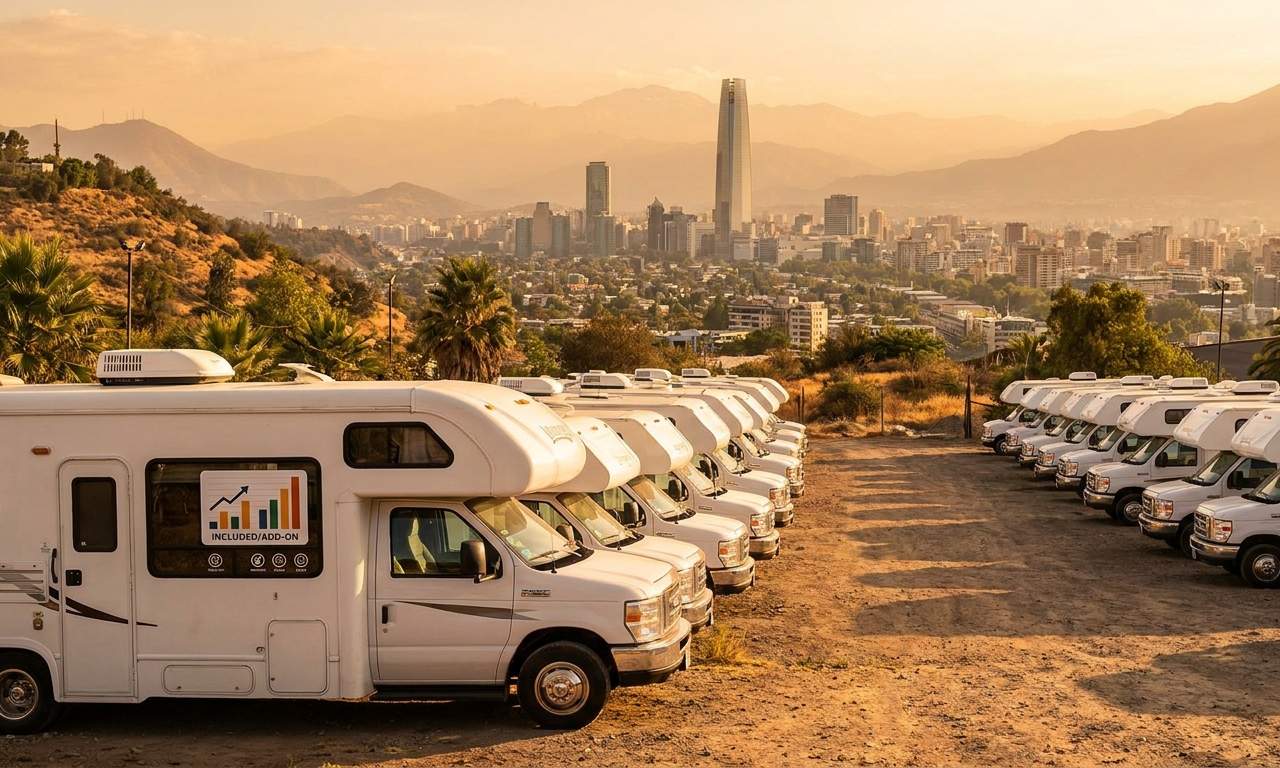
April is typically the cheapest month for RV rental in Santiago, offering a favorable period for families looking to secure competitive rates. RV rental prices are dynamic and change daily based on factors like demand, availability, and seasonality, similar to flight tickets.
Live April Price Comparison — RV Class × Trip Length
| Trip length | Class A | Class B | Class C | Class SI | Class TC |
|---|---|---|---|---|---|
| 1 week 15/04 → 22/04 | Check prices | Check prices | Check prices | Check prices | 1,532.00 € EUR |
| 2 weeks 15/04 → 29/04 | Check prices | Check prices | Check prices | Check prices | 2,500.35 € EUR |
| 1 month 01/04 → 30/04 | Check prices | Check prices | Check prices | Check prices | 4,373.70 € EUR |
Estimates only — flex-rate prices change daily based on availability and season.
Prices shown in the table are flex-rate estimates and may change daily. Always check live prices for your specific travel dates via the search box at the top of the page to get the most accurate rates. For instance, a 1-week family RV trip for 4 in a Class C motorhome could range from $1000 to $2000 USD depending on the season and specific model, while a smaller campervan might start from $700 for the week.
Seasonal Pricing - Peak vs. Shoulder vs. Off-Season in Santiago
RV rental prices in Santiago exhibit significant seasonal swings, directly impacting your family's budget. During peak season, prices change significantly day-to-day - always check specific dates as early as possible.
Peak Season: Generally, Santiago's peak RV rental season aligns with the Southern Hemisphere's summer months, roughly from December to February, and again during popular holiday periods like Easter or school breaks. July and August can also see increased demand due to Northern Hemisphere visitors. During these times, demand is high, and prices are at their premium, often requiring bookings months in advance. You might expect daily rates for a family-sized motorhome to be 20-30% higher than off-peak.
Shoulder Season: The shoulder seasons, typically March-April and September-November, offer a sweet spot for family RV travel in Santiago. The weather is usually pleasant, tourist crowds are thinner, and rental prices are more moderate compared to peak times, providing good value and availability. During these months, you could find a 4-berth motorhome for around $180-250 USD per day.
Off-Season: The off-season, with April often being the lowest-priced month, generally runs from May to early September (excluding potential winter holiday spikes). While temperatures are cooler and some remote areas might have limited access, this period offers the most budget-friendly rates for RV rentals in Santiago and a tranquil travel experience. A Class B campervan like the "rv rental denver example Category Van" for a couple might be found for under $100 a day. Planning a longer trip, perhaps a "Week-Long RV Driving Tour in Santiago 2026", during the off-season can lead to substantial overall savings.
What's Included vs. What's an Add-On
Understanding what comes standard with your family RV rental versus what incurs an extra charge is crucial for accurate budgeting. While specifics vary by motorhome type and rental station, basic insurance is always included with every RV rental in Santiago. On the routes offered through RV PLANET routes, you can itemize and track every expense along the way for easy budgeting.
Common inclusions might cover a standard number of miles per day, but additional mileage often comes as an add-on. Essential items like kitchen kits (utensils, pots, pans), bedding, towels, and even a generator might be offered as optional extras, adding to your overall cost. For example, a full kitchen kit for preparing delicious meals in your rented mobile home might cost an extra $50-100 for the duration of your trip. Always scrutinize the rental agreement details. To get inspired for your next trip and plan some delightful meals on the road, check out our RV-friendly recipes playlist.
Insider tip: Basic insurance is always included. To see prices including the most comprehensive coverage, you can upgrade to a top-level deductible for extra peace of mind and select that option during search – then all relevant insurance options will be shown. Bandana also offers a convenient comparison toggle for kitchen utensils, tableware, and bedding, allowing you to easily see which RVs include these items. Want to check exactly what's included for your next campervan rental in Santiago? Click here.
Hidden Costs to Budget For in Santiago
Beyond the advertised rental price, several hidden costs should be factored into your family RV budget for a trip around Santiago and Chile. These often include road tolls, which can accumulate quickly on major routes like Ruta 5, especially when driving to popular destinations outside the city. Expect to pay daily campsite fees, as wild camping regulations in Chile can be complex and restricted in many areas, with private campgrounds near Santiago charging $20-$50 USD per night. Fuel will be a significant expense, varying greatly depending on your RV's fuel efficiency (e.g., a larger Class C motorhome like the "cruise america rv rental example Explorer" might consume 20-25 liters/100 km) and travel distances. Lastly, dump-station charges for emptying wastewater tanks might apply at some facilities, typically $5-$10 USD per use.
To help mitigate some of these, it's worth asking about specific perks: some RVs let you pre-purchase toll-road usage to avoid surprise charges and fines. Bandana often offers campground discount cards through its network of partners, and some RVs might even include fuel discount cards. Frame these as 'things to ask about at pickup' rather than unexpected warnings, ensuring a smoother journey. For finding campsites and campgrounds during your trip, we recommend using RV PLANET (rvplan.net) - a great resource for locating available spots along your route. On RV PLANET routes, travelers can itemize and track every expense along the way for easy budgeting.
How to Save on family rv rental RV Rental in Santiago
Securing an affordable family RV rental in Santiago involves strategic planning and leveraging available options. One of the most effective ways to save is by booking during the shoulder or off-season (e.g., April) when demand and prices are lower, potentially saving 15-20% on daily rates. Secondly, take advantage of any pre-purchase options for tolls or discount cards for fuel and campgrounds that your rental provider might offer.
Consider the size of the RV: choosing a smaller class that still comfortably accommodates your family, such as a campervan or a compact Class C motorhome like the "C-Small" with its 135/213cm bed over cub, can lead to significant savings on both the daily rental rate and fuel costs (e.g., a campervan might get 11-13 liters/100 km, compared to 20-25 for a large motorhome). Additionally, longer rental durations typically result in a lower daily rate, making extended trips more budget-friendly, so consider a two-week adventure instead of a week-long one. Finally, if your travel dates are flexible, monitor flex-rate drops, as prices can change daily, allowing you to book at an opportune moment. We sell the way we'd like to buy - with honesty, ensuring full transparency with no hidden fees, no surprises.
Another excellent way to save is by utilizing our Rent&Plan service. Pre-planned routes by professionals via RV PLANET (rvplan.net) can save you time and money. Plus, when you use rvplan.net for your itinerary planning, you receive a 25% planning discount on your route plan, a significant reward for using our sister company's expert services.
What are the Total Travel Costs Beyond RV Rental Fees in Santiago?
Beyond the upfront RV rental fee, a family RV trip in Chile from Santiago necessitates budgeting for several key expenses, including fuel, tolls, groceries, campsite fees, national park entrance fees, and an essential emergency fund. Fuel will likely be your largest variable cost, highly dependent on the distance traveled, the RV's fuel efficiency (e.g., a full-size Class C may consume 20-25L/100km), and fluctuating local gasoline or diesel prices. Tolls are prevalent on Chile's well-maintained highway system, particularly around Santiago and leading to major destinations, often totaling $15-$30 USD per day on extensive routes.
Families should also allocate funds for daily groceries, as dining out frequently can quickly escalate costs; a week's worth of groceries for a family of four might be around $100-$150 USD if cooking many meals in your rented motorhome kitchen. Fees for staying at designated campsites near Santiago, such as Camping Las Cascadas, which vary widely in price and amenities, typically range from $20-$50 USD per night. Furthermore, accessing Chile's stunning national parks and reserves, such as Torres del Paine or Conguillío, requires paying entrance fees, which are vital for park maintenance and conservation, usually $5-$15 USD per person. Lastly, an emergency fund of at least $500-$1000 USD is critical for unforeseen circumstances like vehicle repairs, medical issues, or sudden changes in plans, providing financial peace of mind. Remember to travel slowly, max 100-150 km per day on average, to fully experience Santiago and its surrounding beauty, which helps manage fuel costs too.
Which RV Type is Best for Family Travel in Chile and How Does it Affect Cost?
The optimal RV type for family travel in Chile, and its associated costs, is primarily determined by your family's size, desired comfort level, and the specific routes you plan to explore within Chile's diverse geography. Smaller campervans (often Class B or some smaller Class C models), like an "rv rental denver example Category Van" with its compact size and efficiency, are generally more agile, fuel-efficient (averaging 10-13 L/100km), and easier to maneuver on narrower or unpaved Chilean roads, like sections of the Carretera Austral, making them a more budget-friendly option for rental and fuel. These vehicles are ideal for couples or small families of 3-4, often priced from $150 USD per day in shoulder season.
Conversely, larger motorhomes (Class A or larger Class C) such as a "MHC24" offer significantly more living space, amenities like dedicated bathrooms and larger kitchens, and greater comfort for extended family trips of 4-6 people. However, these come with higher rental fees (potentially $250-400 USD per day), consume more fuel (up to 25L/100km), and can be challenging to drive and park in urban areas of Santiago or on more rugged terrain. When making your choice, consider that vehicle size can also impact ferry booking availability and pricing for routes such as those to Patagonia, directly influencing your total travel cost and logistical planning. You can confidently drive almost anywhere without issues in any size RV, just drive slowly and carefully, using common sense and paying attention.
What are the Costs and Requirements for Border Crossing an RV from Chile to Argentina?
Crossing the border from Chile to Argentina in a rented RV requires careful preparation regarding documentation and can involve specific cost considerations, particularly for insurance. To legally cross, you will need your vehicle registration, proof of ownership (or a notarized power of attorney if the RV is rented or not in your name, which your rental company will provide), your driver's license (a standard car license is sufficient for all motorhome classes), and passports for all occupants. Crucially, you must have international vehicle insurance that covers Argentina, often referred to as Mercosur coverage; this is usually an add-on cost from your rental company (e.g., $100-$200 USD for a two-week trip) or must be purchased separately.
While there are no direct 'fees' for the border crossing itself, expect to allocate around 30-60 minutes for customs and immigration procedures at major crossings like Paso Los Libertadores (between Santiago and Mendoza, Argentina), or longer at smaller posts. Ensure all vehicle and personal documents are in order to avoid delays or potential fines, which could incur unexpected costs. It's also wise to budget for any unforeseen expenses that might arise from vehicle inspections or bureaucratic procedures, especially at busy crossings or during peak season. Understanding "Crossing the Andes with Your RV: Chile-Argentina Border Procedures Simplified 2026" can provide detailed guidance.
What are the Costs for Connectivity Options for RVers in Chile?
For RVers exploring Chile, managing connectivity comes with its own set of costs, primarily revolving around accessing mobile data. The most common and cost-effective solution is purchasing a local prepaid SIM card from major Chilean providers such as Movistar, Entel, or Claro. These companies offer various data packages at competitive prices, with a typical 30-day plan offering 10-20GB of data costing around $15-$30 USD, which can typically be topped up as needed.
However, it's crucial to understand that while urban and semi-urban areas, including Santiago and coastal cities, generally have good 4G coverage, connectivity significantly diminishes in remote or mountainous regions, including large stretches of Patagonia or the Andes. For those planning extensive off-grid travel where reliable internet is paramount, the investment in a satellite internet solution (like Starlink) is an option, albeit a high-cost one requiring significant upfront equipment purchase (e.g., $500-$600 USD) and monthly service fees (e.g., $100-$120 USD). Budget for these communication needs, especially if you rely on internet for navigation, entertainment, or remote work, as this will significantly impact your total family rv rental cost in Santiago.
What are the Potential Costs of RV Breakdown or Emergency in Chile?
The potential costs associated with an RV breakdown or emergency in remote Chilean areas are an important aspect of financial planning for any family RV trip. These costs can include expensive towing fees, particularly if the breakdown occurs far from a service center in regions like the high Andes or deep Patagonia, with towing easily costing $300-$1000+ USD depending on distance and terrain, as well as the actual repair expenses. Depending on the severity and location of the issue, you might also face costs for alternative accommodation (e.g., $50-$150 USD per night for a hotel) while your RV is being serviced.
Furthermore, in areas with limited mobile network coverage, unexpected communication costs could arise if you need to use satellite phones or other emergency devices to contact your rental provider or emergency services. It is imperative to have a robust emergency fund to cover these unforeseen expenses, as not all eventualities may be fully covered by your rental insurance. Always clarify with your RV rental provider their specific roadside assistance policies, what is covered by your insurance tier, and how to contact them in an emergency, especially when planning to traverse more isolated routes. Bandana’s commitment as true RV specialists means we offer transparent support before and during your booking, and coordinate closely with suppliers post-booking to ensure you have a smooth journey.
What You Shouldn't Miss
- Explore Cajón del Maipo: Just an hour's drive southeast of Santiago, this Andean canyon offers stunning views, hiking, hot springs, and opportunities for high-altitude camping near Embalse El Yeso.
- Coastal Charms of Valparaíso & Viña del Mar: Head west from Santiago for a day trip or an overnight stay in the colorful, bohemian port city of Valparaíso and its chic neighbor, Viña del Mar, easily accessible with your rented campervan.
- Wine Country Adventures: Discover Chile's renowned wine regions, such as the Maipo Valley or Colchagua Valley, a short drive south of Santiago. Many wineries offer RV-friendly parking and tastings.
- Skiing in the Andes: During winter months (June-September), world-class ski resorts like Valle Nevado and Portillo are easily accessible from Santiago for a thrilling snowy escape in your motorhome.
- Santiago's Urban Oasis: Dedicate time to explore Santiago itself, from the historic Plaza de Armas to the panoramic views from Cerro San Cristóbal, finding convenient parking by planning ahead and driving carefully.
- Looking for expert insights from Avi Bandana? Top 5 Adventures - recommendations from Avi Bandana.
Final Thoughts
A family RV rental in Santiago offers unparalleled flexibility to discover the diverse landscapes of Chile, from the city's vibrant culture to the serene beauty of the Andes and the Pacific coast. Understanding the pricing dynamics, from seasonal shifts to essential add-ons and ancillary costs, empowers you to budget effectively and make the most of your adventure. Remember, whether you're a meticulous pre-planner or a spontaneous traveler, there are always options for a memorable trip.
With Bandana's transparent pricing, diverse fleet options, and dedicated support, you're well-equipped to embark on your Chilean journey with confidence. So, pack your bags, choose your ideal motorhome or campervan, and get ready to create lasting family memories on the open road around Santiago. Discover top destinations, planning tips, all in one place!
Find Motorhome Rentals in Santiago