In This Guide
- Can You Drive an RV in South America? License & Age Rules
- Where to Go: Top RV Destinations in South America
- Road Conditions & Terrain in South America
- RV Size Limits, Bridges & Restricted Zones
- Fuel: Diesel vs. Petrol & Cost per 100 km
- Tolls, Vignettes & Border Rules
- Driving Tips for weekly rv rental Travelers
- Recommended RV Class for South America Roads
- Should I Choose a Compact Van Instead of a Large RV in South America?
- Can I Park Anywhere? Free & Wild Camping Rules in South America
- Can I Drive an RV Into the City Center? Heights, Tunnels & Local Signage
- What is the 3-3-3 rule for RV living?
- Can you technically drive from North America to South America?
- What is the 2 2 2 rule for RV travel?
- Which countries are RV friendly?
- What is the 444 rule for RV?
- What is the largest RV you can drive without a special license?
- Can US citizens travel to South America without a visa?
- Who has the least expensive RV insurance?
Imagine yourself on an incredible week-long RV driving tour in South America, where ancient cultures meet breathtaking natural wonders. Renting an RV in this diverse continent offers unparalleled freedom to explore vibrant cities, majestic mountains, pristine coastlines, and lush rainforests at your own pace. With Bandana Caravan, your adventure begins with full transparency and no hidden fees, ensuring a seamless start to your journey.
For live availability and current prices, start with our RV Rental South America - Complete Guide 2026 guide. We are true RV specialists, dedicated to making your South American exploration unforgettable.
Can You Drive an RV in South America? License & Age Rules
A standard Class B/C driver's license, such as a US Class D or European B, is generally sufficient for most weekly RV rentals weighing under 3.5 metric tons (approximately 7,700 lbs) in South America, provided you also carry an International Driving Permit (IDP).
Most countries in South America require foreign drivers to hold an International Driving Permit (IDP) alongside their national license, typically for vehicles up to 3,500 kg Gross Vehicle Weight (GVW). The minimum driving age for RV rentals in South America usually starts at 21 years old. It's important to ensure your national driving license is current and that your IDP is issued in your home country before departure, as they cannot be obtained once abroad. For larger RVs, verify the specific GVW of your chosen vehicle with your rental supplier.
Where to Go: Top RV Destinations in South America
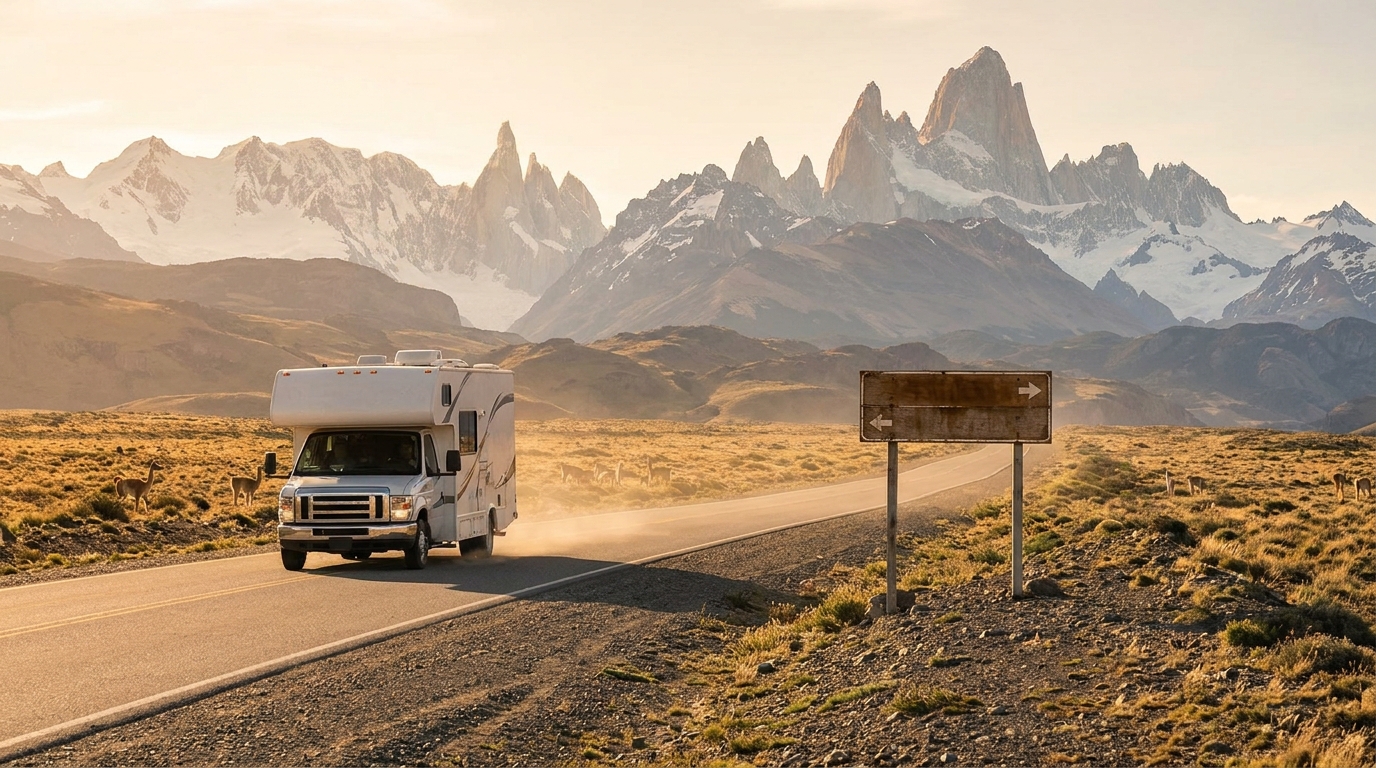
South America offers a myriad of incredible landscapes perfect for a rented motorhome adventure, with Argentina and Chile often highlighted for their extensive networks and diverse terrains.
RV Travel Highlights:
- Argentina: Explore the dramatic peaks of Patagonia, the vast open plains of the Pampas, or the wine regions around Mendoza. Argentina offers incredible scenery and a welcoming attitude towards RV travelers. For detailed planning, consider "RV Rental Deals in South America - Latest Offers 2026" which often include routes through Argentina.
- Chile: Drive the legendary Carretera Austral, wind through the Atacama Desert, or discover the glacial landscapes of Chilean Patagonia. Chile’s infrastructure is well-suited for RV exploration.
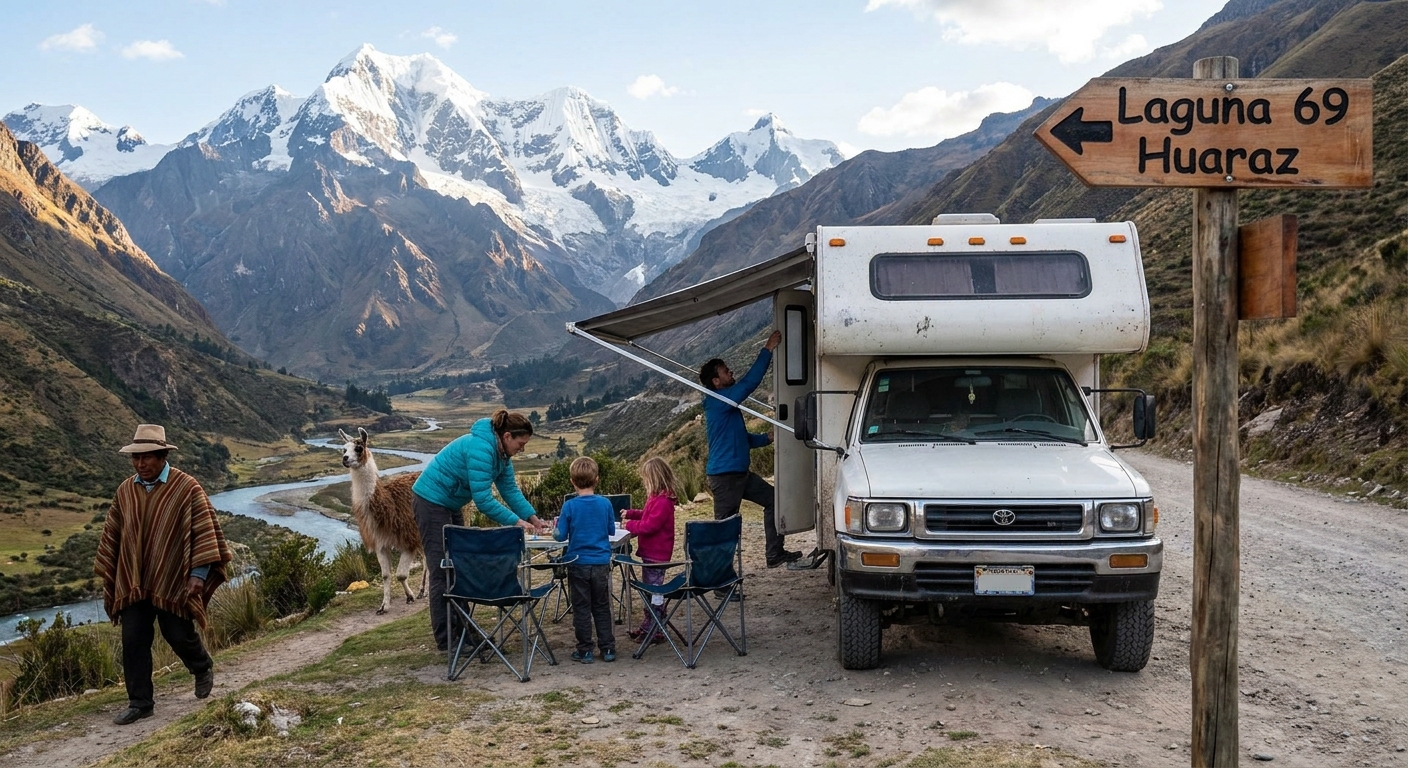
- Peru: Immerse yourself in ancient Incan history, stunning Andean vistas, and vibrant local markets. While roads can be challenging, the rewards are immense.
- Brazil: Discover the expansive coastline, the Amazon rainforest, or the colonial charm of its historic cities. An RV allows you to experience Brazil's incredible diversity firsthand.
- Ecuador & Colombia: These countries are increasingly popular for RV travelers, offering rich cultural experiences, volcanic landscapes, and burgeoning tourism infrastructure, though they require more careful planning regarding road conditions and security.
With a rented RV, you have a mobile headquarters to venture out to national parks and remote areas, enjoying the flexibility to follow the most captivating RV PLANET routes at your own pace.
Road Conditions & Terrain in South America
Road conditions in South America vary significantly by country and region, ranging from well-maintained highways to unpaved gravel tracks, necessitating a flexible driving approach for weekly RV renters.
Major routes connecting large cities, such as Argentina's Ruta 40 or Chile's Carretera Austral, often feature paved sections but also include extensive stretches of gravel or dirt. Drive slowly and carefully, and you can drive almost anywhere without issues. No need to stress - just use common sense and pay attention. Mountainous terrain, especially in the Andes, means winding roads, steep inclines, and potential exposure to diverse weather conditions. Urban driving can be challenging due to dense traffic and different driving customs, making a steady pace and awareness key.
RV Size Limits, Bridges & Restricted Zones
While explicit overall RV size limits are less common across South America than in some European countries, drivers should be mindful of practical limitations concerning bridge clearances, ferry capacities, and access to historic city centers.
Low bridges and tunnels can be encountered, especially on older routes or in urban areas; always pay close attention to posted height and weight restrictions. When planning ferry crossings, such as those along the Carretera Austral in Chile, it is crucial to book in advance and confirm the maximum dimensions your rented motorhome can accommodate. Some cities or protected natural areas may have environmental zones or restricted access for larger vehicles. Drive slowly and carefully, and you can drive almost anywhere without issues. No need to stress - just use common sense and pay attention.
Fuel: Diesel vs. Petrol & Cost per 100 km
Diesel is the predominant fuel type and generally more readily available than petrol in many parts of South America, especially outside major cities, making diesel-powered RVs a practical choice for weekly renters.
Based on Bandana's global fleet averages, Class SI Semi-integrated and Class C Alcove RVs typically consume 10-12 Liters/100 km, while Class B Camper Vans average 8-10 Liters/100 km. For example, a "cruise america rv rental example Explorer" (Class C) has a 75 Liter fuel tank and consumes 11 Liter / 100 Km. The cost per 100 km for an RV in South America can vary significantly by country and fuel price fluctuations, but as a rough estimate, with diesel prices around $1.00 - $1.50 USD per liter, expect to pay approximately $8 - $18 USD per 100 km depending on vehicle type and driving conditions. It's advisable to fill up whenever possible, especially before heading into remote areas, as fuel station density can be sparse. For budgeting ancillary trip costs like fuel, remember that RV PLANET routes allow you to itemize and track every expense along the way for easy management. On the routes offered through RV PLANET routes, you can itemize and track every expense along the way for easy budgeting.
Tolls, Vignettes & Border Rules
RV travelers in South America will encounter various toll roads, particularly on major highways connecting urban centers, which can be paid with local currency or sometimes with credit cards, though cash in small denominations is always recommended.
Unlike some regions with mandatory vignette systems, South American countries primarily use traditional toll booths for road usage, meaning no pre-purchased stickers are generally required for specific regions. Border crossings between South American countries can be time-consuming and require specific documentation, including your passport, vehicle registration (provided by the rental company), proof of insurance valid for the destination country, and an International Driving Permit (IDP). For pets traveling with you, ensure you have up-to-date vaccination records, international health certificates, and compliance with the specific entry requirements of each country, which often include microchipping and parasite treatments. Always allow ample time for border formalities to avoid fines or delays.
Driving Tips for weekly rv rental Travelers
For family travelers on a weekly RV rental in South America, planning for frequent stops every 2-3 hours allows children to stretch and explore, making the journey part of the adventure rather than just transit.
🎬 Video coming soon
Travel slowly, aiming for a maximum of 100-150 km per day on average, to truly connect with the culture, food, and scenery. To manage costs, budgeting for local markets for groceries can significantly reduce food expenses compared to restaurants. Consider learning basic Spanish or Portuguese phrases to enhance interactions with local communities, respecting local customs and driving etiquette. Always secure your rented motorhome at night in designated campgrounds or well-lit areas, avoiding conspicuous displays of valuables to minimize risks.
Recommended RV Class for South America Roads
For a weekly RV rental adventure in South America, Class SI Semi-integrated and Class C Alcove RVs are highly recommended due to their balanced combination of comfort, space, and relative maneuverability on diverse road conditions.
Bandana's global fleet indicates Class SI Semi-integrated RVs average 6.9 meters in length with 3.8 sleeping places, offering a good compromise between interior space and ease of driving on varying South American roads. For example, a "Category Family 5" model offers 6 sleeping places, a 100 Liter fresh water tank, and a 3-burner gas stove, ideal for families. Class C Alcove RVs, averaging 7.5 meters in length with 5.8 sleeping places, provide ample space for families or larger groups, proving robust enough for the region's main highways and well-trodden routes. These classes generally offer sufficient ground clearance to handle common gravel sections or minor imperfections found on South American roads, reducing concerns about scraping the undercarriage.
Should I Choose a Compact Van Instead of a Large RV in South America?
For most weekly RV rentals in South America, there is generally no issue driving any RV size, and the enhanced comfort and indoor space of a larger RV often provide a better experience than the marginal maneuverability gains of a compact van.
While a compact campervan (like a Class B, averaging 5.8 meters from Bandana's global fleet) genuinely helps when navigating tight historic city centers or very narrow mountain passes, a larger rented motorhome offers significantly more living space, larger beds, better bathroom facilities, and more storage for gear, which greatly enhances comfort on a week-long trip. Drive slowly and carefully, and you can drive almost anywhere without issues. No need to stress - just use common sense and pay attention. The perceived maneuverability advantage of a compact van often diminishes outside of dense urban environments, as larger RVs are designed to handle varied road conditions and offer a more stable and comfortable ride over longer distances.
Can I Park Anywhere? Free & Wild Camping Rules in South America
While 'wild camping' or 'boondocking' is often tolerated in many remote and rural areas of South America, especially in countries like Argentina and Chile known for vast open spaces, explicit rules vary greatly by country, region, and even municipality.
Many national parks and protected areas have strict regulations regarding overnight stays, typically requiring visitors to use designated campgrounds or authorized parking areas. For a weekly RV rental, utilizing established campgrounds (either private or state-run) provides access to amenities like water, electricity, and waste disposal, along with enhanced security, making them a preferable option for most travelers. When considering free camping, always prioritize safety by choosing well-lit, visible spots, ideally near a local town or with other campers, and avoid isolated or obviously private property without permission. Always check local regulations, respect private property signs, and call ahead before driving to ensure you'll find a spot. If not at the first campground, then the next one.
Can I Drive an RV Into the City Center? Heights, Tunnels & Local Signage
Yes, you can almost always drive an RV into city centers in South America, though certain restrictions, narrow streets, and limited parking options may make it challenging, especially for larger vehicles.
Drive slowly and carefully, and you can drive almost anywhere without issues. No need to stress - just use common sense and pay attention. Pay close attention to local signage, which will indicate height limits for tunnels, low bridges, and multi-story parking garages; these are typically well-marked in meters. Some historical city centers may have environmental zones or residents-only streets that restrict vehicle access based on size or emissions. For weekly RV rentals, consider parking on the outskirts of major cities at designated RV parks or secure parking lots and using public transportation or taxis to explore the city center, offering a less stressful experience. Smaller RVs like Class B Camper Vans (averaging 5.8 meters) are more agile for urban exploration.
What is the 3-3-3 rule for RV living?
The '3-3-3 rule' for RV living is a popular guideline suggesting a relaxed travel pace, encouraging RVers to drive no more than 300 miles (approximately 480 km) a day, arrive at their destination by 3 PM, and stay for at least 3 nights.
This rule is particularly beneficial for weekly RV rentals in South America, allowing ample time to enjoy each location without feeling rushed, account for unexpected delays due to road conditions, and properly set up camp. Driving no more than 300 miles helps prevent driver fatigue and provides a comfortable pace for navigating unfamiliar roads and diverse terrain. Arriving by 3 PM ensures you have sufficient daylight to find your campsite, get settled, and address any immediate needs before nightfall. Staying for at least 3 nights allows for genuine exploration of the area, relaxation, and minimizes constant packing and unpacking.
Can you technically drive from North America to South America?
Technically, you cannot drive an RV directly from North America to South America due to the impassable Darien Gap, a dense, undeveloped stretch of jungle and swampland spanning about 100 miles at the border of Panama and Colombia.
The only practical method for RV travelers to bridge the Darien Gap is to ship their vehicle, typically via roll-on/roll-off (RoRo) cargo ship or container from Panama to Colombia or vice versa. Shipping an RV involves significant logistics, including customs paperwork, port fees, and insurance for transit, which can add substantial time (weeks) and cost (thousands of USD) to your journey. For weekly RV rentals in South America, it is far more practical and recommended to fly into a major South American city and rent an RV locally, bypassing the complex and costly Darien Gap shipping process entirely.
What is the 2 2 2 rule for RV travel?
The '2-2-2 rule' for RV travel is a conservative guideline for a more relaxed itinerary, recommending that RVers drive no more than 200 miles (approximately 320 km) a day, arrive at their destination by 2 PM, and stay for at least 2 nights.
This rule provides an even more leisurely pace than the 3-3-3 rule, ideal for weekly RV renters who prefer ample time for sightseeing, relaxing, or who are new to RVing in challenging terrains like those found in parts of South America. Limiting daily driving to 200 miles significantly reduces stress and allows for spontaneous stops at interesting sights or charming towns along the way. Arriving by 2 PM ensures maximum daylight hours for setting up camp and exploring the immediate surroundings. Staying for at least 2 nights allows travelers to fully experience a location without constant movement, making it particularly suitable for families or those seeking a more immersive cultural experience during their weekly rental.
Which countries are RV friendly?
Several South American countries are highly RV-friendly, with Argentina and Chile often cited as the most popular and well-equipped for overland travel due to their extensive road networks, stunning natural parks, and established camping infrastructure.
Argentina offers vast landscapes, including Patagonia and the Andean foothills, with a culture that embraces wild camping in many areas, alongside numerous formal campgrounds. Chile provides a diverse range of environments from the Atacama Desert to the fjords of Patagonia, with well-maintained roads like the Carretera Austral (though with gravel sections) and a strong emphasis on national park camping. Countries like Peru, Ecuador, and parts of Colombia are increasingly welcoming to RV travelers, offering incredible historical sites, vibrant cultures, and varied terrains, though road quality and camping infrastructure can be more inconsistent. When choosing an RV-friendly country for a weekly rental, consider factors like political stability, ease of border crossings, and fuel availability.
What is the 444 rule for RV?
The '4-4-4 rule' for RV travel is a less common but still valid guideline for trip planning, suggesting that RVers drive no more than 4 hours a day, arrive by 4 PM, and stay for at least 4 days at each destination.
This rule is particularly suited for weekly RV rentals where travelers desire an exceptionally relaxed pace, prioritizing deep exploration of fewer locations over covering vast distances. Limiting daily driving to 4 hours minimizes fatigue and maximizes time available for leisure, allowing for more spontaneous activities and unhurried travel through South America's diverse landscapes. Arriving by 4 PM provides ample time to set up camp, prepare meals (you can find inspiring RV-friendly recipes playlist online), and settle into the new environment before sunset, contributing to a stress-free experience. Staying for at least 4 days allows for comprehensive exploration of local attractions, participation in activities, and a stronger sense of immersion in the culture and natural beauty of each stop, ideal for those seeking a tranquil and enriching weekly RV adventure.
What is the largest RV you can drive without a special license?
In most South American countries, the largest RV you can typically drive without a special commercial or heavy vehicle license is one with a Gross Vehicle Weight (GVW) of up to 3.5 metric tons (3,500 kg or approximately 7,700 lbs).
This weight limit generally encompasses most Class B Camper Vans, Class SI Semi-integrated RVs, and many smaller Class C Alcove models available for weekly rental, such as a "Category Small" motorhome. For example, a "rent a motorhome example CA-25" has a GVW within this range, making it accessible with a standard license. For vehicles exceeding 3.5 metric tons GVW, a higher license category (e.g., a European C1 license or equivalent) is usually required, similar to regulations in many parts of the world. It's crucial to confirm the specific GVW of your chosen rental RV and verify that your national driver's license, accompanied by an International Driving Permit (IDP), covers that weight class for travel in South America.
Can US citizens travel to South America without a visa?
Whether US citizens can travel to South America without a visa depends entirely on the specific country they plan to visit, as visa requirements vary significantly across the continent for a weekly RV rental trip.
Many popular RV destinations like Argentina, Chile, Colombia, Ecuador, Peru, and Uruguay allow US citizens visa-free entry for tourism purposes, typically for stays of 90 days or less. However, Brazil, as of 2026, generally requires US citizens to obtain an electronic visa (eVisa) prior to arrival, while other countries like Bolivia may require a visa upon arrival or in advance. It is imperative for US citizens planning an RV trip to South America to research the most current visa requirements for each country they intend to enter or transit through well in advance of their departure, as policies can change. Always carry copies of your passport, visa (if required), and any entry/exit stamps, and be aware of the maximum allowed stay.
Who has the least expensive RV insurance?
Determining 'who has the least expensive RV insurance' for international travel in South America is complex, as costs vary widely based on coverage type, deductible, rental company policies, duration of rental, and driver profile, making a direct 'cheapest' provider difficult to pinpoint.
For weekly RV rentals, insurance is typically included in the rental cost as part of a basic package, which often covers third-party liability and a certain level of collision damage with a deductible. Many rental companies offer supplementary insurance options to reduce deductibles or enhance coverage for international travel, which while increasing the upfront cost, can offer significant peace of mind. Remember, with Bandana Caravan, you can upgrade to a top-level deductible for extra peace of mind, an optional upgrade not included by default. Travelers should thoroughly review the insurance policy provided by their RV rental company to understand what is covered, what exclusions apply, and the extent of their financial liability in case of an accident or damage.
What You Shouldn't Miss
Looking for expert insights from Avi Bandana? Top 5 Adventures - recommendations from Avi Bandana:
- Patagonian Wonders (Argentina & Chile): Explore the colossal Perito Moreno Glacier, hike in El Chaltén with views of Fitz Roy, and traverse the dramatic landscapes of Torres del Paine National Park.
- Andean Heights & Ancient Cultures (Peru & Bolivia): Drive through the Sacred Valley to Machu Picchu, discover the breathtaking Lake Titicaca, and explore the vibrant markets and ancient ruins of the Andes.
- Atacama Desert Stargazing (Chile): Witness one of the clearest night skies on Earth in the driest desert, offering unparalleled astronomical experiences and unique lunar-like landscapes.
- Amazonian Immersion (Brazil, Ecuador, Peru): Experience the unparalleled biodiversity of the Amazon rainforest on a guided tour, discovering incredible wildlife and lush ecosystems.
- Coastal Charms & City Vibrancy (Brazil & Uruguay): Enjoy the sun-drenched beaches of Brazil, from Rio de Janeiro to Florianópolis, and explore the artistic streets of Montevideo and colonial beauty of Colonia del Sacramento in Uruguay.
Final Thoughts
A week-long RV driving tour in South America promises an unforgettable blend of adventure, culture, and stunning natural beauty. From the rugged peaks of Patagonia to the vibrant energy of its cities, traveling by a rented motorhome offers a unique perspective and unparalleled flexibility. Remember to travel slowly, embrace the unexpected, and let the open road guide you to incredible discoveries.
We're here to support you every step of the way, from comparing options to coordinating your booking. Get inspired for your next trip! Whether you're seeking "Cheap RV Rental in South America - Budget Guide 2026" or more luxurious options, we have the expertise to help you plan a trip itinerary in advance with minimal effort and maximum enjoyment. Your South American RV adventure awaits!
Check South America RV Rental Prices Now