
In This Guide
- Can You Drive an RV in UK? License & Age Rules
- Road Conditions & Terrain in UK
- RV Size Limits, Bridges & Restricted Zones
- Fuel: Diesel vs. Petrol & Cost per 100 km
- Tolls, Vignettes & Border Rules
- Driving Tips for last minute rv rental Travelers
- Recommended RV Class for UK Roads
- Should I Choose a Compact Van Instead of a Large RV in UK?
- Can I Park Anywhere? Free & Wild Camping Rules in UK
- Can I Drive an RV Into the City Center? Heights, Tunnels & Local Signage
- What do I need to know before driving an RV in the UK?
- How much does it cost to go to the UK in a motorhome?
- Is it easy to drive a motorhome in the UK?
- What is the best month to motorhome in the UK?
- What is the best route for a motorhome in the UK?
Can You Drive an RV in UK? License & Age Rules
Navigating the UK in a rented RV is accessible to most with a standard driving license, but it's crucial to understand the specific requirements. A standard UK Category B license, which most car drivers hold, permits you to drive RVs with a Maximum Authorised Mass (MAM) of up to 3,500kg. For heavier vehicles, typically those exceeding 3,500kg and up to 7,500kg MAM, you'll need a Category C1 license or 'grandfather rights' if your license was obtained before January 1997.
Rental companies generally set a minimum driver age, often 25 years old, especially for larger motorhomes. However, some may allow drivers aged 21 and over, though this can sometimes incur a young driver surcharge. For international visitors, ensure your national driving license is valid. An International Driving Permit (IDP) is highly recommended if your license isn't in English or issued by an EU/EEA country, and it may be mandatory for certain nationalities. Always confirm with your rental provider and check the specific vehicle's MAM to ensure compliance with your license category.
Road Conditions & Terrain in UK
The UK's road network is extensive and generally well-maintained, but the terrain can vary dramatically, adding an element of adventure to your last-minute RV rental experience. You'll find the country boasts a comprehensive motorway network, such as the M1, M6, and M4, offering smooth, multi-lane driving ideal for covering longer distances efficiently. These motorways are typically clearly signposted and well-kept.
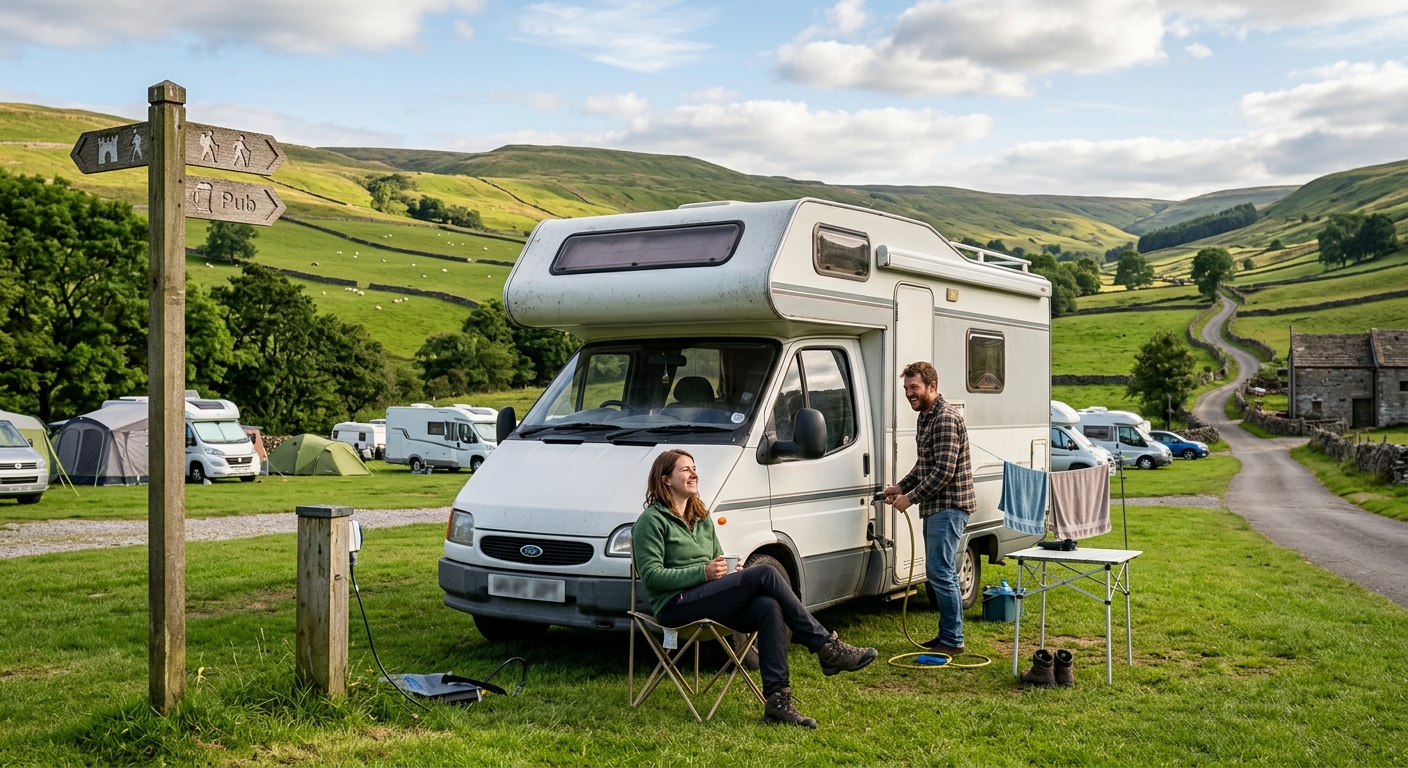
However, venture off the motorways onto A and B roads, and you'll encounter a different driving landscape. These roads are often narrower, winding, and can be bordered by high hedgerows or stone walls, particularly in picturesque rural areas like the Cotswolds, the Lake District, or through charming villages. In the more remote regions of the Scottish Highlands or parts of Wales, you may even encounter single-track roads with designated 'passing places'. It's essential to drive slowly and carefully, using these passing places to allow oncoming traffic or faster vehicles to overtake. Urban driving can present its own challenges with congestion and complex roundabouts, so staying alert and embracing a slightly slower pace will allow you to fully appreciate the diverse beauty of the UK's landscapes.
RV Size Limits, Bridges & Restricted Zones
When planning your last-minute RV rental in the UK, being aware of size restrictions, low bridges, and designated restricted zones is paramount to avoiding damage and ensuring a smooth journey. Low bridges are a common feature across the UK, especially on older routes, near railway lines, or within historic town centers. Always pay close attention to signage indicating maximum height clearances, which are often marked in meters and feet (e.g., 3.0m or 10ft). Exceeding these limits can cause significant damage to your rented RV.
Many historic village centers and market towns have narrow streets, sharp turns, and explicit width restrictions that can make navigation challenging for larger RVs. It might be necessary to find alternative routes or park on the outskirts and explore by public transport. If your itinerary includes London, be aware of the Ultra Low Emission Zone (ULEZ) and the Congestion Charge zone, which may apply charges to vehicles that don't meet specific emission standards. Checking your rental RV's compliance is vital if you plan to enter the capital. Additionally, if you intend to use ferry services, for example, to reach Scottish islands or the Isle of Wight, always declare your RV's accurate dimensions (length and weight) when booking, as restrictions are strictly enforced.
Fuel: Diesel vs. Petrol & Cost per 100 km
The vast majority of RVs available for rental in the UK are diesel-powered, and fortunately, diesel fuel is readily accessible at service stations across the country. Diesel is typically the preferred fuel for motorhomes as it generally offers better fuel economy, a crucial factor for managing costs on longer journeys with larger vehicles.
When budgeting for fuel, a reasonable estimate for a typical rental RV from Bandana's fleet is around 10 to 12 litres per 100 km, though this can vary based on the specific vehicle class, passenger load, and your driving style. Based on current fuel prices in 2026, you should budget approximately £15-£20 per 100 km for diesel. To potentially save on fuel costs, consider refueling at larger supermarket fuel stations, which often offer more competitive prices compared to those found directly on motorways. On the routes offered through RV PLANET routes, you can itemize and track every expense along the way for easy budgeting.
Tolls, Vignettes & Border Rules
The UK primarily operates on a point-to-point toll system rather than a vignette sticker like some other European countries. Tolls are typically applied to specific bridges, tunnels, and select road sections to help fund their maintenance and construction. Key toll points to be aware of include the M6 Toll in the Midlands, the Dartford Crossing east of London, the Severn Bridges connecting England and Wales, and various smaller bridges across Scotland.
Payment methods for these tolls can vary. Many now use Automatic Number Plate Recognition (ANPR) systems, requiring payment online by midnight the day following your crossing, while some traditional booths still accept cash or card payments. It's important to note that there are no border tolls when traveling between England, Scotland, and Wales within the United Kingdom itself. However, if your journey extends to Northern Ireland, the Republic of Ireland, or continental Europe via ferry or the Channel Tunnel, you will encounter their respective toll systems and potential border regulations, which are separate from UK charges. Some rental providers may offer optional pre-purchased toll passes, which can streamline your journey and help avoid unexpected fines or administrative fees.
Driving Tips for last minute rv rental Travelers
Embarking on a last-minute RV driving adventure in the UK requires a few key adjustments for a safe and enjoyable experience. The most significant is remembering to **drive on the left-hand side of the road**, which affects everything from lane positioning to roundabout navigation. Always give way to traffic coming from your right when entering a roundabout. Be exceptionally mindful of the RV's width, especially on narrow country lanes and in villages; utilize your wing mirrors diligently and judge clearances carefully to avoid contact with hedgerows or parked vehicles.
Mastering UK roundabouts, particularly the multi-lane ones found in larger towns and cities, is crucial. Generally, for exits before the 12 o'clock position (straight ahead), use the left lane. For exits after 12 o'clock, indicate early and use the right lane. On single-track roads, actively look for and use designated 'passing places' to allow oncoming traffic or faster vehicles to pass. Finally, remember to schedule frequent breaks, ideally every 2-3 hours, to combat driver fatigue, which is particularly important on longer journeys.
Recommended RV Class for UK Roads
For navigating the diverse roads of the UK, both the compact agility of a Class B Camper Van and the balanced comfort of a Class SI Semi-integrated motorhome are often recommended. The 'Class B - Camper Van' models, typically averaging around 5.8 meters in length from Bandana's fleet, are excellent for their maneuverability. They make tackling tighter country lanes, finding parking in towns, and accessing more remote locations much easier. These are well-suited for couples or small families, often achieving fuel efficiencies of 8-10 Liters/100 Km.
Stepping up slightly, the 'Class SI - Semi-integrated' models, averaging about 6.9 meters in length, offer a significant increase in living space and amenities (typically sleeping 3-4 people comfortably) while remaining manageable on most UK roads. Their fuel consumption is usually around 10-11 Liters/100 km, striking a good balance between space and practicality. While larger Class C Alcove (average 7.5m) and Class A Integrated (also around 7.5m) motorhomes are certainly viable options for exploring the UK, they do require more driver confidence on very narrow routes and might limit access to some smaller, historic villages or tightly packed campsites. For a last-minute RV rental, opting for a Class B or SI often provides the best blend of comfort and capability across the varied UK terrain.
Should I Choose a Compact Van Instead of a Large RV in UK?
While a compact van, like a Class B campervan, certainly offers superior maneuverability in tight spaces and can be easier to park, a slightly larger RV often provides a more balanced and comfortable experience for many last-minute RV rental trips across the UK, without significantly hindering your ability to explore.
For travelers prioritizing the absolute ease of parking, navigating extremely narrow country lanes, or frequently accessing historic city centers with very restrictive height and width limits, a compact camper van (e.g., a Class B, averaging 5.8m in length) can indeed be a more advantageous choice. However, for the majority of UK road networks and popular touring routes, the enhanced living space, more comprehensive onboard facilities, and overall comfort of a larger Class SI semi-integrated motorhome (averaging 6.9m) or even a Class C alcove model (averaging 7.5m) typically outweigh the minor trade-offs in maneuverability. Most main roads and many scenic routes are well-suited for standard motorhome sizes, allowing for a more relaxed and amenity-rich travel experience. Ultimately, the decision hinges on your itinerary priorities: ultimate compactness versus enhanced comfort and amenities.
Can I Park Anywhere? Free & Wild Camping Rules in UK
Understanding the rules around overnight parking and wild camping is crucial for RV travelers in the UK. Generally, wild camping in an RV without explicit permission from the landowner is restricted across much of England and Wales. Overnight parking in public car parks or lay-bys is often prohibited by local bylaws or indicated by signage.
Scotland, however, offers a more liberal approach under its 'right to roam' laws, which generally permit responsible wild camping, including in motorhomes, provided you adhere strictly to the 'leave no trace' principle and respect local privacy and the environment. It's important to note that even in Scotland, certain popular areas, like Loch Lomond & The Trossachs National Park, may have specific restrictions, requiring permits or designated parking bays for overnight stays. For ethical camping, always pack out all rubbish, utilize designated waste disposal points, and be mindful of local communities and wildlife. To find suitable overnight stops, consider using apps like Park4Night or exploring schemes like Brit Stops, which offer free overnight parking at participating pubs, farms, or vineyards for self-contained RVs. Always check local regulations before parking overnight, as rules can vary significantly by region.
Can I Drive an RV Into the City Center? Heights, Tunnels & Local Signage
Yes, you can generally drive an RV into most UK city centers, but it requires meticulous attention to specific local signage, height and width restrictions, and potential environmental zones. Most city centers are accessible, but drivers must remain highly vigilant for signs indicating explicit height or width limitations, particularly in older, historic areas, or around ancient buildings and railway arches.
Be prepared for narrow streets and potential low bridges or tunnels, always adhering to marked clearances to prevent accidents and damage to your rental vehicle. Environmental zones, such as London's Ultra Low Emission Zone (ULEZ), may impose charges on vehicles that do not meet specific emission standards; verify your RV's compliance on the relevant city council websites before entering. Parking in city centers can be challenging and often expensive. In many cases, it's advisable to park your RV on the outskirts at a designated RV-friendly car park or campsite and then utilize public transport for exploring the city center, offering a more relaxed and cost-effective experience.
What do I need to know before driving an RV in the UK?
Before you set off on your UK RV adventure, familiarizing yourself with a few key pieces of information will ensure a smoother and more enjoyable journey. Understanding the fundamental driving adjustments, such as **driving on the left-hand side**, is the most crucial element for international visitors. Take ample time to get comfortable with your RV's dimensions, controls, and features before embarking on longer distances or complex routes. A general rule of thumb is to spend the first hour or so getting acquainted with the vehicle's handling.
Ensure you carry all necessary documentation: your valid driving license (and International Driving Permit if required), the RV rental agreement, proof of insurance, and your passport. For reliable navigation and communication, especially in rural areas, securing a local UK SIM card is highly recommended. Utilize GPS systems or apps like CoPilot RV, which are often tailored for larger vehicles and can help you avoid low bridges, narrow roads, and steep inclines. If you plan to travel with pets, thoroughly research UK pet import rules and identify pet-friendly campsites and attractions well in advance to avoid any logistical issues.
How much does it cost to go to the UK in a motorhome?
The total cost of a motorhome trip to the UK can vary significantly based on several factors, including rental duration, the class of RV, seasonality, and your personal travel style. Your budget will encompass rental fees, fuel expenses, campsite charges, and daily living costs.
Rental Costs: Last-minute RV rentals can sometimes offer discounts due to limited availability, but prices are often higher. Expect costs to range from approximately £70-£160 per day for a Class C motorhome, influenced by the RV's size, features, and rental length. Fuel Expenses: As noted, budget around £15-£20 per 100 km for diesel, with total fuel costs directly proportional to your itinerary's mileage. Campsite Fees: Pitches typically range from £20-£50 per night, varying by location, facilities (from basic to full-hookup sites), and season. Opting for 'wild camping' where legally permitted can significantly reduce this cost. Don't forget to allocate funds for entry fees to attractions, historical sites, and national parks. If planning ferry trips to islands or Ireland, factor in those costs. For peace of mind, consider additional travel insurance. Self-catering is budget-friendly, but enjoying local pub meals is part of the UK experience. For ideas you can prep on the road, watch our RV-friendly recipes playlist on YouTube.
Is it easy to drive a motorhome in the UK?
Driving a motorhome in the UK is generally manageable for most drivers, especially those accustomed to driving on the left, though specific challenges like narrow country lanes and complex multi-lane roundabouts demand extra attention and confidence.
The primary adjustment for many international visitors is consistently driving on the left side of the road. Rural roads can be particularly narrow, often bordered by high hedgerows, necessitating vigilance for oncoming traffic and skillful use of passing places. UK roundabouts, especially multi-lane versions, require clear lane discipline and timely indicator use. While city centers can be congested with tight turns and specific restrictions, it’s often strategic to park on the outskirts and use public transport. Overall, despite the unique challenges, the UK is a popular RV destination, and drivers typically adapt well to its road network with preparation and awareness.
What is the best month to motorhome in the UK?
The optimal time to motorhome in the UK depends heavily on your preferences for weather, crowd levels, and specific interests. However, spring (April-May) and early autumn (September-October) often present an ideal balance.
Spring (April-May): Offers pleasant, mild temperatures, vibrant blooming landscapes, and generally fewer tourists than summer, making it perfect for scenic drives and hiking. Summer (June-August) provides the warmest weather and longest daylight hours, ideal for coastal trips, but it is peak season, leading to higher prices and crowds. Autumn (September-October) brings mild temperatures, stunning foliage, and significantly reduced crowds after the summer rush, excellent for exploring historical sites and national parks. Winter (November-March) features colder weather, shorter days, and many seasonal closures, offering a quieter experience but requiring thorough preparation for potential adverse weather. Consider local event calendars and attraction opening times when planning your ideal motorhome trip.
What is the best route for a motorhome in the UK?
The 'best' motorhome route in the UK is subjective, but popular and incredibly scenic options abound, including the Scottish Highlands, various coastal drives, and historical trails. The North Coast 500 (NC500) in Scotland is a world-renowned 516-mile circular route celebrated for its dramatic landscapes, serene lochs, and ancient castles, though it requires navigating challenging single-track roads.
For coastal beauty, consider the South West Coastal Path in England, exploring the Jurassic Coast or the rugged Cornish coastline with its charming fishing villages and stunning beaches. Wales offers breathtaking mountainous scenery on routes like the Black Mountain Pass or drives through Snowdonia National Park. Alternatively, design a route around historical heartlands, perhaps the Cotswolds for idyllic villages, Hadrian's Wall for Roman history, or even a themed itinerary based on literary landscapes or 'Dark Sky' parks for stargazing.
What You Shouldn't Miss
- Drive the scenic North Coast 500 (NC500) through the Scottish Highlands, experiencing dramatic landscapes and ancient castles.
- Explore the Jurassic Coast in Dorset and Devon, part of England's South West Coastal Path, for stunning geological formations and picturesque seaside villages.
- Journey through the heart of the Cotswolds to discover charming, quintessential English villages like Bourton-on-the-Water and Stow-on-the-Wold.
- Walk sections of Hadrian's Wall in northern England, tracing the Roman Empire's frontier and exploring historical forts and museums.
- Experience the natural beauty and hiking opportunities in Snowdonia National Park, Wales, with its rugged mountains and crystal-clear lakes.
- Visit a designated 'Dark Sky' park, such as the Galloway Forest Park in Scotland or Exmoor National Park, for unparalleled stargazing opportunities away from light pollution.
Final Thoughts
Renting an RV for a last-minute trip in the UK offers an incredible sense of freedom and flexibility. While the UK's roads and regulations present unique considerations, with a bit of planning and awareness, you can have an unforgettable adventure.
Embrace the journey, take your time to savor the stunning landscapes, and enjoy the convenience of having your accommodation and transport combined. From the rolling hills of the Cotswolds to the dramatic peaks of the Scottish Highlands, a rented RV is your perfect companion for exploring the UK at your own pace. Start planning your spontaneous getaway today!
