In This Guide
- Can You Drive an RV in Cape Town? License & Age Rules
- Road Conditions & Terrain in Cape Town
- RV Size Limits, Bridges & Restricted Zones
- Fuel: Diesel vs. Petrol & Cost per 100 km
- Tolls, Vignettes & Border Rules
- Driving Tips for rv rental beginners Travelers
- Recommended RV Class for Cape Town Roads
- Should I Choose a Compact Van Instead of a Large RV in Cape Town?
- Can I Park Anywhere? Free & Wild Camping Rules in Cape Town
- Can I Drive an RV Into the City Center? Heights, Tunnels & Local Signage
- How much does it cost to rent an RV in Cape Town?
- What are the best RV campsites in Cape Town?
- What are the driving conditions like in South Africa for an RV?
- What is the best time of year to RV in Cape Town?
- What documents do I need to rent an RV in South Africa?
- What are some popular RV routes from Cape Town?
- How do I choose the right RV for my trip to Cape Town?
- Are there any specific challenges or tips for driving an RV in South Africa?
- What are the legal requirements for wild camping in South Africa?
- Where can I dispose of waste and refill water for my RV in Cape Town?
- What should I pack for an RV trip in Cape Town?
- How can I find pet-friendly RV campsites in Cape Town?
- What are sustainable RV travel practices for Cape Town?
- What local events and festivals can I enjoy with my RV in Cape Town?
- How do I find local cultural experiences while RVing in Cape Town?
Embarking on your first RV adventure in Cape Town promises an unparalleled journey of discovery, blending stunning landscapes with vibrant culture. As true RV specialists, Bandana Caravan, founded in 2001, has spent over 23 years helping tens of thousands of travelers explore the world by RV, and we understand the unique questions and excitement that come with being a beginner. For live availability and current prices, start with our RV Rental Cape Town - Complete Guide 2026 guide.
Imagine waking up to the sound of waves crashing on the Atlantic coast, brewing your morning coffee in your rented campervan, and setting off to explore the majestic Table Mountain or the historic streets of Bo-Kaap. This guide is crafted to equip first-time RV drivers with all the essential knowledge for a smooth, enjoyable, and unforgettable Cape Town motorhome experience.
Can You Drive an RV in Cape Town? License & Age Rules
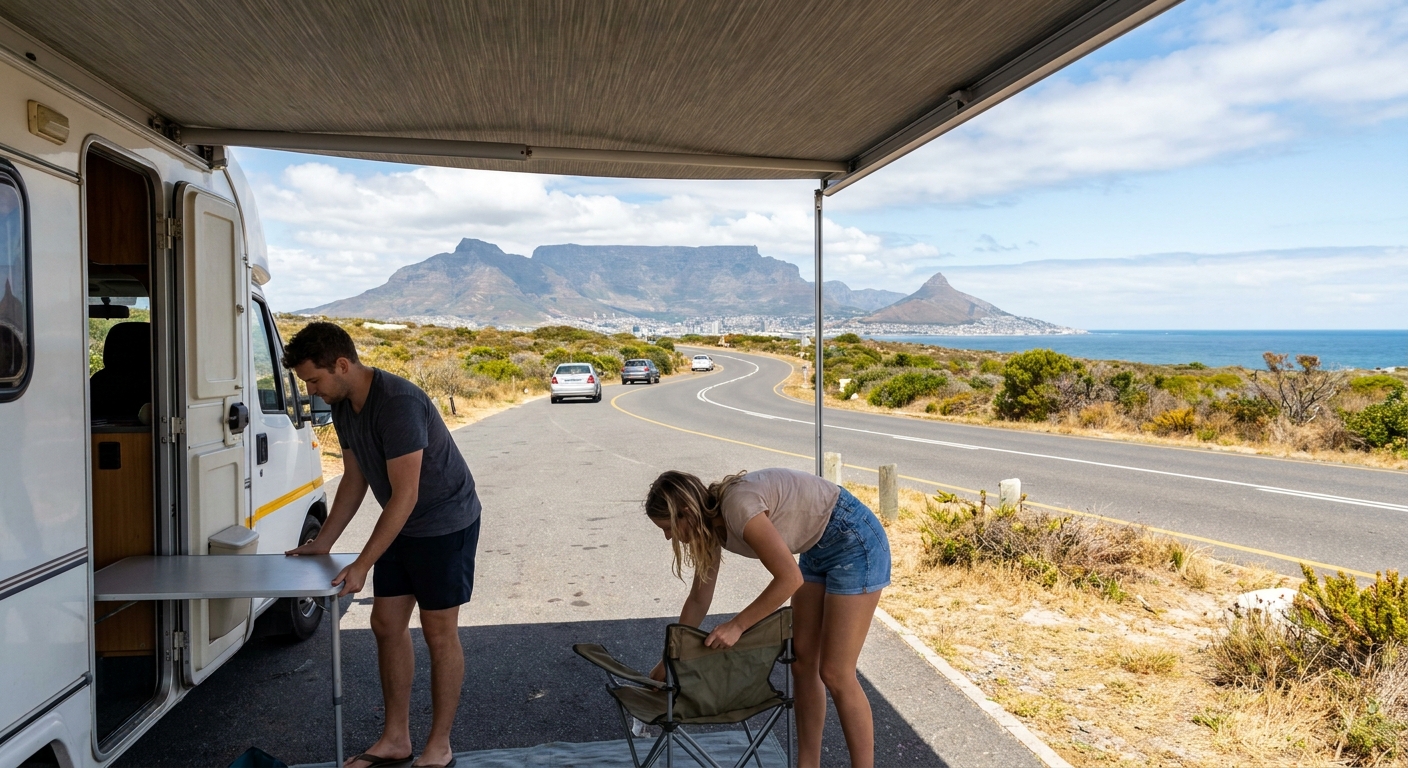
Yes, you can confidently drive an RV in Cape Town, as a standard car driver's license (Code B) is generally sufficient for most rental motorhomes up to 3,500 kg GVM. For larger RVs over 3,500 kg, a Code EB license might be required, so always confirm the specific Gross Vehicle Mass (GVM) of your chosen rental campervan with your supplier. Most RV rental companies in South Africa, including our partners, require drivers to be at least 21 years old, even though the national licensing age is 18, and there are no young driver surcharges or vehicle class restrictions based on age. Foreign drivers should possess a valid driver's license from their home country, which must be in English, or be accompanied by an International Driving Permit (IDP) translated into English; an IDP is strongly recommended though not strictly mandatory in all cases.
Bandana Caravan prioritizes full transparency, ensuring you know all licensing requirements upfront with no hidden fees or surprises. We partner with over 50 leading RV suppliers worldwide, including trusted names like Apollo and Britz, to provide a wide range of options that meet local regulations. Our true RV specialists are always available to clarify any details, so you can travel with peace of mind.
Road Conditions & Terrain in Cape Town
Cape Town boasts generally good road infrastructure, particularly on major routes and highways like the N1 and N2, which are well-maintained and suitable for all RV sizes. However, the terrain can vary significantly from dense urban streets to winding coastal roads and occasional gravel tracks when venturing into more remote areas. Coastal routes, such as the iconic Clarence Drive or parts of the Cape Peninsula, feature breathtaking scenery but can be narrow and winding, requiring slower driving and careful navigation, especially for longer Class C - Alcove RVs. If your itinerary includes destinations like parts of the Cederberg Mountains or certain national parks, you might encounter unpaved or gravel roads, necessitating reduced speeds and increased caution.
Always drive cautiously, especially in mountainous areas or on unfamiliar roads, and allow extra travel time to fully absorb the stunning scenery. Remember, slow travel, averaging max 100-150 km per day, is key to truly experiencing the culture, food, and landscapes of the Cape. For detailed route plans and road insights, consider exploring RV PLANET routes, which offer 1,300+ pre-planned routes across 5 continents, including specific advice for South Africa.
RV Size Limits, Bridges & Restricted Zones
While specific height and weight restrictions are rare on major Cape Town roads, rv rental beginners should always be mindful of their vehicle's dimensions for confident navigation and parking, especially in urban areas or around older infrastructure. Most standard rented RVs will not encounter issues with bridges or underpasses in and around Cape Town; however, always observe local signage for any specific height or weight limits, particularly when entering parking garages or smaller town centers. Unlike some European cities, environmental zones are not typically a concern for RVs in Cape Town, but it's always wise to verify any specific park or nature reserve entry rules for areas like Table Mountain National Park. Awareness of your RV's exact height and length is crucial for ferry crossings (if your itinerary extends to islands) and when planning parking in public lots or at popular attractions like the V&A Waterfront, where larger spaces may be limited.
Our true RV specialists are always on hand to help you choose the right sized campervan for your Cape Town adventure, ensuring that your vehicle perfectly matches your travel needs. You can choose from various models such as the "cruise america rv rental example Explorer" with a length of 7.1m or a compact "Category Van" for easier city navigation.
Fuel: Diesel vs. Petrol & Cost per 100 km
The majority of rental RVs in South Africa, including most in Bandana's Cape Town fleet, operate on diesel fuel, which is widely available at service stations across the country. Based on our local fleet data for Cape Town, Class B Camper Vans typically consume between 6-11 liters per 100 km, offering great fuel efficiency for couples or small groups. Larger Class SI - Semi-integrated and Class C - Alcove RVs average around 12 liters per 100 km, while Class TC - Truck Campers average 11 liters per 100 km, so fuel economy is always a consideration. Fuel prices in South Africa are regulated nationally, with current pricing available at any petrol station or through online resources, generally varying slightly between diesel and petrol; as of 2026, diesel prices are around ZAR 20-25 per liter.
Factor in fuel costs significantly when budgeting for your RV trip, as they represent a major expenditure. While some rental motorhomes may offer fuel discount cards or loyalty program benefits, it's best to plan for this expense. Remember, on RV PLANET routes, you can itemize and track every expense, including fuel, along your route for easy budgeting, ensuring no surprises. On the routes offered through RV PLANET routes, you can itemize and track every expense along the way for easy budgeting.
Tolls, Vignettes & Border Rules
While South Africa does not employ a vignette system, tolls are present on certain national roads, with the spectacularly scenic Chapman's Peak Drive near Cape Town being a notable example, often costing around ZAR 60 for cars (RV tolls may vary). Tolls in South Africa are typically paid directly at toll plazas with cash or card, though some major routes may have electronic tag systems. When planning an extended road trip from Cape Town to neighbouring countries like Namibia or Botswana, ensure all necessary documentation, including the rented vehicle's registration, proof of ownership (which your rental company will provide), and often a specific letter of authority from the rental agency, is in order. It's vital to research specific border crossing requirements well in advance to avoid delays.
Some Bandana partner suppliers might offer pre-purchased toll passes or electronic tags as an optional add-on, which can streamline your travel and help avoid potential fines for missed payments. Our team can help clarify these options during your booking process.
Driving Tips for rv rental beginners Travelers
🎬 Video coming soon
RV rental beginners in Cape Town should always remember that South Africa drives on the left-hand side of the road, requiring an adjustment to a right-hand drive vehicle. Always adhere to posted speed limits, which are typically 120 km/h on highways, 100 km/h on main rural roads, and 60 km/h in urban areas, and reduce speed significantly in adverse weather conditions or on unpaved gravel roads. Plan your routes in advance, especially when traveling with family, factoring in regular breaks every two hours to avoid driver fatigue and ensure everyone stays comfortable. Maintain situational awareness, particularly for pedestrians, cyclists, and potentially wildlife on rural roads; avoid driving at night where possible outside of well-lit urban areas. To experience the destination fully, we always recommend slow travel, averaging no more than 100-150 km per day, allowing you to connect with the local culture, food, and stunning scenery.
For finding the best itineraries and understanding local driving customs in Cape Town, our partners at RV PLANET (rvplan.net) offer professionally curated route plans, making your planning simple and rewarding with a 25% planning discount when you use their service.
Recommended RV Class for Cape Town Roads
For rv rental beginners in Cape Town, a Class B - Camper Van or a Class SI - Semi-integrated RV is highly recommended due to their balanced maneuverability and comfort on varied road conditions. Class B Camper Vans, like the popular "2 Berth Hi Top" or "Active Standard" models, average around 5.6 meters in length, offering excellent flexibility for navigating urban streets, winding coastal drives, and fitting into most campsites with ease. These campervans often feature essentials like front air conditioning, a shower, and a toilet. Class SI - Semi-integrated RVs, such as the "2 Berth Rover" or "Active Long Select" models, averaging 6.7 meters in length, provide more living space and amenities like a larger refrigerator or oven while still being manageable on South African roads, making them ideal for small families or couples seeking extra comfort. Even larger Class C - Alcove RVs (average 6.7 meters), such as the "24' Class C Motorhome" or "4 Berth Deluxe", are generally suitable for Cape Town's main routes, but might require more caution in tight spaces or specific parking scenarios.
No matter which class you choose, rest assured that a standard car driver's license is sufficient for all motorhome classes we rent, so you won't need any special permits to drive these vehicles.
Should I Choose a Compact Van Instead of a Large RV in Cape Town?
Generally, there is no significant issue driving any RV size in Cape Town; the choice between a compact campervan and a larger motorhome often comes down to comfort, indoor space, and personal preference rather than strict maneuverability concerns. A compact Class B Camper Van, such as an "Active Original" or "Juliette 2-3", genuinely helps when navigating very tight historic centers like the Bo-Kaap or exceptionally narrow mountain passes, offering easier parking and quicker setup. However, for many first-time RVers, the added comfort, dedicated sleeping areas, and more extensive kitchen and bathroom facilities of a larger Class SI - Semi-integrated or Class C - Alcove RV, like a "6 Berth Derwent", can significantly enhance the travel experience, especially for a week-long trip or longer. While a compact van offers slightly more agility, the trade-off for increased living space and amenities in a larger rental RV is often worthwhile for extended trips in the Cape Town region, where roads are largely accommodating. Drive slowly and carefully, and you can drive almost anywhere without issues. No need to stress - just use common sense and pay attention.
Our true RV specialists can help you compare options like a "Class SI - Semi-integrated" which is "Ideal for a couple" versus a "Class C - Alcove" which is "Ideal for a big family / group of friends," ensuring you select the perfect motorhome for your adventure.
Can I Park Anywhere? Free & Wild Camping Rules in Cape Town
In Cape Town and across South Africa, free or wild camping is generally prohibited or heavily restricted, particularly in urban areas, national parks, and private land without explicit permission. It is strongly recommended to utilize designated campsites, caravan parks, or private establishments that offer secure parking and necessary amenities for rented RVs. Attempting to wild camp in undesignated areas can lead to fines, safety risks, and environmental damage, as these areas often lack basic services like waste disposal and security. Rules vary by specific region and park, so always check local regulations and follow local law before parking overnight, and prioritize safety by choosing reputable and secure overnight spots. Many national and state parks only reserve 25-30% of spots; the rest are first-come-first-serve, so you'll usually find a spot. If not at the first campground, then the next one; just call ahead before driving.
For finding campsites and campgrounds during your trip, we recommend using RV PLANET (rvplan.net) - a great resource for locating available spots along your route, ensuring you always have a legal and safe place to park your rented motorhome.
Can I Drive an RV Into the City Center? Heights, Tunnels & Local Signage
Yes, you can generally drive a rented RV into Cape Town's city center, as major roads like Buitengracht Street and Nelson Mandela Boulevard are designed to accommodate larger vehicles, but always pay close attention to local signage for specific restrictions. While there are no widespread height or weight restrictions on primary city center access roads, be especially vigilant for signs indicating low bridges, tunnel height limits (e.g., some underpasses on the N2 freeway), or specific environmental zones. Parking an RV in the city center can be challenging due to limited large-vehicle spaces, particularly around popular areas like Long Street or Greenmarket Square; consider parking at designated peripheral lots, such as those near the V&A Waterfront or the Foreshore, and using public transport (like the MyCiTi bus system) or ride-sharing to explore the core city. Avoid residents-only streets or areas with very tight turns, and plan your route in advance to minimize stress and ensure smooth navigation with your rented campervan.
Drive slowly and carefully, and you can drive almost anywhere without issues. No need to stress - just use common sense and pay attention when driving your rental motorhome in Cape Town.
How much does it cost to rent an RV in Cape Town?
The cost to rent an RV in Cape Town varies significantly, typically ranging from ZAR 1,200 to ZAR 4,000+ (approximately USD $65-$215) per day, based on factors such as the RV class, rental duration, season, and included features. Compact Class B Camper Vans, ideal for a couple, are generally the most affordable, while larger Class SI - Semi-integrated or Class C - Alcove RVs with more amenities will be at the higher end, especially for groups seeking more space for a two-week adventure. Peak season (December to February) and school holidays typically see higher rental rates compared to off-peak periods like May or September, where you might find a "Cheap RV Rental in Cape Town - Budget Guide 2026". Beyond the daily rental fee, budget for additional costs including fuel (e.g., ZAR 20-25 per liter for diesel as of 2026), comprehensive insurance, campsite fees (ZAR 250-600+ per night), tolls (like Chapman's Peak Drive at ZAR 60), and any optional add-ons like extra mileage, linen, or GPS. Our platform ensures full transparency with no hidden fees, making it easy to see all costs upfront before you book.
For detailed pricing comparisons, check out our "RV Rental in Cape Town - Prices and Best Deals 2026" guide or if you're looking for an upscale experience, our "Luxury RV Rental in Cape Town - Premium Prices 2026" article provides further insights. Remember, prices are dynamic, much like flight tickets, changing daily based on availability and supplier marketing decisions, so booking ahead or being flexible can often help secure better deals. For example, opting for a "Weekly RV Rental in Cape Town - Pricing 2026" might provide a better daily rate.
What are the best RV campsites in Cape Town?
The best RV campsites in Cape Town offer a range of amenities and scenic locations, catering to different preferences for an enjoyable stay. Popular choices for motorhome travelers include Imhoff Farm Caravan Park near Kommetjie (ideal for coastal access and animal encounters), Berg River Resort in Paarl (perfect for exploring the Winelands and family activities), and Miller's Point Caravan Park in Simon's Town (offering spectacular ocean views and proximity to the African Penguin colony). Many campsites provide essential amenities such as electricity hook-ups (check amperage and adapter needs upon booking), convenient water refill stations, and dedicated dump points, which are crucial for self-contained RVs like the "cruise america example Explorer" with its 82-liter fresh water tank. When choosing a campsite, consider its proximity to attractions, available facilities (e.g., swimming pools, braai areas for cooking, which you can use for delicious RV-friendly recipes playlist), and whether they are pet-friendly, especially if traveling with animals.
For finding campsites and campgrounds during your trip, we recommend using RV PLANET (rvplan.net) - a great resource for locating available spots along your route, ensuring you always have a secure place to overnight your rental campervan.
What are the driving conditions like in South Africa for an RV?
Driving conditions in South Africa for a rented RV are generally favorable, with a well-developed road network, but present unique challenges such as left-hand driving, long distances between major cities, and varied road quality in certain regions. Main highways (N-roads) are typically well-maintained, multi-lane, and suitable for all RV sizes, allowing for comfortable long-distance travel, such as the N1 leading inland from Cape Town or the N2 along the Garden Route. Secondary roads and routes in more remote or scenic areas, like those accessing the Cederberg Wilderness Area, may include gravel sections or be narrower and winding, requiring reduced speed and increased vigilance, especially for larger rigs. Be aware of local driving habits, which can be less predictable than in some other countries, and remain alert for pedestrians, cyclists, and stray animals, particularly in rural or informal settlement areas outside major urban centers. Specific RV driving challenges include navigating narrow roads in older towns like Franschhoek, finding suitable parking for larger rigs at popular attractions, and managing elevation changes on mountain passes (e.g., Sir Lowry's Pass), which requires careful planning and a confident driving approach.
For a broader perspective on touring the country, our "RV Rental South Africa - Complete Guide 2026" offers comprehensive information to help you plan your entire adventure.
What is the best time of year to RV in Cape Town?
The best time of year to RV in Cape Town depends on your preferences, with each season offering unique experiences. Summer (December to February) is ideal for beach lovers and outdoor activities, featuring warm, dry weather (average 26°C), but it's also peak tourist season with higher prices for both RV rentals and more crowded campsites, requiring booking 3-6 months in advance. Spring (September to November) and Autumn (March to May) offer mild, pleasant weather (average 20-24°C), fewer crowds, and stunning natural beauty, such as vibrant wildflowers along the West Coast in spring, making them excellent for hiking and exploring. Winter (June to August) is cooler and wetter (average 17°C) but perfect for whale watching along the coast, experiencing Cape Town's cozy winter charm, often with lower RV rental rates, and quieter campsites, presenting opportunities for a "Cheap RV Rental in Cape Town - Budget Guide 2026". Ultimately, for first-time RVers seeking a balance of good weather and manageable crowds, the shoulder seasons of spring and autumn often provide the most enjoyable experience.
What documents do I need to rent an RV in South Africa?
To rent an RV in South Africa, essential documents typically include a valid national driver's license, an International Driving Permit (IDP) for most foreign nationals, a valid passport, and a major credit card for payment and the security deposit. Your national driver's license must be current and valid for the entire rental period, and if it is not in English, an IDP or a certified translation into English is usually required for legal driving in South Africa. A passport is necessary for identification, especially for international visitors, and serves as proof of identity for all rental agreements. A major credit card (Visa, MasterCard) is standard for rental payments and for the security deposit, which typically ranges from ZAR 15,000 to ZAR 30,000 (approx. USD $800-$1,600) and covers potential damages or additional charges. Additionally, specific cross-border documentation for the rented RV, including a letter of authority from the rental company, might be needed if you plan to travel outside South Africa, for example, to Namibia or Botswana.
Bandana Caravan provides full transparency about all required documentation, ensuring no surprises when you pick up your rental motorhome.
What are some popular RV routes from Cape Town?
From Cape Town, several popular RV routes offer diverse landscapes and experiences, perfect for beginner RV travelers. The iconic Garden Route is a classic, stretching along the southeastern coast through picturesque towns like Hermanus (known for whale watching), Knysna, and Plettenberg Bay, covering approximately 800 km and renowned for its stunning scenery and adventure activities. The West Coast route offers a contrasting experience with its wild beaches, charming fishing villages suchard as Paternoster, and spectacular wildflower displays during spring (August-September), a roughly 200-300 km round trip. For wine enthusiasts, a journey through the Cape Winelands (Stellenbosch, Franschhoek, Paarl) provides access to world-class vineyards and culinary delights, often with RV-friendly accommodations like designated overnight parking at wine farms. The Cederberg Mountains, about 2.5 hours north of Cape Town, offer a rugged, off-the-beaten-path adventure with dramatic rock formations and ancient rock art, ideal for those seeking nature and hiking. Remember to travel slowly, averaging no more than 100-150 km per day, to truly immerse yourself in these places.
For more detailed itineraries and navigation, RV PLANET (rvplan.net) offers 1,300+ pre-planned routes across 5 continents, including excellent route plans from Cape Town.
How do I choose the right RV for my trip to Cape Town?
Choosing the right RV for your Cape Town trip involves carefully considering your group size, budget, desired comfort level, and planned itinerary. For couples or small groups of 2-3 people prioritizing maneuverability and fuel efficiency, a Class B - Camper Van (averaging 5.6m in length, with fuel consumption of 6-11 liters/100 km) like the "Juliette 2-3" or "Active Standard" offers a compact yet comfortable option. Families of 3-4 will find a Class SI - Semi-integrated RV (averaging 6.7m in length, with typical fuel consumption of 12 liters/100 km), such as the "2 Berth Tamar", provides a good balance of space, amenities (like a full kitchen and bathroom), and ease of driving. Larger families or groups of up to 6 might prefer a Class C - Alcove RV (also averaging 6.7m), like the "24' Class C Motorhome", for its additional sleeping capacity and internal space, though these may have slightly higher fuel consumption (e.g., "MHC28" at 14-18 miles/gallon). Factor in load capacity for luggage, fresh water tank size (e.g., 100-150 liters) for remote camping, and common fuel consumption to match the rented RV to your travel style and budget. Our true RV specialists can guide you through the options, ensuring you get the perfect fit for your Cape Town adventure.
Are there any specific challenges or tips for driving an RV in South Africa?
Driving a rented RV in South Africa presents specific challenges and requires adherence to certain tips, including navigating left-hand drive vehicles, managing varied road conditions, and prioritizing overall road safety. Always be aware of other drivers, particularly local 'taxis' (minibuses) which can be unpredictable, and maintain a safe following distance, especially with a larger vehicle like a Class C motorhome. Monitor your RV's tire care regularly, checking pressure before long drives, as varied roads including gravel sections can impact tire wear; know where to find assistance or spare parts availability in case of common issues like punctures. Plan your routes to avoid driving through high-risk areas at night, especially in larger cities like Johannesburg or parts of Cape Town, and secure your vehicle and belongings at all times. Be prepared for potential power outages or water restrictions (particularly in the Western Cape region), and understand how to manage your RV's utilities efficiently, including locating water refill and dump points. We handle the details, you live the journey- personal service from day one until your booking is confirmed.
What are the legal requirements for wild camping in South Africa?
The legal requirements for wild camping in South Africa are strict, with wild camping generally being prohibited in most areas, including national parks, nature reserves, and municipal lands, without explicit prior permission. Most national parks and protected areas, such as those managed by SANParks or CapeNature, only allow overnight stays in designated campgrounds or accommodations, requiring specific permits and booking in advance, often 3-6 months ahead during peak season. Private land requires the owner's express consent for any form of overnight parking or camping, and fines can be substantial for unauthorized stays. Disregard for these regulations can lead to fines, eviction, and potential safety risks due to wildlife (especially in rural areas) or security concerns. Always ensure you are in a legally permitted and safe location before parking your rented motorhome overnight; designated campsites are always the safest and most legal option in Cape Town and beyond. Remember, many park spots are first-come-first-serve, so you'll find a spot; if not at the first campground, then the next one, just call ahead.
Where can I dispose of waste and refill water for my RV in Cape Town?
In Cape Town, you can conveniently dispose of RV waste and refill water at designated dump points and water stations typically found at established caravan parks and some large service stations. Most commercial campsites and resorts throughout the Cape region, including those mentioned previously like Imhoff Farm Caravan Park and Berg River Resort, offer dedicated facilities for emptying greywater and blackwater tanks, often included in the nightly fee for your pitch. Water refill stations are also readily available at these campsites, ensuring a reliable supply of potable water for your RV's fresh water tank (which might hold, for example, 80-150 liters). It's crucial to plan your route to include stops at these facilities, as improper disposal of waste is illegal and harmful to the environment. While some public taps exist, always verify water quality and safety before refilling, especially in more rural settings. Utilizing these facilities ensures a sustainable and comfortable RV trip.
What should I pack for an RV trip in Cape Town?
For an RV trip in Cape Town, essentials to pack include personal clothing suitable for varied weather, toiletries, any specific bedding (if not provided by your rental), basic kitchenware, and important documents. Cape Town weather can change rapidly from sunny beaches to cool mountain air, so pack layers, including swimwear for Clifton Beach, hiking gear for Table Mountain, and warm items for cooler evenings, especially during winter months. Beyond standard toiletries, include a first-aid kit, insect repellent, high SPF sun protection (sunscreen, hat, sunglasses), and any personal medications, as local pharmacies may not carry specific brands. Include universal power adapters if traveling internationally, a portable power bank, and charging cables for electronics, as well as specific power hook-up adapters if needed for different campsite outlets. Don't forget entertainment like books, games for family evenings, or downloaded movies, and practical items such as a headlamp, reusable water bottles, and perhaps a good quality map in addition to your GPS. For detailed culinary experiences in your RV, check out our RV-friendly recipes playlist.
How can I find pet-friendly RV campsites in Cape Town?
Finding pet-friendly RV campsites in Cape Town can be achieved by utilizing online search filters on booking platforms (like rvplan.net), directly checking individual campsite websites, and confirming specific pet policies. Many RV rental companies, including Bandana partners, will specify if pets are allowed in their vehicles, and some may charge an additional one-time cleaning fee (e.g., ZAR 500-1000) for pet travel. Popular pet-friendly campsites might include Imhoff Farm Caravan Park or private resorts listed on specialized 'bring your dog' travel websites for the Western Cape region. It is crucial to be aware that national parks and some nature reserves have strict rules or outright prohibitions on pets to protect local wildlife, so plan your itinerary accordingly if traveling with animals. Always confirm veterinary access in areas you plan to visit, and ensure your pet's vaccinations are up-to-date and you have their necessary documentation, just as you would for human travelers.
What are sustainable RV travel practices for Cape Town?
Sustainable and responsible RV travel practices in the Cape Town region focus on minimizing environmental impact, supporting local economies, and respecting natural and cultural sites. Conserve water and electricity by using onboard resources efficiently, taking shorter showers, and turning off lights and appliances when not needed, especially given potential water scarcity in the region (like the historic drought of 2018). Minimize waste by practicing recycling at designated points, using reusable bags and containers for groceries, and properly disposing of all greywater and blackwater at designated dump points to prevent pollution. Support local communities by purchasing goods and services from local businesses in charming towns like Kalk Bay, engaging with local artisans and food producers at markets (e.g., Old Biscuit Mill), and dining at local restaurants to experience authentic South African cuisine. Respect natural and cultural sites by sticking to marked trails, avoiding disturbing wildlife at places like Boulders Beach, and leaving no trace behind, ensuring the breathtaking beauty of the Cape region is preserved for future generations. For finding local markets and artisans, refer to RV PLANET's route plans for authentic experiences.
What local events and festivals can I enjoy with my RV in Cape Town?
Cape Town hosts a vibrant calendar of events and festivals that RVers can plan their trip around, offering unique cultural and entertainment experiences. Popular options include various wine festivals in the Cape Winelands, such as the Stellenbosch Wine Festival (typically in February) or the Franschhoek Bastille Festival (July), which often have RV-friendly accommodations or nearby campsites. Cultural celebrations like the Cape Town Minstrel Carnival (Tweede Nuwe Jaar, early January) or vibrant market festivals provide opportunities for deep local immersion. Sporting events, including major marathons or cycling races, music festivals (e.g., Cape Town International Jazz Festival in March), and art exhibitions occur throughout the year, many with accessible parking or nearby RV parks. Always check the Cape Town tourism board or local event listings closer to your travel dates for the most current schedule and to identify events with suitable RV parking or camping arrangements for your rental motorhome. Planning your travel around these events can add an enriching layer to your Cape Town adventure.
How do I find local cultural experiences while RVing in Cape Town?
To truly connect with local communities and find non-touristy experiences while RVing in Cape Town, seek out local markets, engage in reputable township tours, and explore smaller towns off the main tourist routes. Visit local farmers' markets or craft markets in areas like Hout Bay, Oranjezicht City Farm Market, or Kalk Bay to interact with local vendors, sample regional foods (like boerewors rolls or biltong), and find unique artisan products. Consider booking a reputable township tour in areas such as Langa or Khayelitsha for a respectful and insightful glimpse into South African history and contemporary life, which can offer profound cultural immersion and direct support to local communities. Detour to smaller towns in the Winelands or along the West Coast, where you can engage with local shopkeepers, try authentic local cuisine, and experience genuine community life. Utilize local guides or ask at your RV campsites for recommendations on authentic experiences, supporting local economies and fostering meaningful connections. Remember to travel slowly, max 100-150 km per day, to fully absorb these experiences and connect to the culture, the food, and the scenery.
What You Shouldn't Miss
- Visit Boulders Beach Penguin Colony: Witness hundreds of African Penguins up close in Simon's Town, a truly unique wildlife experience just 45 minutes from central Cape Town.
- Drive Chapman's Peak Drive: Experience one of the world's most spectacular scenic roads, offering breathtaking views of the Atlantic coastline and Hout Bay. Remember to check vehicle restrictions and tolls.
- Explore the Cape Winelands: Spend a day or two RVing through Stellenbosch or Franschhoek, enjoying wine tastings and gourmet food amidst picturesque vineyards, many offering RV-friendly parking.
- Hike Table Mountain: Take the cable car or hike to the summit of this iconic landmark for unparalleled panoramic views of Cape Town, Lion's Head, and the entire peninsula.
- Discover Bo-Kaap: Wander through the vibrant, colorful streets of this historic Malay Quarter, renowned for its unique architecture, culture, and delicious Cape Malay cuisine.
- Looking for expert insights from Avi Bandana? Top 5 Adventures - recommendations from Avi Bandana
Final Thoughts
Your first RV adventure in Cape Town is more than just a trip; it's an opportunity to discover freedom, flexibility, and the stunning beauty of South Africa at your own pace. With Bandana Caravan, you're not just renting a vehicle; you're gaining a partner dedicated to making your journey smooth and memorable, from the moment you start planning to the day you return your campervan. We're here to handle the details, so you can truly live the journey, immersing yourself in the rich culture and breathtaking landscapes that Cape Town offers.
Remember to embrace slow travel, savoring each moment and connecting with the unique spirit of the Western Cape. Whether you're exploring the Winelands, coastal towns, or bustling city center, your rented motorhome provides a comfortable and convenient base. We pride ourselves on attention to the smallest details, ensuring your first RV driving experience in Cape Town is exceptional. Get inspired for your next trip and plan a journey that exceeds your expectations!
Find Motorhome Rentals in Cape Town