
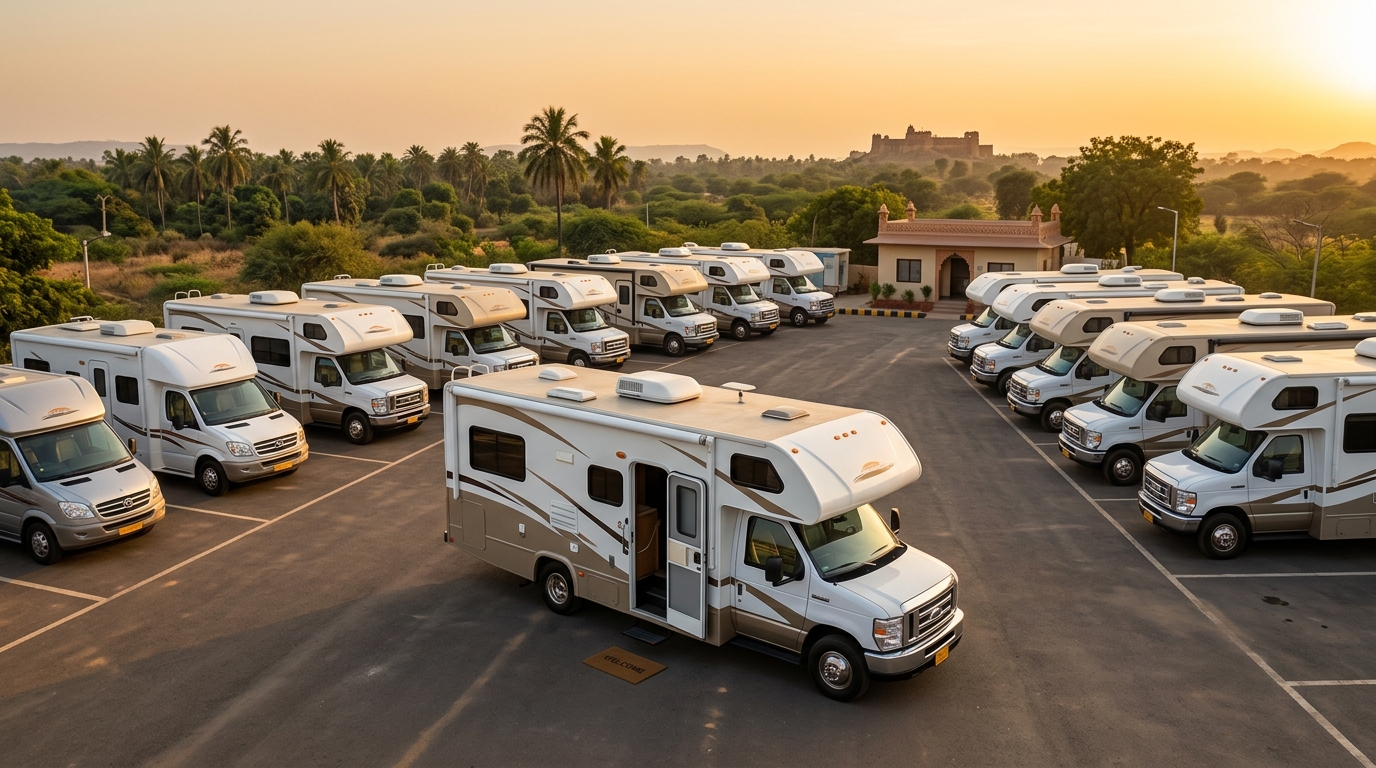
For live availability and current prices, start with our RV Rental India - Complete Guide 2026 guide.
In This Guide
- Best India RV Itinerary for family rv rental — Overview
- 7-Day Classic Route in India
- 14-Day Extended Journey in India
- Recommended RVPlan Trip for India
- Must-See Stops Along the Way (Avi Bandana Picks)
- Daily Driving Distances & Drive Times in India
- Best RV Class for This Itinerary — Couple & Family Picks
- Can foreigners rent an RV in India?
- Is it safe to drive a motorhome in India?
- What are the challenges of RVing in India?
- What are the best places for motorhome camping in India?
- How much does it cost to rent an RV in India?
- How to find an RV rental in India?
Best India RV Itinerary for family rv rental — Overview
An RV trip in India offers a unique way to explore the country's diverse landscapes and rich culture at a leisurely pace, with a recommended minimum duration of 7 days. Avi Bandana's itineraries emphasize slow travel, covering approximately 700-1050 km over 7 days or 1400-2100 km over 14 days, primarily focusing on one region to maximize cultural immersion. The best season for an RV rental in India is typically from October to March, when the weather is cooler and drier, ideal for comfortable travel and outdoor activities across most regions.
7-Day Classic Route in India
This 7-day RV itinerary focuses on a cultural loop in and around Delhi, respecting Avi Bandana's recommendation of a maximum of 150 km per day for a relaxed and immersive experience.
- Day 1: Delhi (RV pickup & orientation, local exploration/prep). Overnight: Secure RV parking in Delhi NCR.
- Day 2: Delhi to Sultanpur Bird Sanctuary & nearby local village (approx. 50 km). Enjoy nature and local life. Overnight: Designated parking/homestay.
- Day 3: Sultanpur to Alwar (approx. 120 km). Visit Bala Quila Fort, Siliserh Lake. Overnight: Secure parking at hotel/resort.
- Day 4: Alwar to Sariska Tiger Reserve (approx. 30 km). Enjoy a jeep safari. Overnight: Parking near Sariska (check permissions).
- Day 5: Sariska to Bharatpur (Keoladeo Ghana National Park) (approx. 100 km). Birdwatching paradise. Overnight: Secure parking near park.
- Day 6: Bharatpur to Mathura/Vrindavan (approx. 40 km). Explore Krishna's birthplace and temples. Overnight: Secure parking.
- Day 7: Mathura/Vrindavan to Delhi (approx. 150 km). RV return and departure.
14-Day Extended Journey in India
This 14-day itinerary offers a deeper dive into Rajasthan's heritage and rural charm, strictly adhering to Avi Bandana's recommendation of a maximum of 150 km per day for a truly unhurried adventure.
- Days 1-2: Delhi (RV pickup & orientation, local exploration/prep). Overnight: Secure RV parking in Delhi NCR.
- Day 3: Delhi to Neemrana (approx. 120 km). Explore Neemrana Fort Palace, stepwell. Overnight: Designated parking/homestay.
- Day 4: Neemrana to Alwar (approx. 70 km). Visit Bala Quila Fort, Siliserh Lake. Overnight: Secure parking at hotel/resort.
- Day 5: Alwar to Jaipur (approx. 150 km). Discover Amber Fort, Hawa Mahal. Overnight: Secure hotel parking/RV-friendly resort in Jaipur.
- Day 6: Jaipur City Exploration (City Palace, Jantar Mantar, local markets). Overnight: Same spot in Jaipur.
- Day 7: Jaipur to Pushkar (approx. 150 km). Experience Holy Pushkar Lake, Brahma Temple. Overnight: Designated parking near Pushkar ghats or secure hotel lot.
- Day 8: Pushkar to Ajmer (approx. 15 km) and towards Sambhar Salt Lake (approx. 70 km). Visit Ajmer Sharif Dargah. Overnight: Secure parking near Sambhar or a local homestay.
- Day 9: Sambhar Salt Lake to Tonk (approx. 100 km). Explore local culture and rural life. Overnight: Secure parking.
- Day 10: Tonk to Ranthambore National Park (approx. 80 km). Enjoy a wildlife safari. Overnight: Secure parking near park (check permissions).
- Day 11: Ranthambore to Karauli (approx. 100 km). Discover City Palace, Bhadrawati Palace. Overnight: Secure parking.
- Day 12: Karauli to Mathura/Vrindavan (approx. 130 km). Explore Krishna's birthplace and its many temples. Overnight: Secure parking.
- Day 13: Mathura/Vrindavan to Delhi outskirts (approx. 120 km). Overnight: Secure RV parking near Delhi.
- Day 14: Delhi (RV drop-off and departure).
Recommended RVPlan Trip for India
As no specific RVPlan data is available for India at this time, Avi Bandana recommends exploring their curated RVPlan trips, which combine an RV rental with a pre-designed itinerary. These comprehensive packages simplify the planning process for your Indian adventure by offering ready-made routes, access to trip-planning software, and expert guidance. Utilizing an RVPlan trip ensures a well-researched journey that considers local driving conditions and suitable overnight stops.
Must-See Stops Along the Way (Avi Bandana Picks)
Avi Bandana’s personal picks for an authentic Indian RV journey focus on cultural immersion and local experiences. Look for traditional temples and palaces, such as the Amber Fort in Jaipur or Mysore Palace, to delve into India's rich history and architecture. Vibrant local markets, like Jaipur's Johari Bazaar or Mysore's Devaraja Market, are excellent for discovering regional crafts, textiles, and spices. For authentic Indian cuisine and a taste of local life, seek out traditional eateries known as 'Dhabas' along the highways, which often offer secure parking and fresh, regional dishes. Explore local industries, where available, to witness traditional crafts or agricultural practices unique to the region you are exploring.
Daily Driving Distances & Drive Times in India
Avi Bandana explicitly recommends a maximum average of 100 miles or 150 km per day for RV travel in India to allow for slow travel, ample exploration, and adaptation to local road conditions. Adhering to this guideline ensures a more relaxed journey, reducing driving fatigue and providing opportunities to truly experience the landscapes and local culture, rather than rushing between destinations.
- For example, driving from Delhi to Neemrana (approx. 120 km) typically takes around 2.5 to 3 hours, depending on traffic and road conditions.
- A journey from Jaipur to Pushkar (approx. 150 km) can be expected to take 3 to 3.5 hours, allowing for scenic breaks.
- Shorter drives, like Delhi to Sultanpur Bird Sanctuary (approx. 50 km), will take roughly 1 to 1.5 hours, making for easy day trips.
Best RV Class for This Itinerary — Couple & Family Picks
For couples, Avi Bandana recommends a Class B - Camper Van for its maneuverability and efficiency on Indian roads. Bandana's global fleet average for Class B - Camper Vans shows an average length of 5.8 meters, 3.2 sleeping places, and 2.7 adults capacity, with common fuel consumption around 8-10 Liters/100 Km, making them ideal for navigating diverse terrains and tighter spots. For families, the Class C - Alcove motorhome is an excellent choice, providing ample space and comfort. Based on Bandana's global fleet average, Class C - Alcove RVs typically feature an average length of 7.5 meters, 5.8 sleeping places, and 4.4 adults capacity, with fuel consumption around 10-12 Liters/100 Km, offering superior living and sleeping arrangements for a family. To simplify your trip planning, consider Avi Bandana's 'Rent & Plan' service, which combines your RV rental with a ready-made itinerary designed by travel experts, providing full access to trip-planning software and removing planning headaches.
Can foreigners rent an RV in India?
Yes, foreigners can rent an RV in India, typically requiring an International Driving Permit (IDP) along with their national driving license, a valid Indian visa, and passport. Essential documentation includes a valid passport with a sufficient visa duration covering the rental period, your national driving license, and an International Driving Permit (IDP) obtained from your home country, which translates your license into multiple languages. It is crucial to clarify specific vehicle registration requirements with the rental provider, especially if the RV will be used across multiple states, and to ensure comprehensive insurance coverage is in place for foreign drivers. Consider an RV rental provider that offers support for international travelers, including assistance with any necessary permits or local regulations.
Is it safe to drive a motorhome in India?
Driving a motorhome in India can be safe with proper preparation and adherence to local driving customs, though it requires heightened awareness due to diverse road conditions and often chaotic traffic etiquette. Drivers should be prepared for varying road conditions, from well-maintained highways to unpaved or pothole-ridden rural roads, and maintain a defensive driving approach. Understanding cultural nuances such as frequent horn usage (often for signaling, not aggression), unpredictable overtaking, and the presence of stray animals on roads is crucial for safe navigation. To enhance safety, prioritize driving during daylight hours, ensure your RV has high ground clearance and robust suspension, and plan overnight stays at secure, reputable locations like hotel parking lots or designated RV-friendly resorts. Familiarize yourself with basic Hindi phrases for essential interactions and carry a local SIM card for communication and emergency assistance, addressing potential language barriers and region-specific safety concerns.
What are the challenges of RVing in India?
The primary challenges for RVing in India include navigating diverse road conditions, limited formal RV park infrastructure, and adapting to local driving styles, all of which can be managed with preparation and suitable vehicle choice. India's road network, while extensive, features varying quality, including sections with poor surfaces, unexpected speed breakers, and unpaved stretches, demanding an RV with high ground clearance and robust suspension. The scarcity of traditional RV dump sites and dedicated RV parks means travelers must plan for alternative waste management and water refill strategies, often utilizing hotel facilities or secure private properties. Navigating chaotic traffic, particularly in urban areas and on single-lane highways, requires patience, defensive driving skills, and a smaller, more maneuverable RV footprint. Finding reliable mechanics for RV-specific issues might be challenging outside major cities, so carrying a basic toolkit and knowing how to troubleshoot minor problems is advisable.
What are the best places for motorhome camping in India?
Given the evolving RV infrastructure in India, the best places for motorhome camping often include secure hotel parking lots, designated homestay parking, some state tourism parks, or informal but safe spots near Dhabas (roadside eateries) with permission. Secure hotel lots offer peace of mind, amenities like restrooms, and sometimes access to power and water, making them a preferred overnight stay for RV travelers. Many homestays in scenic or rural areas are increasingly offering designated parking spaces for RVs, providing an authentic local experience and often including meals. Informal parking near 'Dhabas' (roadside eateries) is a common practice; always seek permission from the owner, who often provides a safe spot in exchange for patronage, though amenities will be minimal. While traditional RV parks are limited, some state tourism departments are developing designated camping sites or properties that can accommodate motorhomes, particularly in popular tourist regions. Wild camping is generally not recommended in India without explicit local guidance or permission due to safety concerns and land ownership complexities; always opt for secure and permitted locations. For ideas you can prep on the road, watch our RV-friendly recipes playlist on YouTube.
How much does it cost to rent an RV in India?
The cost to rent an RV in India varies significantly based on the RV class, rental duration, season, and inclusions, typically ranging from INR 8,000 to INR 25,000+ per day, excluding fuel, tolls, and other on-road expenses. Rental costs depend heavily on the RV type; compact camper vans (Class B) will be at the lower end, while larger, luxury motorhomes (Class A or C) will command higher prices. Fuel expenses are a significant part of the budget; for instance, Bandana's global fleet average for a Class C - Alcove RV typically consumes 10-12 Liters/100 km, which can add up quickly over a long trip. Travelers should budget for tolls on national highways and expressways, as well as potential state entry permits, which can vary by region. Be aware of potential hidden costs such as security deposits, cleaning fees, extra mileage charges beyond a set limit, and charges for additional equipment like camping gear or bicycles. Inquire about what is included in the rental package, such as basic insurance, breakdown assistance, and any provided amenities, to get a detailed cost breakdown before booking. For real-time availability and pricing, check out our RV PLANET routes, where you can itemize and track every expense along the way for easy budgeting. On the routes offered through RV PLANET routes, you can itemize and track every expense along the way for easy budgeting.
How to find an RV rental in India?
To find an RV rental in India, start by searching reputable online platforms and local operators specializing in caravan or motorhome rentals, ensuring they offer comprehensive insurance and support services. Begin your search using major search engines and specialized RV rental marketplaces that list operators in India, such as Avi Bandana, which provides a global fleet and planning services. Look for operators that clearly outline their rental terms, including insurance coverage, breakdown assistance, and any regional restrictions or permits required for travel across different states. Compare vehicle types and pricing from multiple providers to find an RV that suits your family size and budget, ensuring it meets your specific itinerary needs. Review customer testimonials and ratings to gauge the reliability and service quality of potential rental companies. Once you've selected an operator, the booking process typically involves selecting your dates, RV type, providing necessary documentation, and making a deposit to secure your rental. For a seamless experience, explore the curated itineraries available through RV PLANET, which simplifies the process by combining rentals with expert-planned routes.
What You Shouldn't Miss
- Explore the Golden Triangle: Delhi, Agra, and Jaipur offer a classic introduction to India's history and culture, accessible by RV within reasonable driving distances.
- Witness the Taj Mahal at Sunrise: The iconic mausoleum is a breathtaking sight, best experienced in the early morning light.
- Immerse yourself in the Colors of Rajasthan: From the bustling markets of Jaipur to the serene lakes of Udaipur, Rajasthan offers a vibrant cultural tapestry.
- Discover wildlife in Ranthambore National Park: Embark on a jeep safari to spot tigers and other incredible wildlife in their natural habitat.
- Experience the spiritual heart of India in Varanasi: Witness ancient rituals along the Ganges River for a profound cultural insight.
- Seek expert insights from Avi Bandana: For top 5 adventures, check out Avi Bandana's personal recommendations for unique experiences tailored to RV travel.
Final Thoughts
Embarking on an RV journey through India promises an unparalleled adventure, blending the freedom of the open road with the rich tapestry of Indian culture and landscapes. By choosing the right vehicle and planning with the insights we've shared, your family RV rental in India can be an experience filled with wonder and discovery.
Remember to embrace the spirit of slow travel, savoring each moment and the unique experiences that only an RV adventure can provide. We're here to support you in making your Indian RV dreams a reality!
Ready to start planning your unforgettable Indian RV adventure? Explore our curated itineraries and compare RV rental options to find the perfect vehicle for your family. Discover top destinations, planning tips, all in one place with Bandana Caravan!
