
For live availability and current prices, start with our RV Rental Bellflower - Complete Guide 2026 guide.
In This Guide
- Can You Drive an RV in Bellflower? License & Age Rules
- Road Conditions & Terrain in Bellflower
- RV Size Limits, Bridges & Restricted Zones
- Fuel: Diesel vs. Petrol & Cost per 100 km
- Tolls, Vignettes & Border Rules
- Driving Tips for cheap rv rental Travelers
- Recommended RV Class for Bellflower Roads
- Should I Choose a Compact Van Instead of a Large RV in Bellflower?
- Can I Park Anywhere? Free & Wild Camping Rules in Bellflower
- Can I Drive an RV Into the City Center? Heights, Tunnels & Local Signage
- What is the 3-3-3 rule for RVs?
- Does an RV over 20 feet require a CDL?
- What is the 2 2 2 rule for RV?
- What is the 3-3-3 rule when RVing?
- Where can I park an RV for free in California?
- What is the new RV law in California?
- Is it cheaper to RV or stay in hotels?
- Can I own an RV without a license?
- How much does it cost to register a RV in California?
- Do I need a different license to drive an RV in California?
Can You Drive an RV in Bellflower? License & Age Rules
Most recreational vehicles (RVs) rented through Bandana Caravan, with a Gross Vehicle Weight Rating (GVWR) under 26,001 pounds, can be driven in Bellflower, California, with a standard Class C driver's license. This applies to the majority of Class B camper vans, like the Active Small, and Class C alcove models, such as the Adak Argonaut 21 - Bronze. Drivers typically need to be at least 21 years old to rent an RV, with some rental companies, especially for larger Class A motorhomes, requiring a minimum age of 25. Foreign drivers can operate an RV in Bellflower with a valid driver's license from their home country; however, an International Driving Permit (IDP) is highly recommended for translation purposes and may be required by some providers or insurance policies.
Road Conditions & Terrain in Bellflower
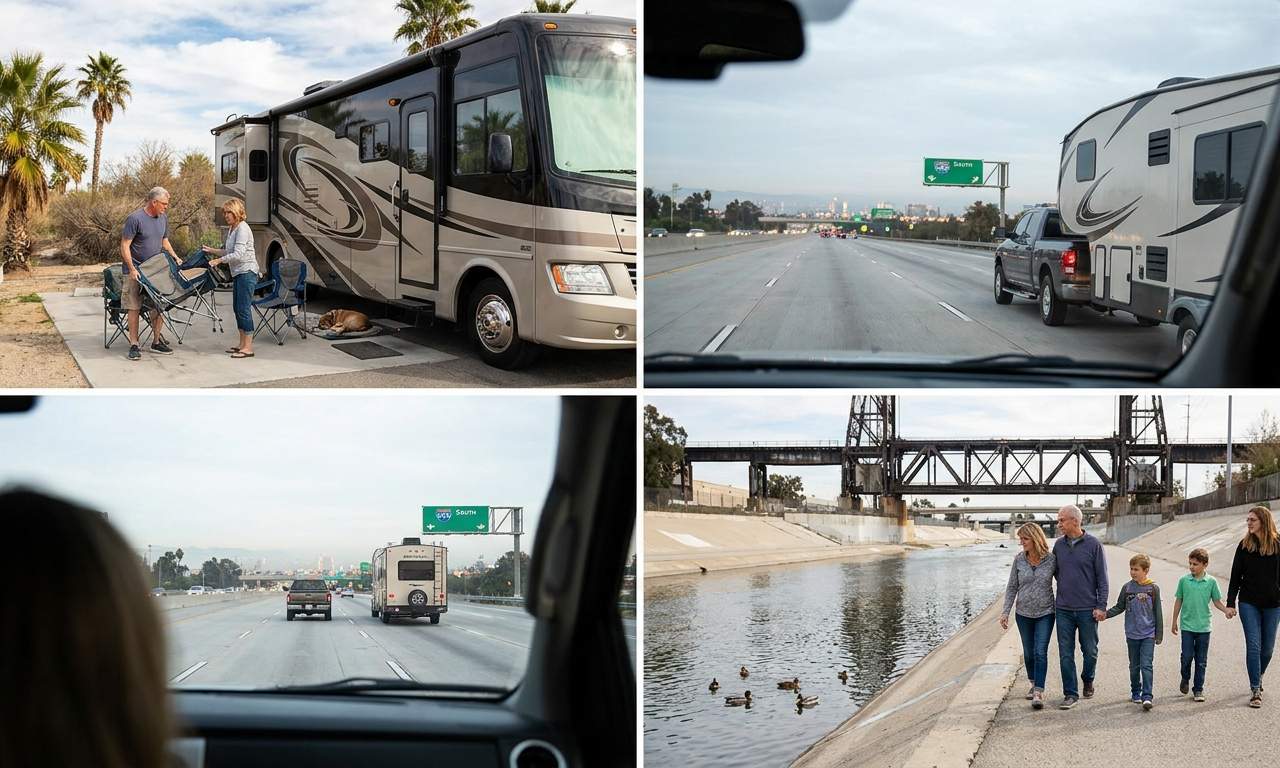
Road conditions in Bellflower and the surrounding Los Angeles County area are generally well-maintained and suitable for all types of RVs, featuring mostly flat urban terrain. Bellflower's strategic location provides excellent access to major Southern California freeways like the I-5, 91, and 605, facilitating smooth RV travel to coastal areas, mountains, or desert destinations. While urban areas can be busy, the predominantly grid-patterned streets are wide enough for larger RVs; however, vigilance for parked cars and understanding turning radii is advised. We always encourage slow, scenic driving, especially when navigating residential streets or approaching popular attractions, to fully enjoy the journey and ensure safety.
RV Size Limits, Bridges & Restricted Zones
Bellflower does not impose unique or specific RV size limits that significantly restrict standard rental RVs on its main roads or freeways. Importantly, there are no notable low bridges or tunnels within Bellflower's immediate vicinity that would pose a challenge for typical RV heights. Drivers should always observe local street signage in residential areas or downtown zones, as temporary parking restrictions or commercial vehicle limits could apply. While not common within Bellflower itself, certain environmental zones or restricted access areas might exist in larger metropolitan centers or national parks further afield, requiring prior research if planning extensive regional travel.
Fuel: Diesel vs. Petrol & Cost per 100 km
Both diesel and petrol (gasoline) are widely available at numerous service stations throughout Bellflower and across Southern California. Many popular RV classes from Bandana's global fleet, such as Class SI Semi-integrated and Class C Alcove motorhomes, typically consume between 10-12 Liters/100 km. Smaller Class B Camper Vans, like the Active Small, often offer better fuel efficiency, averaging 8-10 Liters/100 km, while larger Class A Integrated RVs typically range from 8-12 Liters/100 km. Considering the current fuel prices in California, travelers should budget for higher per-liter costs than the national average, making fuel a significant component of overall RV trip expenses. Some RV rental companies, including Bandana partners, offer fuel discount cards or programs to help offset costs, which can be particularly beneficial for cheap rv rental travelers. On the routes offered through RV PLANET routes, you can itemize and track every expense along the way for easy budgeting.
Tolls, Vignettes & Border Rules
California features various toll roads and express lanes, particularly in Southern California like the I-10, I-110, and I-15, and toll bridges, especially in the San Francisco Bay Area. However, California does not use a vignette system like some European countries. Tolls are typically collected electronically via FasTrak transponders or by license plate processing, with cash payment options becoming increasingly rare. Travelers in Bellflower planning trips through Southern California's Orange County (e.g., SR-73, SR-133, SR-241, SR-261) or to the Bay Area should budget for potential toll costs. To avoid fines and simplify travel, some Bandana rent-motorhome RVs may offer the option to pre-purchase toll passes or provide a transponder, charging tolls post-trip.
Driving Tips for cheap rv rental Travelers
When planning your cheap rv rental journey from Bellflower, it’s essential to prepare effectively. Always use RV-specific GPS or mapping apps to identify suitable roads and avoid potential hazards like low bridges, especially on budget-conscious trips. Take frequent breaks; for families or longer journeys, plan stops every 2-3 hours to stretch, refuel, and allow passengers to enjoy the surroundings, aligning with the popular 2-2-2 or 3-3-3 RV rules. Given varying fuel prices in California, diligently monitor your RV's fuel efficiency (e.g., 8-12 Liters/100 km for many Bandana RVs) and consider filling up in areas with lower prices before heading into more expensive regions. Before embarking on your trip from Bellflower, practice maneuvering in a large, empty lot to understand the RV's dimensions and handling, particularly if you're new to driving a larger vehicle. Finally, and crucially, ensure all cabinets, drawers, and loose items are secured before driving to prevent damage and distractions, especially on potentially bumpy roads outside urban Bellflower.
Recommended RV Class for Bellflower Roads
For cheap rv rental travelers exploring Bellflower and wider Southern California, the Class B Camper Van and Class SI Semi-integrated RVs are highly recommended due to their excellent balance of maneuverability and comfort. Class B Camper Vans, averaging around 5.8 meters in length across Bandana's global fleet, are ideal for navigating Bellflower's urban streets, finding parking, and offering superior fuel economy (typically 8-10 Liters/100 km). Class SI Semi-integrated motorhomes, averaging 6.9 meters in length, provide more living space and amenities for small families or couples while still being manageable for freeway driving and accessing most campgrounds near Bellflower. Both classes offer comfortable driving experiences perfectly suited for California's well-maintained roads and provide ample space for essentials without the bulk of larger Class C or A models, which can sometimes be more challenging for first-time RVers.
Should I Choose a Compact Van Instead of a Large RV in Bellflower?
Generally, driving any standard RV size in Bellflower and its surrounding areas is feasible, as the road infrastructure is well-designed to accommodate a range of vehicles. A compact van, like a Class B Camper Van (averaging 5.8 meters in length), offers distinct advantages in Bellflower for easier parking in tighter city spots, improved fuel economy (typically 8-10 Liters/100 km), and greater maneuverability when exploring urban centers or residential areas. However, a larger RV, such as a Class SI Semi-integrated model (averaging 6.9 meters) or a Class C Alcove (around 7.5 meters), provides significantly more indoor space, sleeping capacity, storage, and essential amenities like a full kitchen and bathroom, which often outweigh minor maneuverability benefits for overall comfort on longer trips. The ultimate choice hinges on your travel style: opt for a compact van if maximum agility and ease of parking are your top priorities, or select a larger RV for enhanced comfort, dedicated living areas, and the ability to comfortably accommodate more travelers. For ideas you can prep on the road, watch our RV-friendly recipes playlist on YouTube.
Can I Park Anywhere? Free & Wild Camping Rules in Bellflower
Free or 'wild camping' in an RV is generally prohibited on public streets and undeveloped land within the city limits of Bellflower, as with most urban areas in California. Bellflower enforces specific regulations for street parking, which may include time limits, overnight parking restrictions, and the requirement for permits in certain zones. Travelers seeking overnight parking near Bellflower should research local RV parks and campgrounds, such as those in nearby Long Beach or Cerritos, which offer essential hookups and amenities. While informal overnight parking might be tolerated in some large retail parking lots (e.g., Walmart, Cabela's), always seek explicit permission from store management before settling in. Remember, rules vary significantly by region across California—always check local ordinances and adhere to local law before parking overnight to avoid potential fines or towing.
Can I Drive an RV Into the City Center? Heights, Tunnels & Local Signage
Yes, you can almost always drive an RV into the city center of Bellflower, as there are no inherent physical barriers like extremely low tunnels or bridges on main thoroughfares. Bellflower's downtown area is generally accessible for RVs, but drivers should pay close attention to local signage concerning parking restrictions, weight limits on specific streets, or temporary construction detours. Unlike some historic European cities, Bellflower does not have restricted environmental zones or tightly wound ancient streets that would pose a significant challenge for most RVs. Always be mindful of street parking regulations and the overall dimensions of your RV when navigating urban environments to ensure safe passage and parking compliance.
What is the 3-3-3 rule for RVs?
The '3-3-3 rule' for RVs is a popular guideline for achieving safe and enjoyable travel, recommending that you drive no more than 300 miles per day, aim to arrive at your destination by 3 PM, and plan to stay for at least 3 nights at each location. Driving no more than 300 miles helps prevent driver fatigue, allows for unexpected delays, and ensures you have ample time to appreciate the scenery and any intermediate stops. Arriving by 3 PM provides sufficient daylight for setting up camp, getting acquainted with the campground, and troubleshooting any issues before nightfall. Staying for at least 3 nights encourages a more relaxed pace of travel, reducing the stress of constant packing and unpacking and allowing more time to explore the local Bellflower area or your chosen destination.
Does an RV over 20 feet require a CDL?
In California, an RV over 20 feet typically does not require a Commercial Driver's License (CDL); a standard Class C license is sufficient for most recreational vehicles up to 26,000 pounds Gross Vehicle Weight Rating (GVWR). Most rental RVs, including Class C Alcove models (averaging 7.5 meters / 24.6 feet) and Class A Integrated motorhomes (also averaging 7.5 meters / 24.6 feet) from Bandana's fleet, fall within these Class C license requirements. A Class B non-commercial driver's license is only required if the single RV you are driving has a GVWR of 26,001 pounds or more, which is primarily for larger, heavier RVs not commonly found in typical rental fleets. Similarly, a Class A non-commercial license is necessary if you are towing a travel trailer exceeding 10,000 pounds GVWR with a vehicle that also exceeds 10,000 pounds GVWR, a scenario less common for initial RV renters.
What is the 2 2 2 rule for RV?
The '2-2-2 rule' for RV travel is a more conservative guideline than the 3-3-3 rule, suggesting you drive no more than 200 miles per day, arrive at your campground by 2 PM, and plan to stay for a minimum of 2 nights at each location. This rule is particularly beneficial for first-time RVers, families with young children, or those who prefer a slower, more relaxed journey, allowing ample time for stops and enjoyment. Limiting daily mileage to 200 miles minimizes driving fatigue and provides more flexibility to explore attractions along your route to or from Bellflower. Arriving by 2 PM ensures you have plenty of daylight for setting up camp, allowing for leisurely evening activities without rushing, and staying for 2 nights provides a full day to enjoy your destination.
What is the 3-3-3 rule when RVing?
When RVing, the 3-3-3 rule serves as a strategic planning guide, advising you to limit daily driving to 300 miles, aim to reach your destination by 3 PM, and plan stays of at least 3 nights at each location. Implementing the 3-3-3 rule helps maintain a sustainable pace for your RV trip, allowing for a better balance between travel time and leisure time, especially for cheap rv rental travelers. This approach reduces the likelihood of driving while fatigued or setting up camp in the dark, which can be challenging and less safe, particularly for those new to RV travel in the Bellflower area. By adhering to the rule, RVers can fully immerse themselves in each destination, fostering a deeper connection with the places visited rather than merely passing through.
Where can I park an RV for free in California?
Free RV parking in California is available in limited locations, primarily on designated Bureau of Land Management (BLM) land or within National Forests (boondocking), or with permission in certain large retail parking lots. Boondocking on BLM land or in National Forests, often found outside major metropolitan areas like Bellflower, allows for free overnight stays, typically with a 14-day limit in any 28-day period. Some Walmart, Cabela's, and other superstore locations may permit overnight RV parking, but policies vary by store and should always be confirmed with management upon arrival. While urban areas like Bellflower generally prohibit free street parking for RVs overnight, apps and websites like iOverlander or FreeCampsites.net can help locate permitted free spots or low-cost options throughout California.
What is the new RV law in California?
There isn't a single, overarching 'new RV law' that uniformly impacts all RVers statewide in California; however, regulations concerning overnight street parking, emissions, and local ordinances are subject to change and vary by municipality. Many California cities, including those near Bellflower, have implemented or strengthened local ordinances regarding RV street parking, often in response to concerns about long-term parking or homeless encampments. RV owners should be aware of potential updates to California's vehicle registration and emissions testing requirements; while most RVs are exempt from smog checks, regulations can change, especially for older diesel models. Always consult the California Department of Motor Vehicles (DMV) website and specific Bellflower city ordinances for the most current and relevant laws affecting RV ownership and operation in 2026.
Is it cheaper to RV or stay in hotels?
RV travel can indeed be more cost-effective than staying in hotels, particularly for families or longer trips in California, but the overall cost depends significantly on rental fees, fuel, campground prices, and personal spending habits. For a family, an RV often provides substantial savings on accommodation and food, as cooking meals in the RV galley (many models, like the Cruise America RV Rental Example Explorer, offer full kitchens) can be much cheaper than dining out. Key cost factors for RV travel include the rental rate (which can be a substantial upfront cost for cheap rv rental options), California's higher fuel prices (e.g., Class C motorhomes often average 10-12 Liters/100 km), and campground fees, which can vary widely from free boondocking to over $100 per night for luxury resorts. When comparing, consider the combined convenience of having your accommodation and transportation in one unit, the inherent flexibility of itinerary, and the unique experience RV travel offers versus the cumulative costs of multiple hotel rooms, restaurant meals, and separate transportation.
Can I own an RV without a license?
Yes, you can legally own an RV in California without possessing a driver's license; however, you cannot legally operate or drive the RV on public roads without the appropriate driving credential. Ownership of a recreational vehicle is akin to owning any other large personal asset and does not necessitate a driving credential. To legally move your owned RV, you would need to either obtain the correct California driver's license (typically a Class C for most RVs) or arrange for a licensed driver to operate it. This distinction is important for individuals who might purchase an RV for use as a stationary living space or have it delivered to a permanent site.
How much does it cost to register a RV in California?
The cost to register an RV in California varies significantly based on factors such as the vehicle's market value, weight, and age, along with any applicable fees, typically ranging from a few hundred to over a thousand dollars annually. Registration fees usually comprise a Vehicle License Fee (VLF), which is 0.65% of the vehicle's market value, a registration fee, a California Highway Patrol (CHP) fee, and potentially a transportation tax. Newer and more expensive RVs, or those with higher GVWRs, will generally incur higher registration costs than older, less valuable models. For the most accurate and up-to-date figures, it is best to utilize the California DMV's online fee calculator or consult their official resources, as these costs can fluctuate year-to-year and are specific to each RV.
Do I need a different license to drive an RV in California?
For the vast majority of RVs, including common rental models like Class B camper vans (averaging 5.8 meters) and Class C alcove motorhomes (averaging 7.5 meters), a standard Class C California driver's license is perfectly sufficient. A different license, specifically a non-commercial Class B, is only required if the single RV you are driving has a Gross Vehicle Weight Rating (GVWR) of 26,001 pounds or more. If you plan to tow a trailer with a GVWR of over 10,000 pounds behind an RV that itself exceeds 10,000 pounds GVWR, a non-s-commercial Class A license becomes necessary. Always verify the GVWR of your specific RV and consult the California DMV's recreational vehicle licensing requirements to ensure you have the appropriate license for your rental or owned vehicle.
What You Shouldn't Miss
- Explore the San Gabriel River Trail: Rent bikes in Bellflower and embark on a cycling adventure directly from your RV to the coast, enjoying scenic views and a unique perspective of the area.
- Discover Local Flavors at a Farmers' Market: If your rental coincides with a local farmers' market day, stock up on fresh, regional produce to enjoy in your RV kitchen, connecting with the area's agricultural heritage.
- Admire the Historic Bell Tower: Make a brief stop to see the unique bell tower of the original Bellflower City Hall, a charming local landmark that adds a touch of history to your drive.
- Experience the 'Backdoor Beaches': Utilize Bellflower's excellent freeway access to reach less-crowded Southern California beaches like Seal Beach or Bolsa Chica, enjoying the coast without battling the worst of the L.A. traffic.
Final Thoughts
Renting an RV in Bellflower offers a fantastic way to explore California at your own pace. With the right planning and understanding of local conditions, your cheap rv rental adventure will be smooth, enjoyable, and budget-friendly. Remember to consider the recommended RV classes for ease of navigation and prioritize booking in advance for the best selection and rates.
We're here to help you every step of the way, from comparing prices to coordinating your booking. Let Bandana Caravan handle the logistics so you can focus on the journey and create lasting memories.
Find Motorhome Rentals in Bellflower