For live availability and current prices, start with our RV Rental Tokyo - Airport - Complete Guide 2026 guide.
In This Guide
- Can You Drive an RV in Tokyo - Airport? License & Age Rules
- Road Conditions & Terrain in Tokyo - Airport
- RV Size Limits, Bridges & Restricted Zones
- Fuel: Diesel vs. Petrol & Cost per 100 km
- Tolls, Vignettes & Border Rules
- Driving Tips for one way rv rental Travelers
- Recommended RV Class for Tokyo - Airport Roads
- Should I Choose a Compact Van Instead of a Large RV in Tokyo - Airport?
- Can I Park Anywhere? Free & Wild Camping Rules in Tokyo - Airport
- Can I Drive an RV Into the City Center? Heights, Tunnels & Local Signage
- What is the RV Driving Experience Like in Japan?
- What are the Cultural Etiquette Tips for RV Travel in Japan?
- What are Recommended RV Itineraries from Tokyo Airports?
- What Emergency Protocols Should I Know for RV Travel in Japan?
- How Can I Combine RV Travel with Public Transport in Japan?
Can You Drive an RV in Tokyo - Airport? License & Age Rules
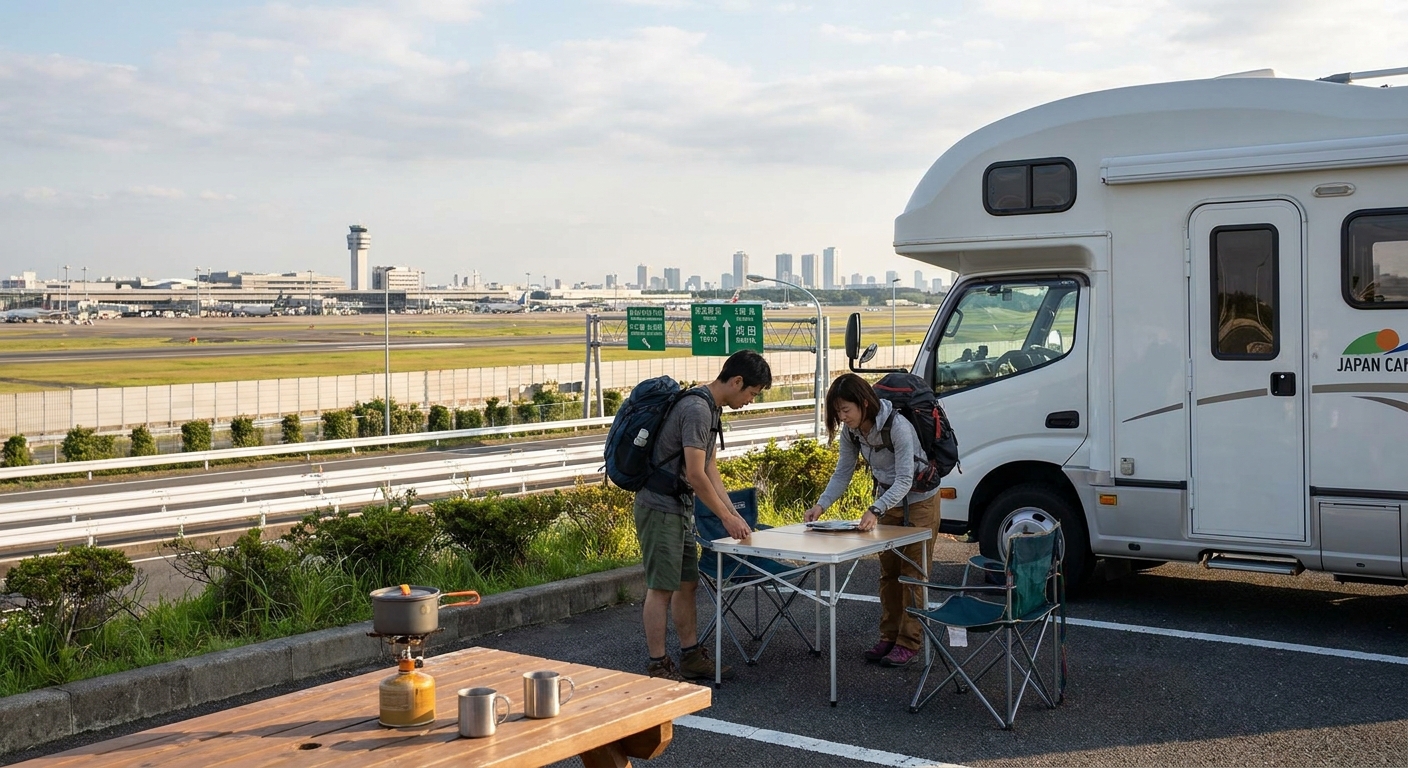
Foreign visitors can legally drive an RV in Japan, including from Tokyo's international airports, provided they possess a valid International Driving Permit (IDP). This IDP must be issued under the 1949 Geneva Convention and presented alongside your original national driver's license. The minimum driving age for RV rentals in Japan is typically 20 or 21, which is slightly different from the legal driving age of 18. Most rental RVs available to tourists in Japan are designed to fall under the 3,500kg gross vehicle weight limit, meaning a standard Category B license, as indicated on your IDP, is usually sufficient. It is crucial to obtain your IDP in your home country before traveling, as it cannot be issued upon arrival in Japan, so ensure this is sorted well in advance of your departure.
Road Conditions & Terrain in Tokyo - Airport
Japan's roads, particularly the expressways connecting Tokyo's airports to the wider country, are meticulously maintained and clearly signposted, often with English translations, ensuring a smooth driving experience. While major routes offer excellent conditions, be prepared for narrower roads in suburban, rural, and mountainous areas, which may require more cautious driving, especially for larger RVs. This is a key consideration for first-time drivers. The terrain directly around Tokyo - Airport is largely flat, but it quickly expands into scenic coastal routes, rolling hills, and accessible mountainous regions like Hakone or the Japan Alps as you venture further afield, encouraging diverse itineraries. Urban driving in Tokyo itself can involve heavy traffic congestion during peak hours, so strategic route planning and opting for early morning departures can significantly enhance your journey.
RV Size Limits, Bridges & Restricted Zones
While Japan doesn't impose a blanket national RV size limit beyond standard vehicle classifications, drivers in Tokyo and other urban areas must be highly vigilant for numerous tunnels, underpasses, and multi-story parking facilities that have explicit height restrictions, often falling between 2.1m and 2.5m. Larger RVs, such as Class C Alcoves that average 7.5 meters in length, may encounter challenges with tight turns and parking in dense city centers, although main thoroughfares are generally navigable with care. Japan currently does not feature widespread environmental zones that restrict RV entry based on emissions, but travelers should always observe local signage for any specific, temporary, or permanent vehicle restrictions. For any potential ferry travel beyond the immediate Tokyo area, it is essential to check the specific length and weight restrictions with the chosen ferry operator in advance to avoid any last-minute issues.
Fuel: Diesel vs. Petrol & Cost per 100 km
Both unleaded petrol (レギュラー, *regyuraa*) and diesel (軽油, *keiyu*) are widely available at service stations across Japan, with diesel commonly fueling larger commercial vehicles and many RV models. Bandana's global fleet averages indicate that Class SI Semi-integrated RVs typically consume 10-11 liters per 100 km, Class C Alcoves consume 10-12 liters per 100 km, and Class B Camper Vans consume approximately 8-10 liters per 100 km. The average cost per 100 km will fluctuate with current fuel prices; for example, using a common consumption of 10.5L/100km for a Class SI and an assumed fuel price of ~170 JPY/L, the cost would be approximately 1785 JPY per 100 km in 2026. Some RV rental companies may offer fuel discount cards or loyalty programs, which can provide savings on fuel expenses during your one-way rental journey in Japan.
Tolls, Vignettes & Border Rules
Japan utilizes an extensive and efficient toll road system for its expressways, charging based on distance traveled, and does not employ a vignette system common in some other countries. An Electronic Toll Collection (ETC) card is highly recommended for RV travelers in Japan to ensure seamless passage through toll gates and potentially access specific ETC-only discounts. Many RV rental providers offer ETC cards as an optional add-on, allowing for convenient pre-payment or post-paid billing, which helps avoid manual payments and potential fines. As an island nation, Japan does not have land borders, meaning RV travelers commencing their journey from Tokyo - Airport only need to adhere to domestic driving regulations, simplifying international travel considerations. On the routes offered through RV PLANET routes, you can itemize and track every expense along the way for easy budgeting.
Driving Tips for one way rv rental Travelers
When embarking on your RV adventure from Tokyo - Airport, mastering left-hand driving is paramount, as Japan operates on the left side of the road, requiring careful adjustment for drivers accustomed to right-hand traffic. Leverage advanced GPS systems with reliable English support, as these are critical for navigating Japan's often complex road network and overcoming potential language barriers on signs. Strategic urban parking is also essential; plan your RV parking in advance, especially in urban areas where spaces are limited and can be costly. Consider utilizing park-and-ride facilities near public transport hubs for easier city access. Securing an ETC card from your rental company is highly recommended to smoothly manage Japan's extensive toll system, avoiding cash payments and benefiting from potential express lane access. Finally, always drive courteously, maintain respectful distances, and minimize horn usage, as Japanese driving culture highly values order and quiet.
Recommended RV Class for Tokyo - Airport Roads
For RV travel originating from Tokyo - Airport and navigating Japan's varied road network, the Class B Camper Van is highly recommended for its excellent balance of comfort and maneuverability. Bandana's Class B Camper Vans average 5.8 meters in length, making them particularly well-suited for narrower roads in smaller towns, easier parking, and more nimble navigation through winding scenic routes. The Class SI Semi-integrated RVs, with an average length of 6.9 meters from Bandana's fleet, also provide a comfortable option, offering more living space while remaining relatively manageable for most Japanese roads. While larger options like Class C Alcoves (avg. 7.5m) or Class A Integrated RVs (avg. 7.5m) offer more amenities, their increased dimensions can pose challenges for parking and navigating very tight urban or rural areas.
Should I Choose a Compact Van Instead of a Large RV in Tokyo - Airport?
While there are generally no outright restrictions preventing larger RVs from operating in Japan, choosing a compact van often provides a distinct advantage for maneuverability and accessibility, particularly when starting your journey from Tokyo - Airport. A compact van or smaller camper, such as a Class B Camper Van or a kei-camper, excels in navigating Japan's often narrow city streets, accessing smaller parking spaces, and tackling winding mountain roads with greater ease. However, selecting a larger RV, like a Class SI Semi-integrated, offers significantly more interior living space, a full complement of amenities (kitchen, bathroom, dedicated sleeping areas), and enhanced comfort, which can be a better trade-off for travelers prioritizing on-board convenience for longer trips. The decision hinges on your itinerary: if extensive urban exploration or deeply rural routes are planned, a compact van is highly practical; if comfort and comprehensive facilities for scenic touring on main routes are paramount, a larger RV remains a viable and enjoyable option. For ideas you can prep on the road, watch our RV-friendly recipes playlist on YouTube.
Can I Park Anywhere? Free & Wild Camping Rules in Tokyo - Airport
In Japan, strict 'wild camping' (unregulated overnight stays on public land) is generally not permitted, but the country offers excellent and legal alternatives for RV travelers, primarily through 'Michi-no-Eki' (roadside stations) and dedicated RV parks. Michi-no-Eki are government-designated roadside rest areas that provide free, safe overnight parking, clean restrooms, and often local produce, restaurants, and information, serving as a cornerstone for RV travel in Japan. Dedicated RV parks and private campgrounds across Japan offer more comprehensive facilities, including electrical hookups, water, and waste disposal, ideal for longer stays or when full amenities are desired. Always observe local signage regarding overnight parking, particularly in urban areas or near popular tourist sites, and practice good etiquette by minimizing external setups and properly disposing of waste. Rules vary by region, so always check local regulations and follow local law before parking overnight.
Can I Drive an RV Into the City Center? Heights, Tunnels & Local Signage
Yes, an RV can generally be driven into central Tokyo and other Japanese city centers, provided drivers remain highly attentive to specific height, width, and parking restrictions. Tokyo's urban expressways and many central areas feature numerous tunnels, underpasses, and multi-story parking garages with strict height limits, often posted between 2.1m and 2.5m, which larger RVs may exceed. Local signage is consistently clear and often bilingual (Japanese and English), indicating height restrictions, residents-only streets, and specific environmental or traffic zones; careful observation is paramount. A practical strategy for city exploration is to park your RV at designated RV-friendly parking lots or 'Michi-no-Eki' on the city's outskirts and then utilize Japan's world-class public transportation for central city access.
What is the RV Driving Experience Like in Japan?
Driving an RV in Japan offers an incredibly unique and rewarding experience, combining a highly organized infrastructure with breathtaking natural beauty, though it requires adapting to left-hand traffic and occasional narrow roads. Japan's expressways are meticulously maintained and efficient, but navigating its complex toll system (best done with an ETC card) and being prepared for narrower urban and rural streets is key for larger RVs. Reliable GPS navigation with English support is essential for overcoming potential language barriers on local signs and ensuring smooth travel between destinations. Parking in dense urban areas can be limited and costly, necessitating prior planning, while 'Michi-no-Eki' (roadside stations) provide widespread, convenient, and often free overnight parking options for RVs across the country.
What are the Cultural Etiquette Tips for RV Travel in Japan?
To ensure a respectful and harmonious RV journey in Japan, it is essential to observe local cultural norms, which prioritize cleanliness, quietness, and respect for public spaces and communities. Proper waste disposal is paramount; Japan has strict recycling rules, so always sort your trash carefully and dispose of it at designated facilities found at campgrounds or 'Michi-no-Eki'. Maintain low noise levels, especially when parked overnight at 'Michi-no-Eki' or in residential areas, and refrain from setting out extensive camping equipment in public spaces unless at a private campground. When visiting local establishments like onsen (hot springs) or restaurants, always follow their specific rules and customs, such as removing shoes indoors or understanding bathing etiquette. Always be mindful of your presence and aim to be an unobtrusive visitor, showing appreciation for local customs and avoiding any actions that might be considered impolite or disruptive.
What are Recommended RV Itineraries from Tokyo Airports?
Starting from Narita (NRT) or Haneda (HND) airports, a popular RV itinerary involves heading southwest towards the iconic Fuji-Hakone-Izu National Park area, famous for its views of Mount Fuji, rejuvenating hot springs, and picturesque coastal drives. Another compelling route leads northwest into the 'Japan Alps' region (e.g., Nagano, Takayama), offering stunning mountainous landscapes, historic villages, and opportunities for outdoor activities suitable for RV travel via well-maintained expressways. For a blend of nature and culture, consider heading north along the Pacific coast towards the Tohoku region, known for its untouched natural beauty, tranquil onsen towns, and less crowded roads, perfect for a relaxed RV journey. Curated itineraries should prioritize destinations with RV-friendly parking (like Michi-no-Eki) and allow ample time to explore local attractions, onsen, and regional cuisine. Advance planning of overnight stops and major attractions will ensure a smooth and enjoyable RV adventure from Tokyo's airports.
What Emergency Protocols Should I Know for RV Travel in Japan?
For RV travelers in Japan, it is crucial to be prepared for emergencies by knowing key contact numbers: 110 for police, 119 for fire and ambulance, and your RV rental company's specific breakdown assistance hotline. In the event of a vehicle breakdown, pull over immediately to a safe location, activate your hazard lights, and contact your rental provider, who typically has established partnerships for roadside assistance across Japan. Always carry a basic first-aid kit, and proactively identify hospitals or clinics along your planned route, particularly when traveling through more rural regions; major hospitals often have some English-speaking staff. Japan is susceptible to natural disasters like earthquakes and typhoons; stay informed about local weather advisories and emergency warnings via local news or disaster alert apps on your smartphone. Ensure your personal travel insurance includes coverage for RV-related incidents, medical emergencies, and trip interruptions while abroad, and understand the specific terms of your RV rental agreement regarding accidents or damage.
How Can I Combine RV Travel with Public Transport in Japan?
Integrating RV travel with Japan's highly efficient public transport system is an excellent strategy for exploring dense urban centers like Tokyo and Kyoto, where RV parking is challenging and expensive. The most effective approach involves parking your RV at designated 'Michi-no-Eki' (roadside stations) or large, secure parking lots located on the outskirts of major cities that offer convenient access to train or bus stations. From these peripheral parking locations, you can easily use local trains, subways, or buses to reach city centers for sightseeing, effectively circumventing urban driving stress and parking difficulties with your RV. For longer day trips, consider parking your RV at a train station with overnight facilities and utilizing Japan's renowned Shinkansen (bullet train) for swift travel to more distant cities, returning to your RV in the evening. Purchasing a rechargeable IC card (e.g., Suica or Pasmo) upon arrival at Tokyo - Airport will significantly streamline payments for buses and trains across most of Japan's major cities and regions.
What You Shouldn't Miss
- Immerse yourself in the Fuji-Hakone-Izu National Park: Witness breathtaking views of Mount Fuji, relax in rejuvenating onsen (hot springs), and enjoy picturesque drives along the coast. This area is a perfect introduction to Japan's natural beauty.
- Explore the historic villages of the Japan Alps: Head northwest from Tokyo to discover the charm of Takayama or Kanazawa, with their preserved Edo-period streets and rich cultural heritage. RV-friendly routes connect these stunning mountain regions.
- Savor the tranquility of Tohoku's Onsen Towns: Venture north along the Pacific coast to experience less crowded roads and discover hidden gems like Yamagata or Aomori, known for their natural beauty and serene hot spring resorts.
- Discover local flavors at a Michi-no-Eki: Beyond free parking, these roadside stations are culinary hotspots. Sample regional specialties, pick up fresh produce, and experience a unique aspect of Japanese travel culture.
- Navigate Tokyo with ease using public transport: Park your RV on the city's outskirts and hop on Japan's efficient train system to explore central Tokyo, from the bustling Shibuya crossing to the historic Imperial Palace, without the stress of urban RV parking.
Final Thoughts
Embarking on an RV adventure in Japan from Tokyo - Airport offers an incredible opportunity to explore diverse landscapes and rich culture at your own pace. By understanding the driving nuances, licensing requirements, and embracing the local approach to RVing, you're set for an unforgettable journey. Remember to plan your routes, take advantage of the unique 'Michi-no-Eki' system, and most importantly, travel slowly to truly immerse yourself in the Japanese experience.
Bandana Caravan is here to support you every step of the way, ensuring your RV rental is as seamless and enjoyable as your travels will be. We believe in transparent pricing and genuine support, so you can focus on the adventure ahead.
Find Motorhome Rentals in Tokyo - Airport